Roman Shade Fold Depth Calculator
Size balanced roman shade folds, ring rows, lift-line spacing, row marks, and raised stack height from the actual finished shade drop.
Choose a starting point, then adjust the finished drop, allowances, fabric thickness, and fold target for your exact shade.
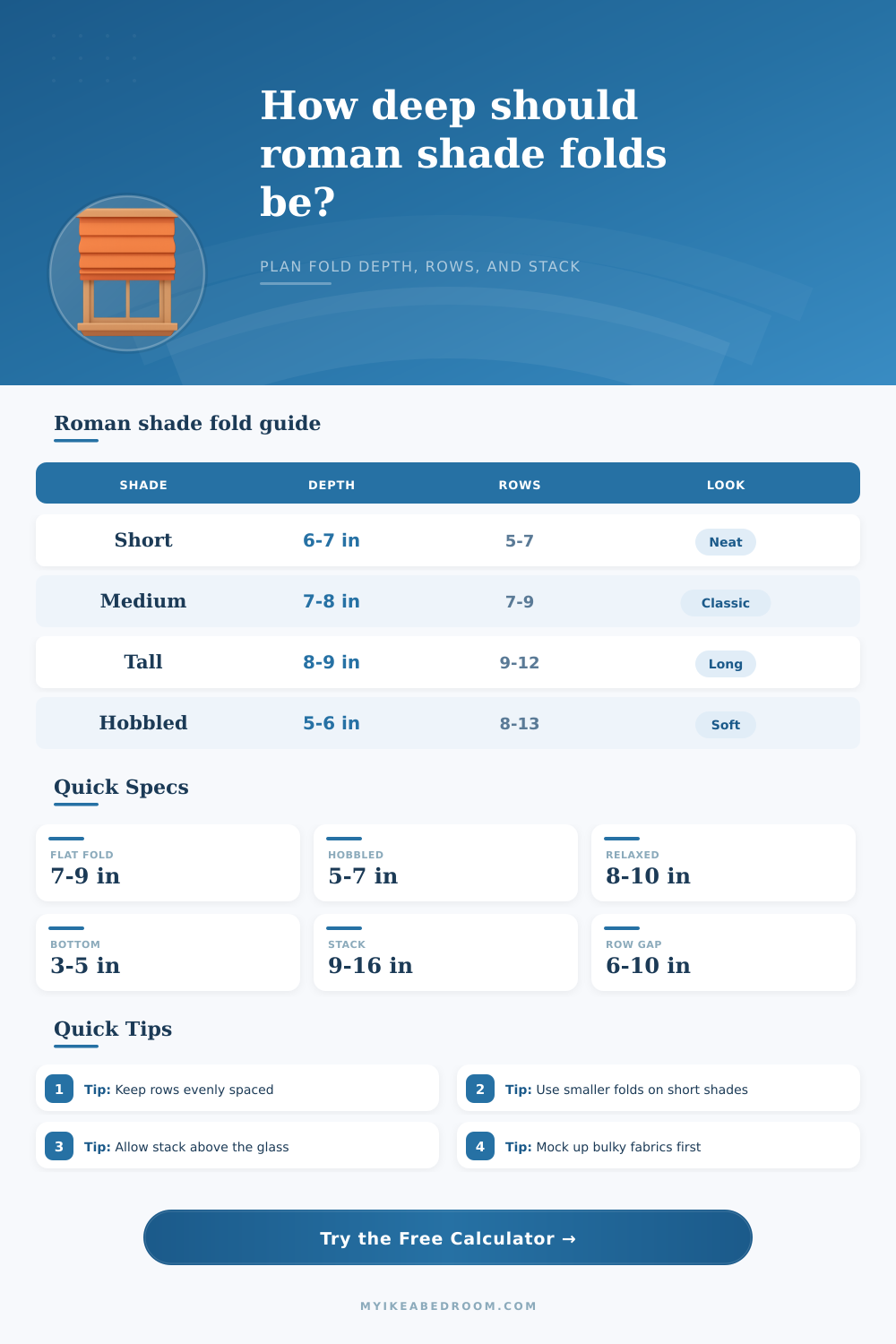
| Shade drop | Typical fold depth | Fold spaces | Ring rows | Best use |
|---|---|---|---|---|
| 30-42 in | 5.5-7 in | 4-6 | 5-7 | Kitchen, bath, short cafe shades |
| 42-60 in | 6.5-8 in | 6-8 | 7-9 | Bedroom and office windows |
| 60-78 in | 7.5-9 in | 8-10 | 9-11 | Tall bedroom or living room windows |
| 78-96 in | 8-10 in | 9-12 | 10-13 | Doors, sidelights, dramatic long shades |
| Style | Depth target | Stack effect | Row advice | Notes |
|---|---|---|---|---|
| Flat classic | 7-9 in | Medium | Even rows, top to bottom | Crisp folds suit lined cottons and prints. |
| Relaxed roman | 8-10 in | Medium low | Wider folds look softer | Center droop needs lighter fabric and fewer rows. |
| Hobbled roman | 5-7 in | Higher | More rows create loops | Plan extra stack and test loop depth. |
| Front-slat roman | 6-8 in | Medium high | Rows align with slat pockets | Keep spacing precise so ribs look intentional. |
| Finished width | Lift lines | Side inset | Max spacing | Layout note |
|---|---|---|---|---|
| 18-28 in | 2 | 1.5-2 in | 16-18 in | Small shades can use left and right lines. |
| 28-44 in | 3 | 2 in | 14-18 in | Add a center line to reduce sag. |
| 44-62 in | 4 | 2-2.5 in | 14-16 in | Four lines help wide folds lift evenly. |
| 62-84 in | 5-6 | 2.5-3 in | 12-15 in | Use extra lines for heavy or blackout shades. |
The secret to a professional looking Roman Shade (and an amateurish one) hinges on fold depth. Why? Because shade material weigh something, and hardware pulls something back. How much material do you cover vertically? That’s how much will stack up at the top of your shade when it’s in the open position. If you don’t factor that in correctly, you’ll have either a bunch of tight folds or ones that are loosey-goosey. If you factor it in correcty, you’ll have the exact look you want.
Now, I know what you’re thinking, Fold depth? That’s just a matter of personal taste, right? Nope. Fold depth = volume = math. Enter a little fabric weight + desired finished drop into a calculator and let machine do all the heavy lifting. No more wondering if an 8 inch fold will be too bulky in a petite window.
The Secret to Perfect Roman Shades
Consider the space that is taken up by the hem pocket at the bottom, as well as the headrail hiding out above. These are the areas that won’t fold over on themselves. If you simply divide the total height without subtracting these areas first, you’ll end up with your folds crowding each other towards the bottom. It’s a little thing, but it throw off the rhythm of the pleats.
Then there’s fabric selection. If I use sheer, lightweight fabric (like linen) it will drape beautifully and pack up really tightly in a small stack. Heavier blackout lining have much more bulk, it requires deeper folds to maintain its structure. Thicker upholstery fabric is good if you want a more relaxed look. Otherwise your shade will look like a stiff accordion. By choosing the weight of your lining, the tool will adjust its estimate of how tall the stacked shade will be.
How does the shade behave when up? Not only how does it appear when down? Lift lines are the vertical cords or tape inside the shade that pull the fabric into position. Without enough support points to hold folds up, wider shades will not stay straight. If you have a wide shade and only one center line, the sides will be baggy. Standard spacing for lift lines based off width is shown in reference tables so there isn’t any drooping. Most folks don’t think about how it works inside until they notice some of the folds starting to tilt towards the corner.
Planning how far the shade is inset from the edge allows for even tension across whole face of the shade. You should also consider hobbled folds, which form a soft loop instead of a sharp pleat. Because each fold loops back into itself, it takes up more vertical space in the raised stack. In other words, to get the same amount of coverage as a flat style, you need additional rows.
Mounting your shade too low means that your shade will also block some portion of the window (even when raised). Ugh! What a bummer to find out after installation.
For shorter kitchen/bath windows, smaller folds is preferable. On a thirty-inch drop, a six-inch fold is both proportionate and neat. If you use that same six-inch fold on a seventy-eight-inch door sidelight, you’ll have thirteen rows, which will look crowded and overwhelming. Eight- and nine-inch deep folds are preferrable on taller windows where the elongated appearance works better. The eye judges your shade based off how the fold depth compares to the total height.
There’s no such thing as one right fold depth for any given room; Roman shades is an exercise in precision. Your desired stack height, the weight of the fabric, and the size of your window all factor into the final result. Enter a trusted planning tool and run those numbers: Voilà! You get a perfectly engineered shade that stacks neatly, operates smoothly, and ensures the shade look custom-designed for the opening.