Rod Pocket Depth Calculator
Estimate curtain rod pocket depth, header ruffle height, stitch line placement, top allowance, cut length, rod clearance, and slide comfort for sheers, cafe curtains, lined panels, and heavy bedroom drapes.
Choose a starting point for a real curtain setup, then adjust the rod size, fabric behavior, header ruffle, finished drop, hems, and shrinkage before cutting.
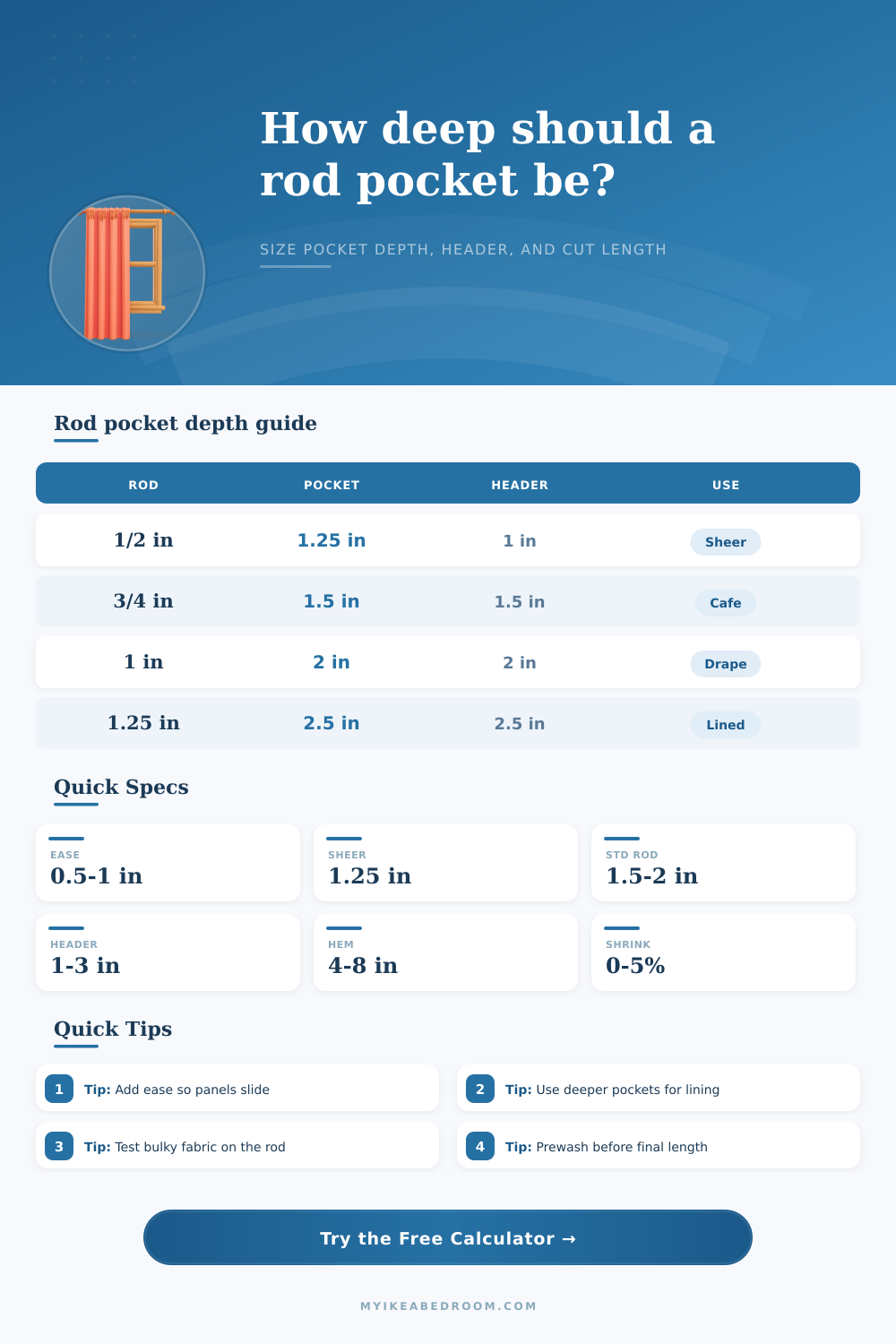
| Rod diameter | Minimum pocket | Comfort pocket | Typical use |
|---|---|---|---|
| 3/8 to 1/2 in | 1 in | 1.25 in | Sheers, cafe curtains, small sash rods |
| 5/8 to 3/4 in | 1.25 in | 1.5 in | Light cotton, linen-look, short panels |
| 7/8 to 1 in | 1.5 in | 2 in | Standard bedroom rods and medium fabric |
| 1 1/8 to 1 1/4 in | 1.75 in | 2.25 to 2.5 in | Lined curtains and heavier decorative rods |
| 1 1/2 in | 2.25 in | 3 in | Thick wood rods, casual panels, utility dividers |
| Header look | Ruffle above pocket | Best fabric | Cut length effect |
|---|---|---|---|
| No ruffle | 0 in | Utility, closet, cafe panels | Lowest top allowance |
| Small gathered crown | 1 to 1.5 in | Sheer, cotton, lightweight linen | Adds a soft top edge |
| Classic bedroom header | 1.5 to 2.5 in | Medium linen and lined panels | Balances long drops |
| Deep decorative header | 2.5 to 3.5 in | Valances and tall panels | Needs careful proportional check |
| Fabric type | Bulk factor | Ease cue | Pocket note |
|---|---|---|---|
| Sheer voile or lace | Low | 0.25 to 0.5 in | Can use a shallow pocket if it rarely moves |
| Light cotton or muslin | Low-medium | 0.4 to 0.6 in | Standard cafe and kitchen curtain behavior |
| Medium linen blend | Medium | 0.5 to 0.75 in | Use a slightly deeper pocket for slubby fabric |
| Blackout lined fabric | High | 0.75 to 1 in | Deeper pocket reduces bunching near brackets |
| Velvet or dense weave | Very high | 1 in or more | Test the tunnel before sewing all panels |
| Project | Rod size | Pocket depth | Header |
|---|---|---|---|
| Cafe curtain pair | 1/2 in rod | 1.25 in | 0.75 to 1 in |
| Bedroom linen panel | 3/4 in rod | 1.5 to 1.75 in | 1.5 to 2 in |
| Blackout panel | 1 in rod | 2 to 2.25 in | 1.5 to 2.5 in |
| Closet divider | 1 in rod | 2.25 in | 0 to 1 in |
| Valance topper | 3/4 in rod | 1.5 in | 2 to 3 in |
Test the pocket before final stitching. Fold a scrap to the calculated pocket depth and slide it over the rod. If it grips, add ease before cutting all panels.
Keep the top fold consistent. Mark the header ruffle and pocket stitch lines with the same ruler setting across every panel so the curtain tops align.
Or maybe you realize after cutting out that your curtain panels is an inch off because you didn’t think about the thickness of the tunnel in the pocket. Yea I know, been there done that. Usually this result in having to pin up more hem OR go back to the fabric store. When you plug in what length you want your curtains to be (finished) plus your rod size the rod pocket depth calculator do all the figuring for you so you don’t end up with a guess at the conversions and math. You just end up with a cut length that fits available wall space.
Rod vs. Fabric: Curtains suck to make. Rods are rigid; fabric isn’t. Try making a pocket that fits both a thin tension rod and a fat wooden dowel. That’s why the tool want to know the size of your rod. It controls the minimum width of the tunnel, before friction causes everything to stick. Ignore it and your curtains won’t even glide open.
Why You Need This Calculator
Everyone cares about how much their curtain drape, not whether it slides along the rod. Making a deep pocket is a matter of mechanics, not style. Also keep in mind what’s being sewn into the pockets. Lined blackout fabric take up way more space than sheer voile inside the folded over top fabric. Because the fabric volume is doubled by a lining, there’s an adjustment for lining type in the calculator.
Velvets are thick so if you sew a standard pocket depth, it won’t lie flat, the rod will cause a permanent bulge. That just looks bad and pulls the rest of the fabric up, which makes the whole drape look wrinkly. Half an inch of extra ease make all the difference between a nice crispy hanging drape or a wrinkly mess. The fabric weight is matched up against recommended pocket depths in the reference table on the page.
The vertical math gets even more complicated when you start adding in things like header ruffles. Those extra couple of inches of gathered decoration up top gobble up some precious fabric that might of been dropped instead. So if you want a two inch header, then add two inches to your top allowance before measuring what will actualy be seen of the curtain. Subtract those allowances off your overall desired drop and the calculator spits out your final cut number. Enter the final drop you’re seeing on the wall, and the tool tell you exactly where to make your initial snip with the shears.
One thing to be aware of with custom sewing is shrinkage. You can adjust your cut length to account for that by entering the % of shrinkage on the fabric. If it’s a natural fiber such as cotton or linen, you’ll want to preshrink it before sewing so that those fabrics don’t get pulled tighter during their initial wash. Without accounting for shrinkage, your panel could end up too short after only one wash. Better to have an extra inch to hem!
Fullness ratios count as well (more for width and less for height). And of course side hem matter, which influences width. The calculator calculates for your side allowances so that you know how much yardage to cut all together for the actual panel width.
Keep in mind: A rod pocket is like a tube inside another tube. If the inner tube is too snug then the outside fabric will bunch up. First try out your seam allowance on a scrap piece. Slide it over a similar rod. Does it drag? Add some more ease before cutting into the final panels. Measure twice and measure correctly.
The calculator takes into account all the folds and seams, the top turn, the bottom hem, the header ruffle and pocket depth, and comes up with one number. It is one number that eliminates the math from your brain. Use one number to help you get the drape part right, and then judge how it looks with your eyes.
You want a good curtain to look like a piece of cloth, not something that fights back or hangs off-kilter. No need to worry about an awkward hemline if you do this math correctly.