Room Quarter Round Quantity Calculator
Estimate quarter round or shoe molding for a room by combining wall perimeter, door deductions, bay or closet additions, outside corners, return pieces, waste, stick length, pack rounding, nails, and caulk.
Choose a realistic room setup, then adjust dimensions, openings, stick length, corner count, waste, and pack size for your actual molding.
| Stock length | Best use | Approx. room before waste | Splice watchout |
|---|---|---|---|
| 8 ft stick | Bedrooms, halls, small rooms | 37 to 52 ft net run | Long walls over 8 ft need scarf joints |
| 10 ft stick | Medium bedrooms and offices | 48 to 65 ft net run | Fewer wall splices than 8 ft stock |
| 12 ft stick | Living rooms and open plans | 55 to 78 ft net run | Check transport and straightness |
| 16 ft stick | Long walls and stain-grade runs | 70 to 100 ft net run | Harder to carry, but cleaner walls |
| Feature | How to count it | Typical value | Calculator field |
|---|---|---|---|
| Single door | Subtract clear floor opening | 2.5 to 3 ft | Door openings |
| Double closet | Subtract clear opening, add side returns | 5 to 6 ft | Door openings and returns |
| Cabinet run | Subtract length with no exposed baseboard | 2 to 8 ft | No-trim runs |
| Bay window or alcove | Add measured short walls | 3 to 10 ft | Alcove add-on |
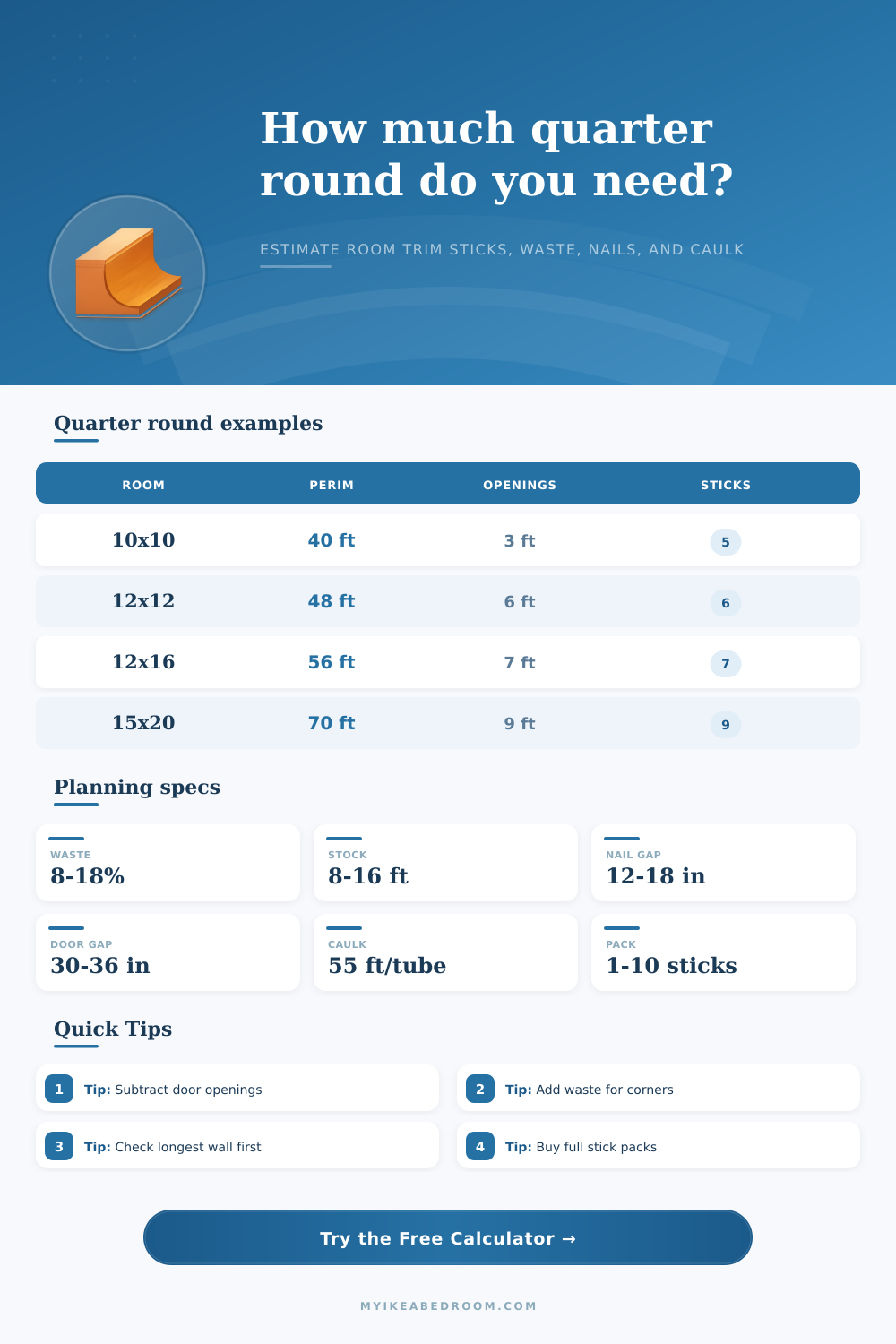
| Room size | Net trim run | 10% waste length | 8 ft sticks |
|---|---|---|---|
| 10 x 10 ft bedroom, one door | 37 ft | 41 ft | 6 sticks |
| 12 x 14 ft bedroom, closet | 51 ft | 57 ft | 8 sticks |
| 10 x 12 ft office, two openings | 39 ft | 44 ft | 6 sticks |
| 15 x 20 ft living room, wide entry | 64 ft | 72 ft | 9 sticks |
Measure wall runs, not floor area. Quarter round follows the exposed baseboard perimeter, so doors, cabinets, hearths, and slider tracks matter more than square footage.
Keep long walls in mind. If a wall is longer than your stock, plan a scarf joint away from doorways and avoid using very short pieces in visible stretches.
Add returns deliberately. Doorway ends, stair noses, and cabinet breaks often need tiny return pieces that use little length but add cuts and waste.
Round purchase quantities up. Trim defects, bowed sticks, test miters, and color matching can turn an exact stick count into a stressful shopping list.
To calculate how many piece of quarter round you will have to take into account the total length of the walls in the rooms you are completing with quarter round as well as several different measurement that will change that total length. Measuring the walls in your rooms will provide you with the starting point for your calculation of the total length of quarter round that you will need to purchase, but the total length of those walls wont necessarily provide you with the total length of quarter round that you will need for those rooms. You will need to make adjustments to that total length to account for both areas where quarter round will not be installed as well as areas where quarter round will need to extend beyond the walls of the rooms.
To calculate quarter round, you will first need to determine the length of areas where quarter round will not be installed. Examples of such areas include doorway and passages in those rooms, areas taken up by kitchen cabinet, and hearths. You should subtract the width of each of these area from the total length of the walls to determine the total length of quarter round that will be required.
How to Calculate How Much Quarter Round You Need
If you dont subtract these lengths from the total length of the walls, you will end up purchasing more quarter round than you will require for the project. In the second step in calculating quarter round, you will determine the lengths of area where quarter round will extend beyond the walls of the rooms that will be finished with quarter round. Examples of such areas include small alcoves in the walls, closet returns, and bay window.
The length of each of these feature should be added to the total length of the walls to determine the total length of quarter round that will be required for those rooms. If these length are not added to the total length of the walls, you will not have enough quarter round to complete the project. The third step in calculating the length of quarter round that will be required for a project is to account for the length of quarter round that will be lost when cutting the quarter round.
Each miter cut or cope cut in the quarter round will require the removal of a small amount of the total length of the quarter round. Additionally, if the quarter round that you purchase has damaged end, you may also need to cut those ends off of the sticks of quarter round. The total length of the walls of the rooms that will be finished with quarter round should be adjusted to account for this lost length.
By accounting for the length that will be lost when cutting the quarter round, you will ensure that you have enough quarter round to account for the length that will be lost during the cutting process. The fourth step in calculating the length of quarter round that will be required for a project is to determine the percentage of quarter round that will be lost due to mistake in cutting the quarter round. For projects in which you will paint the quarter round, a percentage of waste can be low.
For projects in which you will stain the quarter round, or for rooms that contain non-square corner in the walls, a higher percentage of waste should be determined. A percentage of waste that is too low of the total length of quarter round that will be needed may result in the depletion of your quarter round. Using a percentage of waste that is too high of the total length will result in purchasing more quarter round than you will require and may lead to waste of your purchased quarter round.
The fifth step in calculating the length of quarter round that will be required for a project is to account for the stock length of the quarter round. The stock length of quarter round is the length of each individual stick of quarter round that is available for purchase. If the length of the walls that will be finished with quarter round is longer than the stock length of available quarter round, it will be necesary to join two stick of quarter round together at a scarf joint.
The quarter round calculator that is available will allow you to determine how many sticks of quarter round will be required by the length of each stick. Additionally, the calculator will allow you to determine whether it is better to purchase single sticks of quarter round or contractor pack of quarter round. Though contractor packs of quarter round may be cheaper per stick, there will be an increased requirement of purchasing quarter round in quantities that are larger than the number that may be required for your project.
Finally, the quarter round calculator will provide a complete list of supply that will be required to complete the installation of quarter round in your project. After determining the total amount of quarter round that will be required, the calculator will also calculate the amount of nail that will be required for installing the quarter round as well as the amount of caulk. Knowing the amount of nails and caulk that will be required for installation allows you to create your shopping list in one trip to the store.
By using the calculator to determine the lengths of area where quarter round will need to be subtracted, the lengths of area where quarter round will need to be added, the cut allowance for quarter round, and the waste percentage for cutting quarter round, you can ensure that you purchase the correct amount of quarter round for your project.