Window Seat Cushion Size Calculator
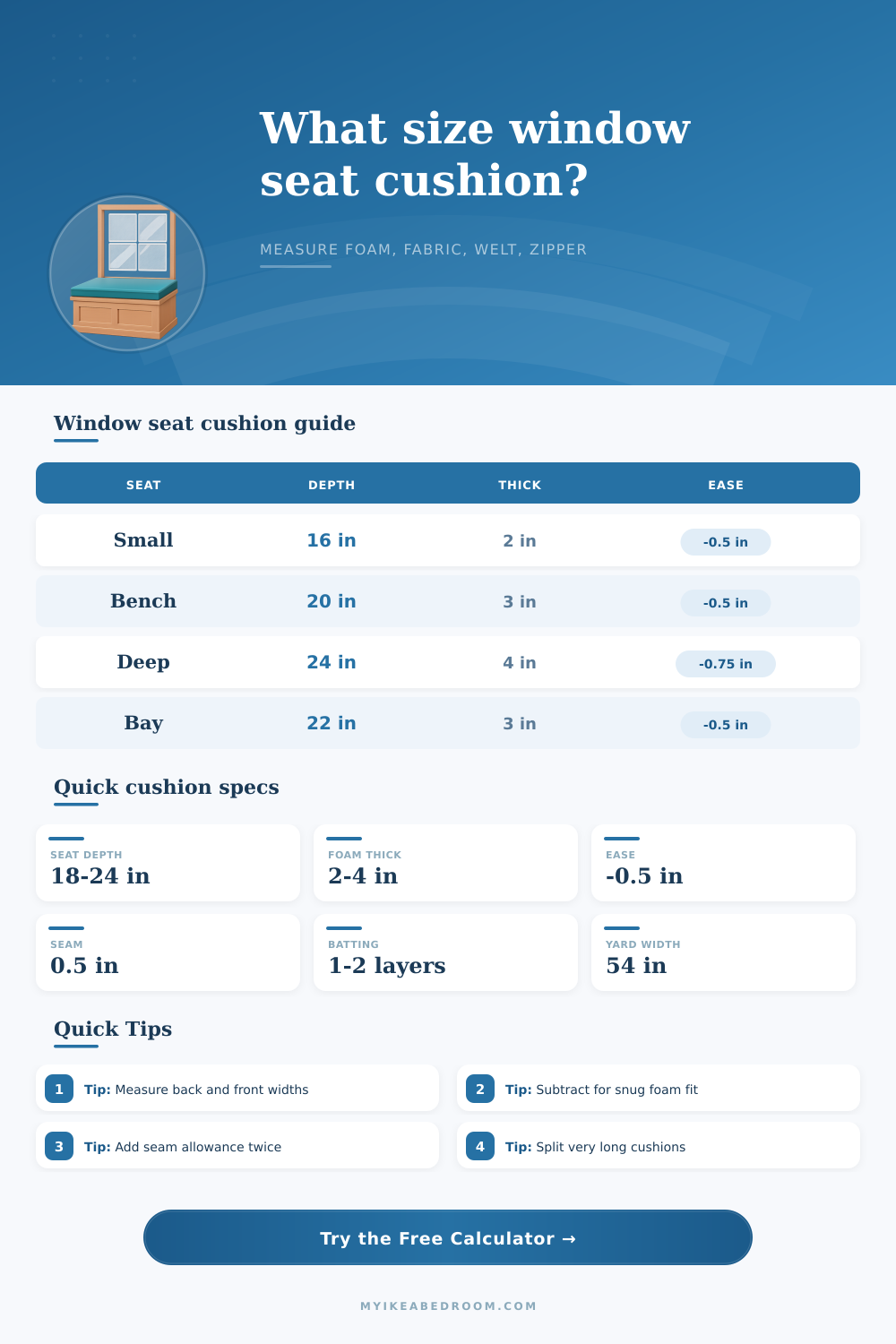
Measure a straight, bay, or split window bench cushion and estimate finished cover size, foam cut size, boxing strip, welt cord, zipper length, batting wrap, and fabric yardage.
Choose a starting layout, then adjust the exact back width, front width, depth, thickness, seams, and split count from your own bench.
What this calculator includes
- Average depth and trapezoid area for bay window cushions.
- Per-section foam sizing after split gaps and compression ease.
- Top and bottom fabric panels with seam allowance added.
- Boxing strip width, strip length, welt cord, zipper, and batting wrap.
- Fabric yardage using roll width, layout direction, and waste buffer.
| Use case | Typical thickness | Foam density | Best sizing note |
|---|---|---|---|
| Decorative sill pad | 1.5 to 2 in | 1.5 to 1.8 lb | Keep ease small so the thin cover does not look loose. |
| Daily window bench | 3 in | 1.8 to 2.4 lb | Use a boxed edge and a zipper near the full back width. |
| Deep reading nook | 3 to 4 in | 2.4 lb or higher | Add batting wrap to soften the top and front edge. |
| Banquette cushion | 3 to 4 in | 2.4 to 2.8 lb | Split long runs so each cover can be removed easily. |
| Finished cushion | Common split | 54 in fabric estimate | Notes included in estimate |
|---|---|---|---|
| 36 x 16 x 2 in | 1 section | 1.5 to 2 yd | Top, bottom, boxing, small welt allowance, and waste. |
| 60 x 20 x 3 in | 1 section | 2.5 to 3 yd | Works well when fabric can be railroaded across the width. |
| 84 x 22 x 3 in | 2 sections | 3.5 to 4.5 yd | Split panels add extra boxing and seam waste. |
| 108 x 24 x 4 in | 3 sections | 5 to 6.5 yd | Pattern matching and welt can push yardage higher. |
| Allowance | Typical value | Where it applies | Calculator effect |
|---|---|---|---|
| Compression ease | -0.25 to -0.5 in per edge | Foam dimensions | Makes the foam slightly smaller than the finished cover. |
| Seam allowance | 0.5 in per edge | Fabric cuts | Adds twice the allowance to each cut panel dimension. |
| Batting wrap | 1 to 2 in past edge | Batting cut | Adds enough wrap to pull around foam edges. |
| Split gap | 0.25 to 0.5 in | Finished width | Subtracts total gaps before dividing into sections. |
Measure both ends. If depths differ, use left and right depths so the average panel area stays realistic.
Use front and back widths. A trapezoid cushion needs both edges because the front is often wider.
Split the run. Multiple sections reduce foam bending and add a small gap between covers.
Add matching buffer. Directional motifs, stripes, and large repeats need more yardage.
Use the smallest inside width. Built-ins are rarely square, so measure back, front, left depth, and right depth before cutting foam.
Label the template face up. For angled bay seats, mark window side, room side, left, and right directly on the paper template.
Separate finished size from cut size. Finished cushion size describes the cover; fabric cuts include seam allowance and foam may be slightly smaller.
Round yardage upward. Fabric rolls, stripes, and welt cutting rarely land exactly on a mathematical minimum.
Window seat cushion requires precise measurements because the cushion for the window seat must fit the window bench perfectly. If the window seat cushion are the wrong size, it will either slide on the bench or press against the wall. Using the calculator will tell you the measurements you need to order a perfect window seat cushion, and the calculator will account for the thick of the cushion and allowances for seam.
First, you must take the measurements of the window bench. Most window bench are not formed into perfect squares. You must measure both the back and front edge of the window bench.
How to Measure a Window Seat Cushion
You should also measure the depth of the window seat on both the left and the right side of the bench. Taking these two measurements allows the calculator to find the average depth of the window bench. Finding the average depth of the window bench will ensure that the cushion is not a rectangle that will not properly fit onto the window bench.
Another essential measurement are the thickness of the foam for the cushion. For decorative sills, use a two-inch thick foam pad. For areas that will be used daily, use a three-inch or four-inch foam pad.
Input the thickness you want the finished cushion to be into the calculator. This will determine the width of the boxing strip and the batting wrap. The batting wrap will soften the edge of the cushion to ensure it does not look boxy when placed on the window bench.
You must also consider the foam ease setting. Use a small negative value as the foam will be smaller than the cover. Making the foam smaller than the cover make it easier to insert the foam into the cushion cover.
It will also prevent the fabric from stretching or wrinkling as the cushion is filled. Using too much foam ease will make the cushion feel loosely within the cover. Using too little foam ease will make it difficult to insert the cushion cover onto the foam pad with the zipper.
You can also choose to split the long window bench into multiple cushion sections. Each cushion section will have its own top and bottom panel. Each will have its own boxing strip, and there will need to be a small gap between each cushion.
The gaps between cushions will prevent the covers of the cushions from buckling when individuals sit on the window bench. The calculator will adjust the perimeter and zipper length if you choose this option. Using multiple cushion sections will require more fabric and there will be more seam.
However, the cushions will be more easier to carry and store. When buying the fabric for the cushion, you must consider the fabric direction and fabric waste. Using a railroaded layout for the top panel of the cushion, the fabric pattern will go across the width of the cushion.
Using a railroaded layout will save you fabric if using solid fabric color. For patterned fabric with large repeating design, you will need to add an extra buffer of fabric to allow the designs to line up on each cushion section. The calculator will include a percentage for fabric waste when it calculates the yardage you will need to order for the cushions.
This will ensure that you do not run out of fabric while constructing the cushions. People often make mistake before they enter the measurements into the calculator. The most common mistake is forgetting to measure the seam allowance when measuring the width of the cushion.
Additional mistake include measuring the width of the cushion for the window seat but not including the allowance for notches to accommodate radiator or posts. If you do not account for these notches when measuring the width of the cushion, the foam will not fit properly into the window bench. Ensure that the measurements you take account for all the specific of the window bench.
The calculator cannot see the room that you are constructing the cushions for. The calculator will give you a breakdown of all the numbers once you enter your measurements. These numbers will include the finished size of the cushion top panel, the size of the cut foam, the length of the boxing strips, the length of the welt cord, the length of the zipper, and the area of the batting.
You can use these measurements to determine the width of each top panel that you will cut, the amount of foam that you will need to order, and whether or not you have enough fabric to complete your project. Additionally, there is a diagram of the window bench that will update as you enter your measurements. The diagram will show you the back width of the cushion, the front width of the cushion, and the depth of the cushion.
The goal of making these measurements is to construct a window seat cushion that will lay flat on the window bench and fill the area created by the window bench itself. Window seat cushion requires precise measurements because the cushion for the window seat must fit the window bench perfectly. If the window seat cushion are the wrong size, it will either slide on the bench or press against the wall.
Using the calculator will tell you the measurements you need to order a perfect window seat cushion, and the calculator will account for the thick of the cushion and allowances for seam. First, you must take the measurements of the window bench. Most window bench are not formed into perfect squares.
You must measure both the back and front edge of the window bench. You should also measure the depth of the window seat on both the left and the right side of the bench. Taking these two measurements allows the calculator to find the average depth of the window bench.
Finding the average depth of the window bench will ensure that the cushion is not a rectangle that will not properly fit onto the window bench. Another essential measurement are the thickness of the foam for the cushion. For decorative sills, use a two-inch thick foam pad.
For areas that will be used daily, use a three-inch or four-inch foam pad. Input the thickness you want the finished cushion to be into the calculator. This will determine the width of the boxing strip and the batting wrap.
The batting wrap will soften the edge of the cushion to ensure it does not look boxy when placed on the window bench. You must also consider the foam ease setting. Use a small negative value as the foam will be smaller than the cover.
Making the foam smaller than the cover make it easier to insert the foam into the cushion cover. It will also prevent the fabric from stretching or wrinkling as the cushion is filled. Using too much foam ease will make the cushion feel loosely within the cover.
Using too little foam ease will make it difficult to insert the cushion cover onto the foam pad with the zipper. You can also choose to split the long window bench into multiple cushion sections. Each cushion section will have its own top and bottom panel.
Each will have its own boxing strip, and there will need to be a small gap between each cushion. The gaps between cushions will prevent the covers of the cushions from buckling when individuals sit on the window bench. The calculator will adjust the perimeter and zipper length if you choose this option.
Using multiple cushion sections will require more fabric and there will be more seam. However, the cushions will be more easier to carry and store. When buying the fabric for the cushion, you must consider the fabric direction and fabric waste.
Using a railroaded layout for the top panel of the cushion, the fabric pattern will go across the width of the cushion. Using a railroaded layout will save you fabric if using solid fabric color. For patterned fabric with large repeating design, you will need to add an extra buffer of fabric to allow the designs to line up on each cushion section.
The calculator will include a percentage for fabric waste when it calculates the yardage you will need to order for the cushions. This will ensure that you do not run out of fabric while constructing the cushions. People often make mistake before they enter the measurements into the calculator.
The most common mistake is forgetting to measure the seam allowance when measuring the width of the cushion. Additional mistake include measuring the width of the cushion for the window seat but not including the allowance for notches to accommodate radiator or posts. If you do not account for these notches when measuring the width of the cushion, the foam will not fit properly into the window bench.
Ensure that the measurements you take account for all the specific of the window bench. The calculator cannot see the room that you are constructing the cushions for. The calculator will give you a breakdown of all the numbers once you enter your measurements.
These numbers will include the finished size of the cushion top panel, the size of the cut foam, the length of the boxing strips, the length of the welt cord, the length of the zipper, and the area of the batting. You can use these measurements to determine the width of each top panel that you will cut, the amount of foam that you will need to order, and whether or not you have enough fabric to complete your project. Additionally, there is a diagram of the window bench that will update as you enter your measurements.
The diagram will show you the back width of the cushion, the front width of the cushion, and the depth of the cushion. The goal of making these measurements is to construct a window seat cushion that will lay flat on the window bench and fill the area created by the window bench itself. Window seat cushions requires precise measurements because the cushion for the window seat must fit the window bench perfectly.
If the window seat cushion are the wrong size, it will either slide on the bench or press against the wall. Using the calculator will tell you the measurements you need to order a perfect window seat cushion, and the calculator will account for the thick of the cushion and allowances for seam. First, you must take the measurements of the window bench.
Most window bench are not formed into perfect squares. You must measure both the back and front edge of the window bench. You should also measure the depth of the window seat on both the left and the right side of the bench.
Taking these two measurements allows the calculator to find the average depth of the window bench. Finding the average depth of the window bench will ensure that the cushion is not a rectangle that will not properly fit onto the window bench. Another essential measurement are the thickness of the foam for the cushion.
For decorative sills, use a two-inch thick foam pad. For areas that will be used daily, use a three-inch or four-inch foam pad. Input the thickness you want the finished cushion to be into the calculator.
This will determine the width of the boxing strip and the batting wrap. The batting wrap will soften the edge of the cushion to ensure it does not look boxy when placed on the window bench. You must also consider the foam ease setting.
Use a small negative value as the foam will be smaller than the cover. Making the foam smaller than the cover make it easier to insert the foam into the cushion cover. It will also prevent the fabric from stretching or wrinkling as the cushion is filled.
Using too much foam ease will make the cushion feel loosely within the cover. Using too little foam ease will make it difficult to insert the cushion cover onto the foam pad with the zipper. You can also choose to split the long window bench into multiple cushion sections.
Each cushion section will have its own top and bottom panel. Each will have its own boxing strip, and there will need to be a small gap between each cushion. The gaps between cushions will prevent the covers of the cushions from buckling when individuals sit on the window bench.
The calculator will adjust the perimeter and zipper length if you choose this option. Using multiple cushion sections will require more fabric and there will be more seam. However, the cushions will be more easier to carry and store.
When buying the fabric for the cushion, you must consider the fabric direction and fabric waste. Using a railroaded layout for the top panel of the cushion, the fabric pattern will go across the width of the cushion. Using a railroaded layout will save you fabric if using solid fabric color.
For patterned fabric with large repeating design, you will need to add an extra buffer of fabric to allow the designs to line up on each cushion section. The calculator will include a percentage for fabric waste when it calculates the yardage you will need to order for the cushions. This will ensure that you do not run out of fabric while constructing the cushions.
People often make mistake before they enter the measurements into the calculator. The most common mistake is forgetting to measure the seam allowance when measuring the width of the cushion. Additional mistake include measuring the width of the cushion for the window seat but not including the allowance for notches to accommodate radiator or posts.
If you do not account for these notches when measuring the width of the cushion, the foam will not fit properly into the window bench. Ensure that the measurements you take account for all the specific of the window bench. The calculator cannot see the room that you are constructing the cushions for.
The calculator will give you a breakdown of all the numbers once you enter your measurements. These numbers will include the finished size of the cushion top panel, the size of the cut foam, the length of the boxing strips, the length of the welt cord, the length of the zipper, and the area of the batting. You can use these measurements to determine the width of each top panel that you will cut, the amount of foam that you will need to order, and whether or not you have enough fabric to complete your project.
Additionally, there is a diagram of the window bench that will update as you enter your measurements. The diagram will show you the back width of the cushion, the front width of the cushion, and the depth of the cushion. The goal of making these measurements is to construct a window seat cushion that will lay flat on the window bench and fill the area created by the window bench itself.
Window seat cushions requires precise measurements because the cushion for the window seat must fit the window bench perfectly. If the window seat cushion are the wrong size, it will either slide on the bench or press against the wall. Using the calculator will tell you the measurements you need to order a perfect window seat cushion, and the calculator will account for the thick of the cushion and allowances for seam.
First, you must take the measurements of the window bench. Most window bench are not formed into perfect squares. You must measure both the back and front edge of the window bench.
You should also measure the depth of the window seat on both the left and the right side of the bench. Taking these two measurements allows the calculator to find the average depth of the window bench. Finding the average depth of the window bench will ensure that the cushion is not a rectangle that will not properly fit onto the window bench.
Another essential measurement are the thickness of the foam for the cushion. For decorative sills, use a two-inch thick foam pad. For areas that will be used daily, use a three-inch or four-inch foam pad.
Input the thickness you want the finished cushion to be into the calculator. This will determine the width of the boxing strip and the batting wrap. The batting wrap will soften the edge of the cushion to ensure it does not look boxy when placed on the window bench.
You must also consider the foam ease setting. Use a small negative value as the foam will be smaller than the cover. Making the foam smaller than the cover make it easier to insert the foam into the cushion cover.
It will also prevent the fabric from stretching or wrinkling as the cushion is filled. Using too much foam ease will make the cushion feel loosely within the cover. Using too little foam ease will make it difficult to insert the cushion cover onto the foam pad with the zipper.
You can also choose to split the long window bench into multiple cushion sections. Each cushion section will have its own top and bottom panel. Each will have its own boxing strip, and there will need to be a small gap between each cushion.
The gaps between cushions will prevent the covers of the cushions from buckling when individuals sit on the window bench. The calculator will adjust the perimeter and zipper length if you choose this option. Using multiple cushion sections will require more fabric and there will be more seam.
However, the cushions will be more easier to carry and store. When buying the fabric for the cushion, you must consider the fabric direction and fabric waste. Using a railroaded layout for the top panel of the cushion, the fabric pattern will go across the width of the cushion.
Using a railroaded layout will save you fabric if using solid fabric color. For patterned fabric with large repeating design, you will need to add an extra buffer of fabric to allow the designs to line up on each cushion section. The calculator will include a percentage for fabric waste when it calculates the yardage you will need to order for the cushions.
This will ensure that you do not run out of fabric while constructing the cushions. People often make mistake before they enter the measurements into the calculator. The most common mistake is forgetting to measure the seam allowance when measuring the width of the cushion.
Additional mistake include measuring the width of the cushion for the window seat but not including the allowance for notches to accommodate radiator or posts. If you do not account for these notches when measuring the width of the cushion, the foam will not fit properly into the window bench. Ensure that the measurements you take account for all the specific of the window bench.
The calculator cannot see the room that you are constructing the cushions for. The calculator will give you a breakdown of all the numbers once you enter your measurements. These numbers will include the finished size of the cushion top panel, the size of the cut foam, the length of the boxing strips, the length of the welt cord, the length of the zipper, and the area of the batting.
You can use these measurements to determine the width of each top panel that you will cut, the amount of foam that you will need to order, and whether or not you have enough fabric to complete your project. Additionally, there is a diagram of the window bench that will update as you enter your measurements. The diagram will show you the back width of the cushion, the front width of the cushion, and the depth of the cushion.
The goal of making these measurements is to construct a window seat cushion that will lay flat on the window bench and fill the area created by the window bench itself. Window seat cushions requires precise measurements because the cushion for the window seat must fit the window bench perfectly. If the window seat cushion are the wrong size, it will either slide on the bench or press against the wall.
Using the calculator will tell you the measurements you need to order a perfect window seat cushion, and the calculator will account for the thick of the cushion and allowances for seam. First, you must take the measurements of the window bench. Most window bench are not formed into perfect squares.
You must measure both the back and front edge of the window bench. You should also measure the depth of the window seat on both the left and the right side of the bench. Taking these two measurements allows the calculator to find the average depth of the window bench.
Finding the average depth of the window bench will ensure that the cushion is not a rectangle that will not properly fit onto the window bench. Another essential measurement are the thickness of the foam for the cushion. For decorative sills, use a two-inch thick foam pad.
For areas that will be used daily, use a three-inch or four-inch foam pad. Input the thickness you want the finished cushion to be into the calculator. This will determine the width of the boxing strip and the batting wrap.
The batting wrap will soften the edge of the cushion to ensure it does not look boxy when placed on the window bench. You must also consider the foam ease setting. Use a small negative value as the foam will be smaller than the cover.
Making the foam smaller than the cover make it easier to insert the foam into the cushion cover. It will also prevent the fabric from stretching or wrinkling as the cushion is filled. Using too much foam ease will make the cushion feel loosely within the cover.
Using too little foam ease will make it difficult to insert the cushion cover onto the foam pad with the zipper. You can also choose to split the long window bench into multiple cushion sections. Each cushion section will have its own top and bottom panel.
Each will have its own boxing strip, and there will need to be a small gap between each cushion. The gaps between cushions will prevent the covers of the cushions from buckling when individuals sit on the window bench. The calculator will adjust the perimeter and zipper length if you choose this option.
Using multiple cushion sections will require more fabric and there will be more seam. However, the cushions will be more easier to carry and store. When buying the fabric for the cushion, you must consider the fabric direction and fabric waste.
Using a railroaded layout for the top panel of the cushion, the fabric pattern will go across the width of the cushion. Using a railroaded layout will save you fabric if using solid fabric color. For patterned fabric with large repeating design, you will need to add an extra buffer of fabric to allow the designs to line up on each cushion section.
The calculator will include a percentage for fabric waste when it calculates the yardage you will need to order for the cushions. This will ensure that you do not run out of fabric while constructing the cushions. People often make mistake before they enter the measurements into the calculator.
The most common mistake is forgetting to measure the seam allowance when measuring the width of the cushion. Additional mistake include measuring the width of the cushion for the window seat but not including the allowance for notches to accommodate radiator or posts. If you do not account for these notches when measuring the width of the cushion, the foam will not fit properly into the window bench.
Ensure that the measurements you take account for all the specific of the window bench. The calculator cannot see the room that you are constructing the cushions for. The calculator will give you a breakdown of all the numbers once you enter your measurements.
These numbers will include the finished size of the cushion top panel, the size of the cut foam, the length of the boxing strips, the length of the welt cord, the length of the zipper, and the area of the batting. You can use these measurements to determine the width of each top panel that you will cut, the amount of foam that you will need to order, and whether or not you have enough fabric to complete your project. Additionally, there is a diagram of the window bench that will update as you enter your measurements.
The diagram will show you the back width of the cushion, the front width of the cushion, and the depth of the cushion. The goal of making these measurements is to construct a window seat cushion that will lay flat on the window bench and fill the area created by the window bench itself. Window seat cushions requires precise measurements because the cushion for the window seat must fit the window bench perfectly.
If the window seat cushion are the wrong size, it will either slide on the bench or press against the wall. Using the calculator will tell you the measurements you need to order a perfect window seat cushion, and the calculator will account for the thick of the cushion and allowances for seam. First, you must take the measurements of the window bench.
Most window bench are not formed into perfect squares. You must measure both the back and front edge of the window bench. You should also measure the depth of the window seat on both the left and the right side of the bench.
Taking these two measurements allows the calculator to find the average depth of the window bench. Finding the average depth of the window bench will ensure that the cushion is not a rectangle that will not properly fit onto the window bench. Another essential measurement are the thickness of the foam for the cushion.
For decorative sills, use a two-inch thick foam pad. For areas that will be used daily, use a three-inch or four-inch foam pad. Input the thickness you want the finished cushion to be into the calculator.
This will determine the width of the boxing strip and the batting wrap. The batting wrap will soften the edge of the cushion to ensure it does not look boxy when placed on the window bench. You must also consider the foam ease setting.
Use a small negative value as the foam will be smaller than the cover. Making the foam smaller than the cover make it easier to insert the foam into the cushion cover. It will also prevent the fabric from stretching or wrinkling as the cushion is filled.
Using too much foam ease will make the cushion feel loosely within the cover. Using too little foam ease will make it difficult to insert the cushion cover onto the foam pad with the zipper. You can also choose to split the long window bench into multiple cushion sections.
Each cushion section will have its own top and bottom panel. Each will have its own boxing strip, and there will need to be a small gap between each cushion. The gaps between cushions will prevent the covers of the cushions from buckling when individuals sit on the window bench.
The calculator will adjust the perimeter and zipper length if you choose this option. Using multiple cushion sections will require more fabric and there will be more seam. However, the cushions will be more easier to carry and store.
When buying the fabric for the cushion, you must consider the fabric direction and fabric waste. Using a railroaded layout for the top panel of the cushion, the fabric pattern will go across the width of the cushion. Using a railroaded layout will save you fabric if using solid fabric color.
For patterned fabric with large repeating design, you will need to add an extra buffer of fabric to allow the designs to line up on each cushion section. The calculator will include a percentage for fabric waste when it calculates the yardage you will need to order for the cushions. This will ensure that you do not run out of fabric while constructing the cushions.
People often make mistake before they enter the measurements into the calculator. The most common mistake is forgetting to measure the seam allowance when measuring the width of the cushion. Additional mistake include measuring the width of the cushion for the window seat but not including the allowance for notches to accommodate radiator or posts.
If you do not account for these notches when measuring the width of the cushion, the foam will not fit properly into the window bench. Ensure that the measurements you take account for all the specific of the window bench. The calculator cannot see the room that you are constructing the cushions for.
The calculator will give you a breakdown of all the numbers once you enter your measurements. These numbers will include the finished size of the cushion top panel, the size of the cut foam, the length of the boxing strips, the length of the welt cord, the length of the zipper, and the area of the batting. You can use these measurements to determine the width of each top panel that you will cut, the amount of foam that you will need to order, and whether or not you have enough fabric to complete your project.
Additionally, there is a diagram of the window bench that will update as you enter your measurements. The diagram will show you the back width of the cushion, the front width of the cushion, and the depth of the cushion. The goal of making these measurements is to construct a window seat cushion that will lay flat on the window bench and fill the area created by the window bench itself.
Window seat cushions requires precise measurements because the cushion for the window seat must fit the window bench perfectly. If the window seat cushion are the wrong size, it will either slide on the bench or press against the wall. Using the calculator will tell you the measurements you need to order a perfect window seat cushion, and the calculator will account for the thick of the cushion and allowances for seam.
First, you must take the measurements of the window bench. Most window bench are not formed into perfect squares. You must measure both the back and front edge of the window bench.
You should also measure the depth of the window seat on both the left and the right side of the bench. Taking these two measurements allows the calculator to find the average depth of the window bench. Finding the average depth of the window bench will ensure that the cushion is not a rectangle that will not properly fit onto the window bench.
Another essential measurement are the thickness of the foam for the cushion. For decorative sills, use a two-inch thick foam pad. For areas that will be used daily, use a three-inch or four-inch foam pad.
Input the thickness you want the finished cushion to be into the calculator. This will determine the width of the boxing strip and the batting wrap. The batting wrap will soften the edge of the cushion to ensure it does not look boxy when placed on the window bench.
You must also consider the foam ease setting. Use a small negative value as the foam will be smaller than the cover. Making the foam smaller than the cover make it easier to insert the foam into the cushion cover.
It will also prevent the fabric from stretching or wrinkling as the cushion is filled. Using too much foam ease will make the cushion feel loosely within the cover. Using too little foam ease will make it difficult to insert the cushion cover onto the foam pad with the zipper.
You can also choose to split the long window bench into multiple cushion sections. Each cushion section will have its own top and bottom panel. Each will have its own boxing strip, and there will need to be a small gap between each cushion.
The gaps between cushions will prevent the covers of the cushions from buckling when individuals sit on the window bench. The calculator will adjust the perimeter and zipper length if you choose this option. Using multiple cushion sections will require more fabric and there will be more seam.
However, the cushions will be more easier to carry and store. When buying the fabric for the cushion, you must consider the fabric direction and fabric waste. Using a railroaded layout for the top panel of the cushion, the fabric pattern will go across the width of the cushion.
Using a railroaded layout will save you fabric if using solid fabric color. For patterned fabric with large repeating design, you will need to add an extra buffer of fabric to allow the designs to line up on each cushion section. The calculator will include a percentage for fabric waste when it calculates the yardage you will need to order for the cushions.
This will ensure that you do not run out of fabric while constructing the cushions. People often make mistake before they enter the measurements into the calculator. The most common mistake is forgetting to measure the seam allowance when measuring the width of the cushion.
Additional mistake include measuring the width of the cushion for the window seat but not including the allowance for notches to accommodate radiator or posts. If you do not account for these notches when measuring the width of the cushion, the foam will not fit properly into the window bench. Ensure that the measurements you take account for all the specific of the window bench.
The calculator cannot see the room that you are constructing the cushions for. The calculator will give you a breakdown of all the numbers once you enter your measurements. These numbers will include the finished size of the cushion top panel, the size of the cut foam, the length of the boxing strips, the length of the welt cord, the length of the zipper, and the area of the batting.
You can use these measurements to determine the width of each top panel that you will cut, the amount of foam that you will need to order, and whether or not you have enough fabric to complete your project. Additionally, there is a diagram of the window bench that will update as you enter your measurements. The diagram will show you the back width of the cushion, the front width of the cushion, and the depth of the cushion.
The goal of making these measurements is to construct a window seat cushion that will lay flat on the window bench and fill the area created by the window bench itself. Window seat cushions requires precise measurements because the cushion for the window seat must fit the window bench perfectly. If the window seat cushion are the wrong size, it will either slide on the bench or press against the wall.
Using the calculator will tell you the measurements you need to order a perfect window seat cushion, and the calculator will account for the thick of the cushion and allowances for seam. First, you must take the measurements of the window bench. Most window bench are not formed into perfect squares.
You must measure both the back and front edge of the window bench. You should also measure the depth of the window seat on both the left and the right side of the bench. Taking these two measurements allows the calculator to find the average depth of the window bench.
Finding the average depth of the window bench will ensure that the cushion is not a rectangle that will not properly fit onto the window bench. Another essential measurement are the thickness of the foam for the cushion. For decorative sills, use a two-inch