🛏 Comforter Overhang Calculator
Measure side drop, foot drape, loft loss, and floor clearance before choosing bedding
| Bed size | Mattress size | Common comforter | Typical side overhang |
|---|---|---|---|
| Twin | 38 x 75 in | 68 x 86 in | 13-15 in before loft |
| Twin XL | 38 x 80 in | 68 x 90 in | 13-15 in before loft |
| Full | 54 x 75 in | 80-88 x 86-90 in | 12-17 in before loft |
| Queen | 60 x 80 in | 88-98 x 88-98 in | 13-19 in before loft |
| King | 76 x 80 in | 104-116 x 90-98 in | 14-20 in before loft |
| California King | 72 x 84 in | 104 x 96 in | 14-16 in before loft |
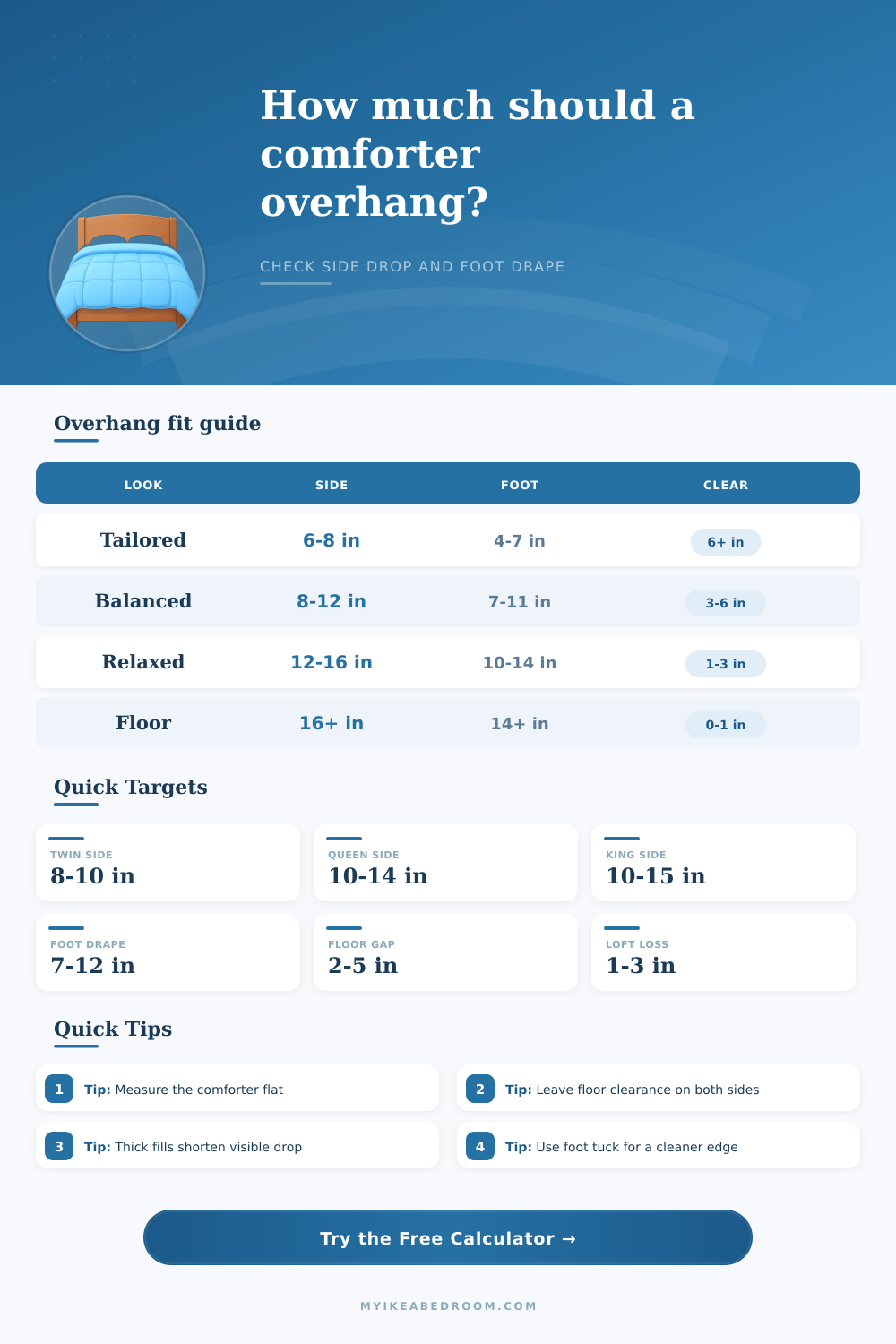
| Look target | Visible side drop | Visible foot overhang | Floor clearance |
|---|---|---|---|
| Tailored | 6-8 in | 4-7 in | 6 in or more |
| Balanced | 8-12 in | 7-11 in | 3-6 in |
| Relaxed | 12-16 in | 10-14 in | 1-3 in |
| Floor-skimming | 16 in or more | 14 in or more | 0-1 in |
| Loft profile | Drop loss | Best estimate | Why it matters |
|---|---|---|---|
| Flat quilt | 0.5 in | Minimal curve | The edge hangs close to the measured width. |
| Light fill | 1.0 in | Small curve | Thin comforters lose a little visible length at the edge. |
| All-season fill | 1.5 in | Medium curve | Most everyday comforters need a moderate adjustment. |
| Lofty fill | 2.5 in | Full curve | Puffy sides can look shorter than their flat measurement. |
| Winter plush | 3.5 in | Heavy curve | Thick bedding may need oversizing for the same visible drop. |
| Scenario | Common issue | Adjustment | Result to watch |
|---|---|---|---|
| Low platform | Edge hits floor | Use less width | Floor clearance |
| Deep mattress | Drop looks short | Use oversized width | Mattress coverage |
| Pillow reveal | Foot hangs long | Reduce head reveal | Foot overhang |
| Footboard | Bulk bunches up | Add foot tuck | Visible foot drop |
| Shared bed | Sides feel tight | Add 4-8 in width | Side drop |
When you purchase a comforter, there is several specific measurements to consider. The measurements of the comforter will determine how it will sit on the bed. A comforter may appear to be the correct size for the bed while it is on teh shelf of the retail store.
However, a comforter may not correctly fits the dimensions of the bed. The comforter may hang too highly off the bed or it may hang too low and touch the floor. Additionally, most people dont consider the size of the comforter until after they have purchase the comforter and washed it.
How to Choose a Comforter That Fits Your Bed
Due to the fact that comforters is difficult to return once they have been washed, people should of considered the size of the comforter prior to washing it. The height of the mattress is one of the primary measurements to consider when purchasing a comforter. The height of the mattress will determine the length of the comforter that will hang off the bed.
For example, if an individual has a very tall mattress due to the purchase of a mattress topper, the comforter will have to have additional length so that it will reach the ground. Conversely, if an individual has a low platform mattress, then the comforter may touch the ground. An individual can use the calculator to determine the height of their mattress and the dimensions of the comforter to determine if the comforter will reach the floor or if it may be too short for the individuals bedroom.
Another specific measurement to consider is the loft of the comforter. The loft of the comforter is the thickness of the comforter. If the comforter have a high loft, it will curve outward from the edges of the mattress.
Due to the way that the comforter naturaly curves outward, the drop of the comforter will be shorter than the listed measurements. Two comforters can have the same dimensions, but due to the loft of the comforter, they may look differently in the bedroom. The calculator accounts for the different lofts of comforters by permitting individuals to select the loft of their comforter and by subtracting the loft from the total length of the comforter.
In addition to mattress height, loft, and comforter dimensions, another consideration is the use of pillows on the head of the bed. If an individual uses many pillow on the head of the bed, these pillows will cover the comforter at the head of the bed. Thus, the comforter will not be visible on the foot of the bed.
Additionally, if an individual desires to tuck the foot of the comforter beneath the mattress, the amount of comforter that will hang off the foot of the bed will change. These change in the use of the comforter can be accounted for in the calculator. Comforter sizes come in different standard sizes to accommodate the majority of mattresses.
However, most mattress do not come in the dimensions of the average mattress. For instance, an individual may purchase a comforter that is the size of a king-sized mattress but their bed may be queen-sized. In this example, the comforter may hang too high or too low from the bed.
The reference tables can display the different standard sizes of comforters and how they will work with mattresses of the average dimensions. Floor clearance refers to the amount of space between the comforter and the floor. If the clearance is too small, the comforter may touch the floor or it may collect dust from the flooring.
Conversely, if there is too much clearance between the comforter and the floor, the sides of the comforter may appear too short for the bed. The individual can use the target clearance field in the calculator to determine the desired amount of clearance between the comforter and the floor. The calculator will display whether or not the comforter can provide the amount of floor clearance that the individual desire.
Understanding each of these measurements allows an individual to make an informed decision when purchasing a comforter. Individuals should learn each of these measurements so that they can purchase a comforter that will fit the bed that they have. By understanding each of these measurements, individuals will be able to avoid purchasing a comforter that wont correctly fit their beds.