Throw Blanket Quantity for Room Calculator
Estimate how many throw blankets a room needs by balancing seating, bed layers, guests, wash rotation, pet or kid reserve, basket storage, and room size.
Choose a realistic starting point, then adjust seats, bed layers, guest use, wash reserve, display storage, and blanket sizes for your room.
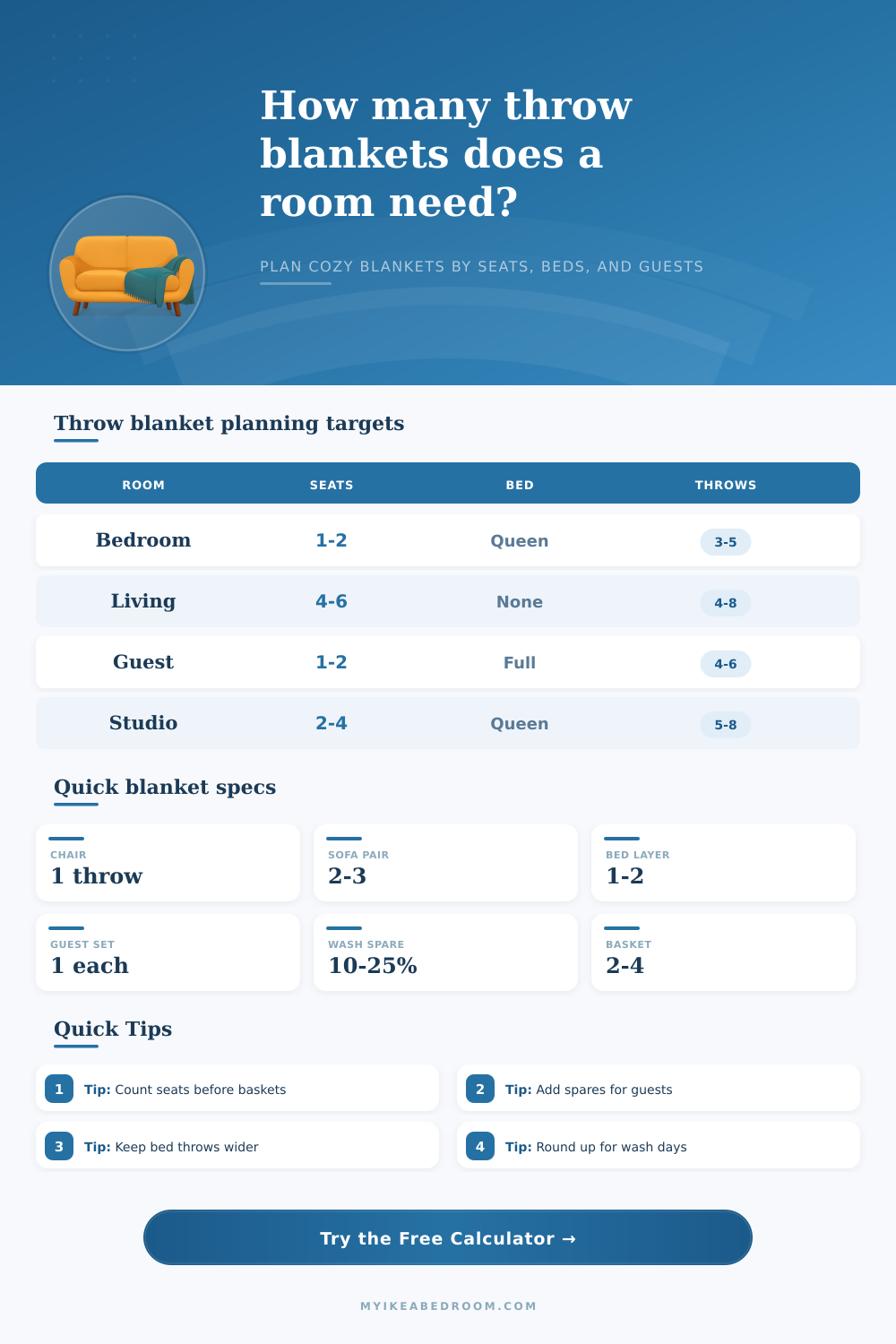
| Room type | Typical active seats | Bed or sleep zone | Useful throw range |
|---|---|---|---|
| Primary bedroom | 0-2 chairs or bench spots | Queen or king bed | 3-5 throws including wash reserve |
| Guest bedroom | 0-2 occasional seats | Twin, full, or queen bed | 4-6 throws when overnight guests are common |
| Living room | 4-7 sofa and chair seats | No bed | 4-8 throws depending on simultaneous use |
| Studio apartment | 2-4 seats | Bed and sofa share one room | 5-8 throws with limited visible storage |
| Nursery or kids room | 1-3 adult or reading seats | Twin, crib-side adult use, or daybed | 3-6 throws with higher wash rotation |
| Strategy | Seat multiplier | Best for | Watch point |
|---|---|---|---|
| Light styling | 45% of seats | Rooms where throws are mostly visual | May feel short during movie nights |
| Balanced comfort | 65% of seats | Bedrooms and everyday living rooms | Needs guest reserve when hosting |
| Cozy lounge | 85% of seats | Family rooms, cold rooms, sectionals | Storage can get crowded |
| One per seat | 100% of seats | Cabins, drafty rooms, shared TV spaces | Use baskets or hidden reserve |
| Bed size | Typical throw width | Base count | When to add one |
|---|---|---|---|
| Twin or twin XL | 50-60 in wide | 1 throw | Add one for dorm wash rotation |
| Full bed | 50-70 in wide | 1 throw | Add one for guest-ready storage |
| Queen bed | 60-80 in wide | 1-2 throws | Add one for layered foot folds |
| King bed | 70-90 in wide | 2 throws or one wide runner | Add one if two people use separate throws |
| Daybed or sleeper sofa | 50-70 in wide | 1 throw | Add one when it doubles as guest sleep space |
| Reserve type | Calculation | Typical count | Good storage place |
|---|---|---|---|
| Occasional guest | 1 throw for every 2 likely guests | 1-2 throws | Basket or closet shelf |
| Overnight guest | 1 throw per extra sleeper | 1-4 throws | Guest closet or storage bench |
| Light wash reserve | 10% of active throws rounded up | 1 throw | Closet shelf |
| Pet or kid reserve | 1-3 washable throws | 1-3 throws | Lidded basket or laundry-ready bin |
Best baseline: place one throw on the bed, one on a chair, and one on the sofa end.
This keeps the count low but leaves little wash or guest reserve.
Best baseline: keep two to four folded throws visible for shared seating.
The calculator flags overflow if the total exceeds your basket capacity.
Best baseline: store guest and wash reserve out of sight, not all on the bed.
This works well when the room has limited chairs or surfaces.
Best baseline: separate pretty throws from washable high-use throws.
Pets, kids, and nurseries need extra count more than extra display.
Count use before display: Start with where people sit, sleep, or read. A ladder full of throws can look finished but still leave the favorite chair uncovered if every useful spot is not counted first.
Keep reserve throws intentional: Guest, pet, kid, and wash-day blankets should have a real storage home. If the calculator shows overflow, reduce display throws or move reserves to a closet shelf.
In order to determine the correct number of throw blankets that a person should own in a given room, it is first necessary to consider how the individuals in the house are to use that room, and how many throw blankets each person may need. If there are not enough throw blankets in the room, then some of the individuals in that room may feel cold, or may have to travel to the closet to find a throw blanket to use. Should there be to many throw blankets, however, it is possible that the throw blankets will not be able to fit upon the furnitures in the room, or that the throw blankets will not be able to fit within the storage area for those blankets.
Therefore, it is necessary to find a balance in the number of throw blankets that are provided to the room in relation to the way in which that room is to be used. One of the factors that you must consider in determining the number of throw blankets that are necessary for a room are the number of seats in the room. Each of the seats in the room indicate a location where a blanket may be needed, so you should count each of those seats in the determination of the number of blankets required for that area.
How Many Throw Blankets Do You Need in a Room
Furthermore, it will also be necessary to determine how many of those seats will have a throw blanket that is available at the same time. In some rooms, only a few throw blankets may be necessary. In other rooms, however, a throw blanket may be required for every person that uses that room.
Thus, the number of seats in the room and the number of individuals that will be using those seats will help to determine the initial number of throw blankets that the individuals in that room should own. In addition to the number of seats in the room, it is also necessary to consider the number of beds in the room. A person may need to have one throw blanket placed at the foot of the bed to make the bed looking finished, for example.
In this case, one throw blanket is necessary to allow one person to use that blanket. However, a person may also need two throw blankets in there bed if there are two individuals that will be using the bed, or if the person needs to have one blanket as a spare blanket in case others are being washed. If the bed that you are to consider is a guest bed in the house, then more throw blankets will be necessary to allow those guests to use the blanket.
Thus, the number of guests that will be visiting the room will influence the total number of throw blankets that will be needed in that room. In addition to each of these factors, additional considerations will include the laundry rotation of the throw blankets, as well as the presence of pets or children in the room that may use the throw blankets. For instance, if the throw blankets are placed on the sofa in the living room, they will become stained and need to be washed frequent.
In this case, a throw blanket will be missing from the living room while it is being washed. If the room has pets or children, those throw blankets will be used more often than those in a room that does not have any pets or children. Thus, in these situations, it will be necessary to have extra throw blankets to rotate through the laundry.
Another factor that will influence the number of throw blankets that a person will own in the room is the storage capacity of the room. For instance, a basket or ladder may be used to hold a few throw blankets, but only in amount that is limited by the size of the basket or