Potting Soil Quantity for Planter Calculator
Estimate potting mix for rectangular boxes, round pots, corner planters, tapered containers, and custom-volume planters with fill depth, drainage layers, root-ball displacement, settling, overage, bag counts, liters, and weight.
Choose a realistic starting container, then adjust inside dimensions, fill height, drainage layer, plant displacement, mix type, and bag size.
| Fill depth | Area from 1 cu ft | Area from 2 cu ft | Metric depth | Metric volume |
|---|---|---|---|---|
| 6 in | 2.0 ft² | 4.0 ft² | 15.2 cm | 28.3 L per ft³ |
| 8 in | 1.5 ft² | 3.0 ft² | 20.3 cm | 28.3 L per ft³ |
| 10 in | 1.2 ft² | 2.4 ft² | 25.4 cm | 28.3 L per ft³ |
| 12 in | 1.0 ft² | 2.0 ft² | 30.5 cm | 28.3 L per ft³ |
| 16 in | 0.75 ft² | 1.5 ft² | 40.6 cm | 28.3 L per ft³ |
| 18 in | 0.67 ft² | 1.3 ft² | 45.7 cm | 28.3 L per ft³ |
| Package size | Cubic feet | Quarts | Liters | 8 in fill coverage |
|---|---|---|---|---|
| 8 quart bag | 0.27 ft³ | 8 qt | 7.6 L | 0.4 ft² |
| 16 quart bag | 0.53 ft³ | 16 qt | 15.1 L | 0.8 ft² |
| 25 quart bag | 0.84 ft³ | 25 qt | 23.7 L | 1.3 ft² |
| 1 cu ft bag | 1.00 ft³ | 29.9 qt | 28.3 L | 1.5 ft² |
| 2 cu ft bag | 2.00 ft³ | 59.8 qt | 56.6 L | 3.0 ft² |
| 3 cu ft bale | 3.00 ft³ | 89.8 qt | 85.0 L | 4.5 ft² |
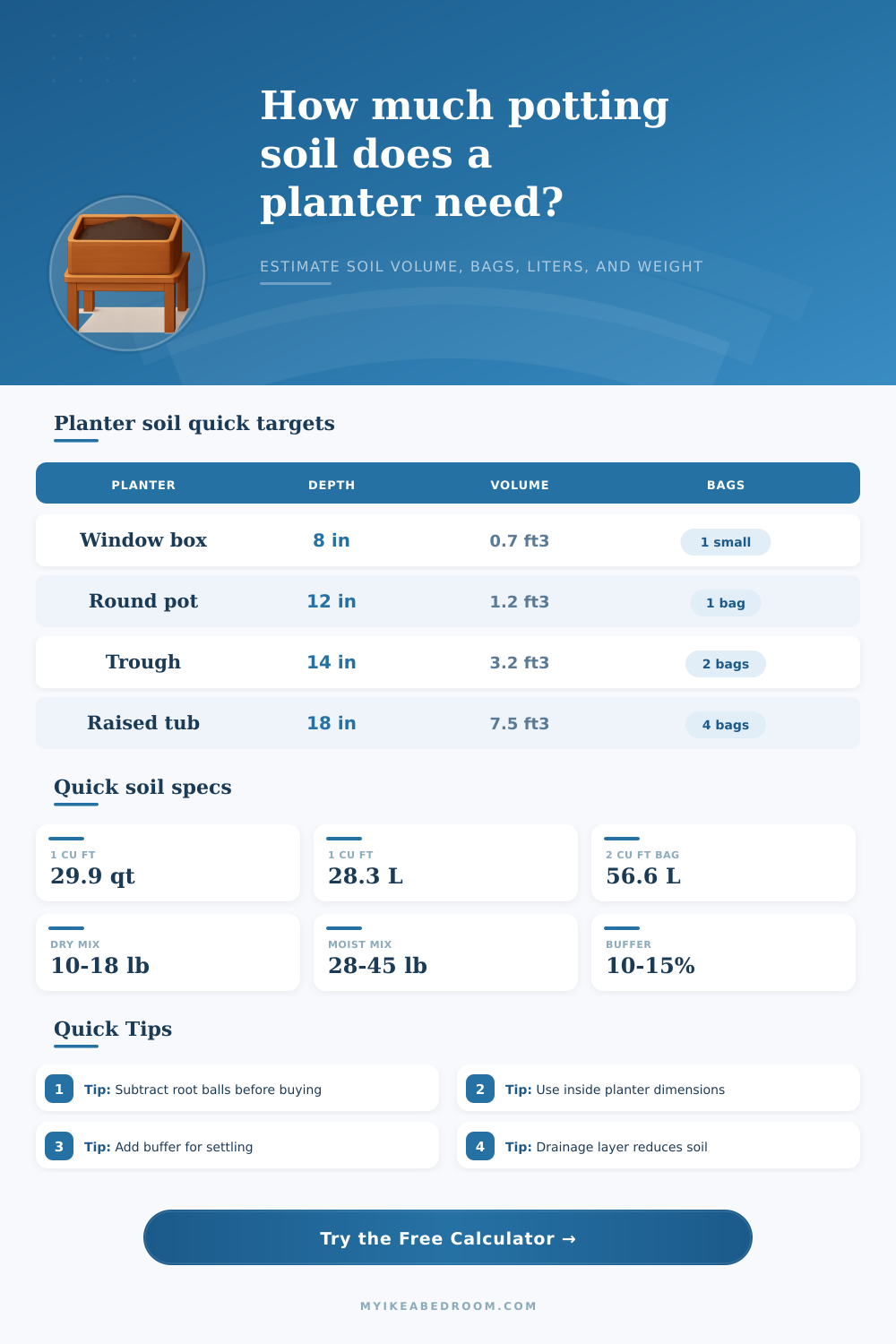
Typical size: 36 × 8 × 8 in.
Usually needs about 1.3 cu ft before root-ball displacement and extra buffer.
Typical size: 18 in diameter by 14 in fill.
Usually lands near 2.1 cu ft before overage for settling.
Typical size: 48 × 12 × 10 in.
Expect about 3.3 cu ft before drainage layers or existing plant roots.
Typical size: 36 × 24 × 18 in.
Needs about 9 cu ft before displacement, settling, and top-off buffer.
Measure the soil cavity: The calculator is based on inside dimensions. Thick ceramic walls, liners, reservoirs, and false bottoms can make outside planter dimensions overstate soil needs by a surprising amount.
Separate fill height from planter height: Leave rim space for watering, subtract any non-soil drainage layer, and subtract large root balls when repotting so you do not overbuy.
Buying an correct amount of potting soil require you to understand how much space exist within the planter. The amount of potting soil that you need to purchase for your planter will depend on several different factor. For instance, the shape of the planter will determine the amount of potting soil that is required, the amount of space within the planter that you leave for watering the plant, and how much space the roots of the plants will take up within the planter.
Additionally, whether or not you plan to include a drainage layer for the planter will also affect the amount of potting soil that is required. Finally, the amount of potting soil will depend upon the settling of the potting soil after watering, as well. A calculator is useful in that it take into account each of these different variables, and it will provide an answer as to the amount of potting soil that are required for your particular planter.
How Much Potting Soil Do You Need
The shape of the planter will affect the way in which you calculate the amount of potting soil that the planter is require. For instance, the measurements will be different for a container with a rectangular shape then it will be for a container that is tapered or triangular in the shape of the corner of the structure within which the container is placed. Additionally, a round container will hold the potting soil different than a long trough shaped container.
In each case, the dimensions of the container that is to be measured are the inside dimension of the container, not the outside dimensions. The calculator will account for these different shapes after you have selected the shape of the container that you are use. The dimension of the container that is most important is the height of the container that is to be filled with potting soil.
It is typical to leave space within the container for watering the plants, and it is typical for those who use planter to include a gravel reservoir at the bottom of some of the containers. Each of these element will displace some of the potting soil that would otherwise be within the container. Thus, each planter will require a different amount of potting soil depending upon how the dimension of the container are set up.
Finally, the amount of space that will be taken up by the roots will also impact the amount of potting soil that is require, as some of the potting soil will be used to fill in the roots rather than filling the entire container with potting soil. Thus, you can subtract the volume of the root mass of the plants from the total amount of potting soil that is required for the container. The type of potting soil will impact the weight of the planter rather than the volume of the container that is filled.
For instance, it is different to use a light indoor potting soil compared to a dense raised bed potting soil. Each planter will have a weight range of the potting soil that the calculator can estimate, which will allow those who use the calculator to understand the weight of the completed planter. This is especially important for individuals using balcony or rooftops to place these containers of plants.
The weight range will also help the individual to decide whether to purchase several bag of smaller potting soil compared to one large bag of potting soil. The settling of the potting soil is one of the factor that is easily underestimated. The fresh potting soil will settle and compress within the container after it is watered, especially if the potting soil contain bark or peat.
Thus, it is necessary to add some buffer to the amount of potting soil that is calculated for the container to account for the settling of the soil. Additionally, it is also important to provide a small buffer for the possibility of spillage of the potting soil. The reference tables located on the page will assist with understanding how the different size of bags of potting soil can fill the containers to the depth that are required.
Some common examples of planters include those window boxes that are often seen in gardens, as well as deep containers for tub plants that may be place in a patio. Each of these containers will require a certain amount of potting soil. For instance, the common window box may require just over one cubic foot of potting soil to be placed within the container prior to add the soil for settling.
The deep tub may require several times that amount of soil. These amounts are only starting point for determining the amount of soil, however. They can be adjusted according to the specifications for the individual container.
By determining the amount of potting soil that will be require for the container, you can purchase only the amount that is required. Thus, you will not waste any of the potting soil. Additionally, you will ensure that you do not underfill the container with the potting soil, which is a mistake that should be avoid.
Once you have determined the amount of potting soil that will be required for your container, you can easily fill the container with the soil.