Vanity Light Width for Mirror Calculator
Size a vanity light from mirror width, vanity width, mounting layout, fixture count, side clearances, fixture depth, backplate width, and the amount of task lighting you want.
Choose a real bathroom or bedroom vanity situation, then adjust the mirror, wall room, and fixture style.
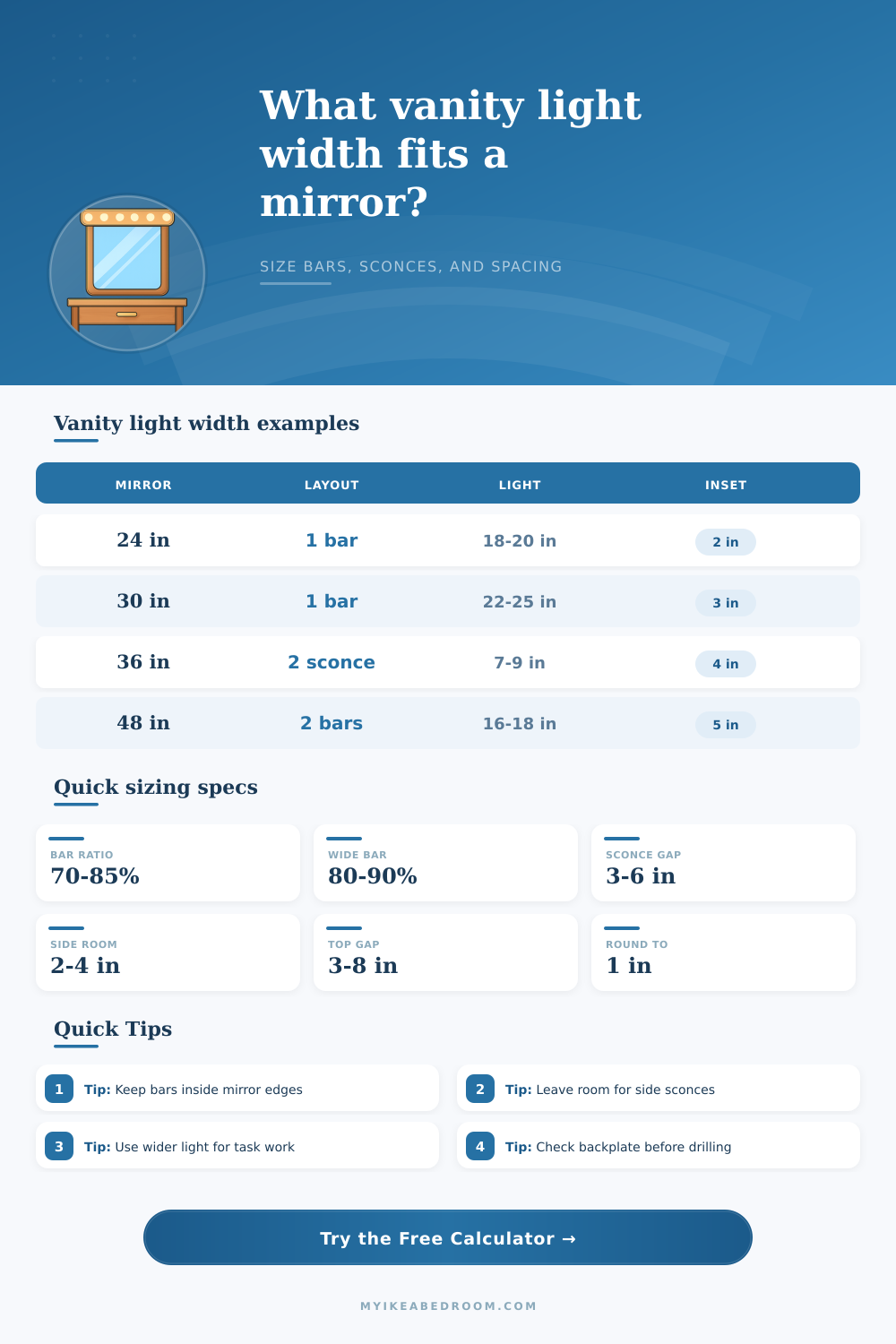
| Mirror width | Soft width | Balanced width | Task width | Best fit note |
|---|---|---|---|---|
| 20-24 in | 14-17 in | 16-20 in | 18-21 in | Good for small powder rooms and narrow mirrors. |
| 25-30 in | 18-21 in | 20-25 in | 23-27 in | Common single sink vanity mirror range. |
| 31-36 in | 22-25 in | 25-30 in | 28-32 in | A 3-light or 4-light bar often works here. |
| 37-42 in | 26-29 in | 30-35 in | 33-38 in | Check wall room before choosing a very wide bar. |
| 43-48 in | 30-34 in | 34-40 in | 39-43 in | Two shorter bars can align better than one long bar. |
| 49-60 in | 34-42 in | 39-50 in | 44-54 in | Use split bars or centered multi-light fixtures for even spread. |
| Layout | Width logic | Needs wall width | Best mirror shape | Watch point |
|---|---|---|---|---|
| One top bar | 70-85% of mirror | Low | Rectangle, pill | Keep the bar centered on the mirror. |
| Wide top bar | 80-90% of mirror | Medium | Wide rectangle | Can overpower small round mirrors. |
| Two top bars | Each 32-42% of mirror | Medium | Wide rectangle | Leave a center gap between bars. |
| Side sconces | Mirror plus two fixtures | High | Round, arch | Wall width must include both sides. |
| Three pendants | Fixture group 65-80% | Medium | Round, rectangle | Shade diameter controls spacing. |
| Fixture count | Typical use | Target group width | Shade spacing | Mirror note |
|---|---|---|---|---|
| 1 | Small bar or centered sconce | 55-75% of mirror | Not needed | Best on very small mirrors. |
| 2 | Side sconces or split bars | Mirror plus gaps | Mirror edge plus 3-6 in | Needs clear wall on both sides. |
| 3 | Classic 3-light bar | 70-82% of mirror | Shade diameter plus 2-4 in | Works well on 24-36 in mirrors. |
| 4 | Wider bar | 75-88% of mirror | Shade diameter plus 2-3 in | Good for 32-48 in mirrors. |
| 5 | Long task bar | 80-90% of mirror | Shade diameter plus 1.5-3 in | Keep the bar below vanity width. |
| Clearance item | Usual minimum | Preferred range | Calculator input | Why it matters |
|---|---|---|---|---|
| Mirror edge to top bar edge | 1 in | 2-5 in | Minimum side clearance | Prevents a bar from looking wider than the mirror. |
| Mirror edge to side sconce | 3 in | 4-6 in | Minimum side clearance | Keeps sconces from crowding the glass. |
| Fixture edge to side wall | 2 in | 3-5 in | Clear wall width | Allows shade width, glass globes, and cleaning room. |
| Mirror top to fixture bottom | 2 in | 3-8 in | Gap above mirror | Keeps the light visually attached to the mirror zone. |
| Backplate to mirror frame | 0.5 in | 1-2 in | Backplate width | A wide backplate can collide with thick frames. |
Best for: simple rectangular mirrors and centered wiring.
Use the recommended total width as the fixture width, then center it over the mirror.
Best for: grooming and makeup zones where even face lighting matters.
Choose the upper end of the range, but keep it inside both mirror and vanity width.
Best for: round, arched, and framed mirrors with clear side wall.
The total span includes mirror width, side gaps, and both fixture widths.
Best for: wide mirrors or double-sink layouts.
Size each bar separately so the pair frames the sink positions instead of making one long strip.
Use the mirror edge as the visual boundary. A top light usually looks most intentional when the shade or bar ends inside the mirror width, while side sconces should sit outside the mirror with a clean gap.
Check the wall box before buying. A slightly off-center box may still work with a wide backplate or adjustable bar, but side sconces need two well-placed boxes and enough side clearance.
To determine the width of an vanity light that will best suit a bathroom vanity mirror and vanity cabinet, you have to measure the width of the mirror and the width of the vanity cabinet. The width of the vanity mirror will allow you to establish where you should place the vanity light. If the vanity light is too narrow for the mirror, it will appear as if the vanity light is center within the mirror.
However, if the vanity light is too wide for the mirror, it may appear as if the vanity light is poorly placed within the mirror. Additionally, the width of the vanity cabinet will allow you to understand how the vanity light may visually appear within the bathroom. For example, a vanity light may visually appear correct in relation to the mirror, but incorrect if it is too wide relative to the vanity cabinet.
How to Choose the Right Width for a Vanity Light
You must also take into account the available space within the bathroom walls surrounding the vanity mirror. Many bathrooms does have limited space along the walls surrounding the mirror. The width of the available space within the walls will tell you if the vanity light will physicaly fit within the bathroom.
Additionally, you must consider the clearance of the vanity lights shades from the edge of both the vanity mirror and the walls. For example, if there is too little clearance between the vanity light and the vanity mirror, the vanity light may be difficult to clean. If there is too much clearance between the vanity light and the mirror or walls, the vanity light may appear as if it dont belong to the vanity mirror.
The number of vanity lights that are selected for the vanity will impact the calculation of the width of the vanity light. For example, if you select a single vanity light bar, the light will span the entire width of the vanity mirror. If two sconces are selected, the sconces will divide the width of the vanity mirror into two sections.
If three or four vanity lights are selected, those vanity lights must divide the width of the vanity mirror into sections with enough space between each vanity light shade to ensure the vanity lights do not appear as if they are more cramped together. The calculator consider the number of vanity lights that are to be installed to determine the appropriate width for each vanity light shade. Furthermore, the calculator takes into account the width of each individual shade or globe of the vanity light.
Additionally, the calculator considers the width of the backplate of the vanity light; the part of the vanity light that is mount into the wall may be wider than the shade that reflects the light from the vanity mirror. Another factor that the calculator will consider is the task level of the vanity light. Vanity lights can be utilized for either task lighting or ambient lighting within the bathroom.
Task lighting provides light for specific activities in the bathroom (like shaving or applying makeup) while ambient lighting is a more general lighting of the bathroom. Task lighting requires vanity lights that are wider than those used for ambient lighting. Additionally, the shape of the vanity mirror will also impact the width of the vanity light that is to be installed.
For example, if the vanity mirror is round or arched, the vanity light may need to be narrower so that it does not appear to conflict with the curves of the mirror. In addition to measuring the vanity mirror and vanity cabinet, measuring the available wall space, clearance, and taking into account the type of vanity lights that are to be installed, the width of each shade, the backplate, the task level, and the shape of the mirror, the calculator will recommend a width for the vanity light. Furthermore, the calculator will provide an inset value for the vanity light which indicates how far in or out from the vanity mirror the vanity light will be position.
Finally, the calculator will indicate whether or not the vanity light will fit within the available space along the bathroom walls. These recommendations are not rules that must be followed, but they are helpful in providing a starting point in selecting a vanity light that will suit the vanity mirror and vanity cabinet. Due to the fact that bathrooms often have complications that the calculator does not take into account in the recommendations, it is necessary to test a few different layout options within the bathroom.
For example, the electrical boxes within the walls may not be center within the mirror, and the mirrors may have thick frames that reduce the available space for the vanity lights. Additionally, it may be preferred that you install one long bar of vanity light rather than sconces installed on the sides of the vanity mirror. Each of these different layout options can be tested based off the actual measurements within the bathroom.
For example, a narrow hallway bathroom with a 24-inch vanity mirror may only require an 18-inch vanity light bar when side clearance is taken into account. In a bathroom with two vanities and two sink, two shorter vanity light bars may be better than a single vanity light bar that spans the width of two vanity mirror. Overall, the goal is to find the correct width of a vanity light to both provide for the functionality and the physical space requirements of the bathroom mirror and vanity.