Dining Table Chandelier Size Calculator
Estimate chandelier diameter, linear fixture span, multi-light spacing, table-edge clearance, room-scale fit, and hanging height from your dining table and room dimensions.
Start from a real dining layout, then adjust the table width, length, room size, ceiling height, fixture style, and visual scale.
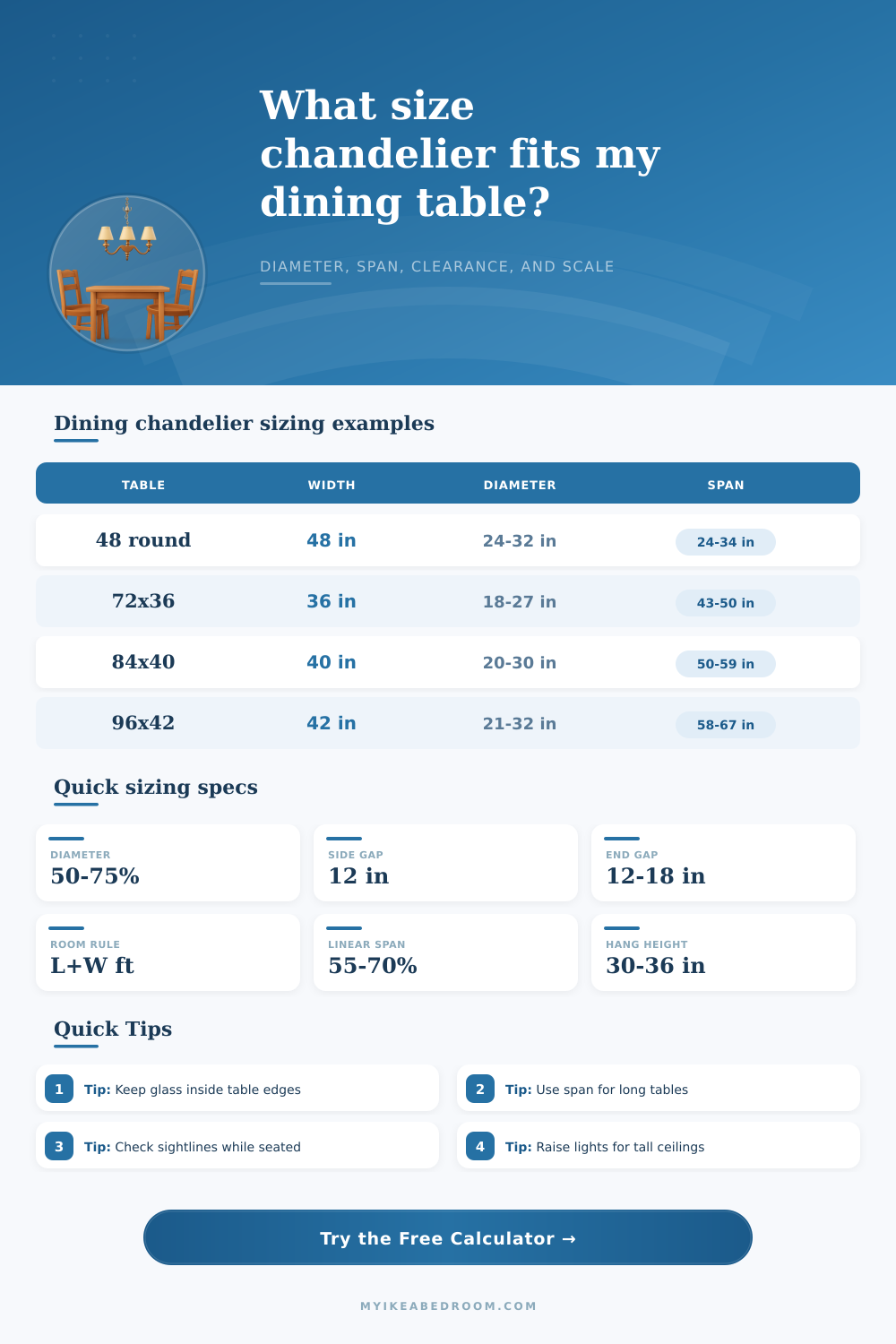
| Table width | Compact diameter | Balanced diameter | Statement diameter |
|---|---|---|---|
| 30 in narrow table | 15-17 in | 18-20 in | 21-22 in |
| 36 in table | 18-20 in | 22-24 in | 25-27 in |
| 40 in table | 20-22 in | 24-26 in | 28-30 in |
| 42 in table | 21-23 in | 25-28 in | 29-32 in |
| 48 in table | 24-26 in | 29-32 in | 34-36 in |
| Table length | Compact span | Balanced span | Max span with end gap |
|---|---|---|---|
| 60 in table | 33 in | 39 in | 36-42 in |
| 72 in table | 40 in | 47 in | 42-48 in |
| 84 in table | 46 in | 55 in | 54-60 in |
| 96 in table | 53 in | 62 in | 66-72 in |
| 108 in table | 59 in | 70 in | 78-84 in |
| Dining room size | Room sum | Typical diameter | Use this when |
|---|---|---|---|
| 10 x 10 ft | 20 in | 18-22 in | Small square dining nook |
| 12 x 14 ft | 26 in | 24-28 in | Average dining room |
| 14 x 16 ft | 30 in | 28-32 in | Open dining area |
| 16 x 18 ft | 34 in | 32-36 in | Large room with high ceiling |
| 18 x 20 ft | 38 in | 34-40 in | Formal or open-plan dining |
| Pendant count | Typical shade | Center spacing | Good table length |
|---|---|---|---|
| 2 pendants | 12-16 in | 24-34 in | 60-72 in table |
| 3 pendants | 10-14 in | 18-26 in | 72-96 in table |
| 4 pendants | 8-12 in | 16-22 in | 96-120 in table |
| 5 pendants | 6-10 in | 14-20 in | 108-132 in table |
Best for: round, square, oval, and short rectangular tables.
Use table width for diameter first, then confirm against the room-sum rule.
Best for: rectangular tables longer than about 72 inches.
Use table length for span and table width for the fixture depth.
Best for: long tables where multiple smaller shades feel lighter.
Target the same total span as a linear fixture, then divide by pendant count.
Best for: medium tables and narrow rooms with centered seating.
Keep each light inside the table edge and leave balanced center spacing.
Check the side view: The calculator keeps the fixture inside the table footprint, but sit at the table and confirm that shades, bulbs, and chains do not block faces across the table.
Use the stricter limit: When the room rule suggests a larger chandelier than the table allows, favor the table clearance cap or switch to a longer linear fixture instead of widening the light.
Choosing an chandelier for a dining table requires you to consider the widths of the dining table, the size of the room, the length of the dining table, the height of the ceiling in the room, and the styles of the chandelier. A chandelier must relate to the dining table and a chandelier must relate to the room where the dining table is located. If a chandelier is too small for the room that contain the dining table, the chandelier may not provide enough visual interest for that space.
If a chandelier is too large for the dining table and the room, the chandelier may make the dinner table look more cramped. The width of the dining table will have the primary influence upon the sizes of the chandelier. A chandelier that is sized for a dining table that is 40 inches in width will not necessarily be proportional to a dining table that is 48 inches in width.
How to choose a chandelier for your dining table
The chandelier should be hung in such a way that it sits within the edges of the dining table, but there should be enough clearance beneath the chandelier for diners to avoid crowding the chandelier with their elbows and dining table movements. If the chandelier is too close to the edges of the dining table, the dining room may begin to feel somewhat cramped. The size of the room is another factor that will influence the size of the chandelier.
A large room will require a chandelier that has a strong visual presence to ensure that people dont easily miss the chandelier within the large space. A chandelier that is too large for a small dining room can potentially create an overwhelming and dominating element within that room. Because the size of the dining table and the size of the room may not always match, it is important for those who are selecting a chandelier to consider both of these factors.
The length of the dining table is another factor to consider if the length of the dining table is six foot or longer. A single round chandelier may leave the ends of the dining table dark. Instead, you may select a linear chandelier or a row of pendants.
These types of chandeliers will provide even lighting from one end of the dining table to the other. However, the linear chandelier or row of pendants should not extend so far out from each end of the dining table that the chandelier appear to be crowding those who dine at the ends of the table. The height of the ceiling influence the way in which the chandelier is hung above the dining table.
Chandeliers are typically hung between thirty and thirty-six inches above a dining table that has an eight-foot ceiling. If the dining room has a ceiling that is taller than eight feet in height, the chandelier can be hung slightly higher than thirty-six inches from the dining table. The height of the chandelier should be chosen so that both the seated guest can view the area above the dining table without obstruction by the chandelier, yet there is enough space for dishes to be passed between those who share the dining table.
The style of the chandelier may also influence the type of dining table in the kitchen. Round chandeliers appear to work best over round dining tables or square dining tables. Linear chandeliers and rows of pendants work best over rectangular dining tables.
For instance, if the dining table that will be used in the kitchen is of medium size and the kitchen is relatively narrow in comparison to the rest of the house, you may purchase a pair of chandeliers that each have two lights to ensure that you distribute the visual weight of the chandeliers appropriately. Many people make mistakes in hanging chandeliers when they focus upon only a few of the measurements for the dining room. For instance, people may choose a chandelier based off the size of the room where the dining table is located, which can result in the chandelier being too large for the dining table.
Alternatively, people may decide upon a chandelier based only upon the width of the dining table, which may result in the chandelier being too small for the entire dining room. It is important to consider each of the measurement discussed above. The most restrictive of these measurements will help to determine the size of the chandelier that should be chosen.
Finally, sitting at the dining table should determine the height of the chandelier. When seated at the table, individuals should look to the individual who is sitting across from them. If the bottom of the chandelier is at or below eye level of those across from you, the chandelier may interrupt the conversation between the individuals at the table.
Raising the chandelier or choosing a narrower chandelier will prevent these types of conversations from being interrupted. Following the considerations noted above, the chandelier will be of an appropriate size for the dining table and the room in which the table exist.