Island Pendant Quantity Calculator
Calculate pendant count, center-to-center spacing, shade-to-shade gap, end setbacks, and whether an odd or even layout fits your island length.
Load a realistic island length and pendant size, then adjust the spacing, setback, and odd or even layout rule.
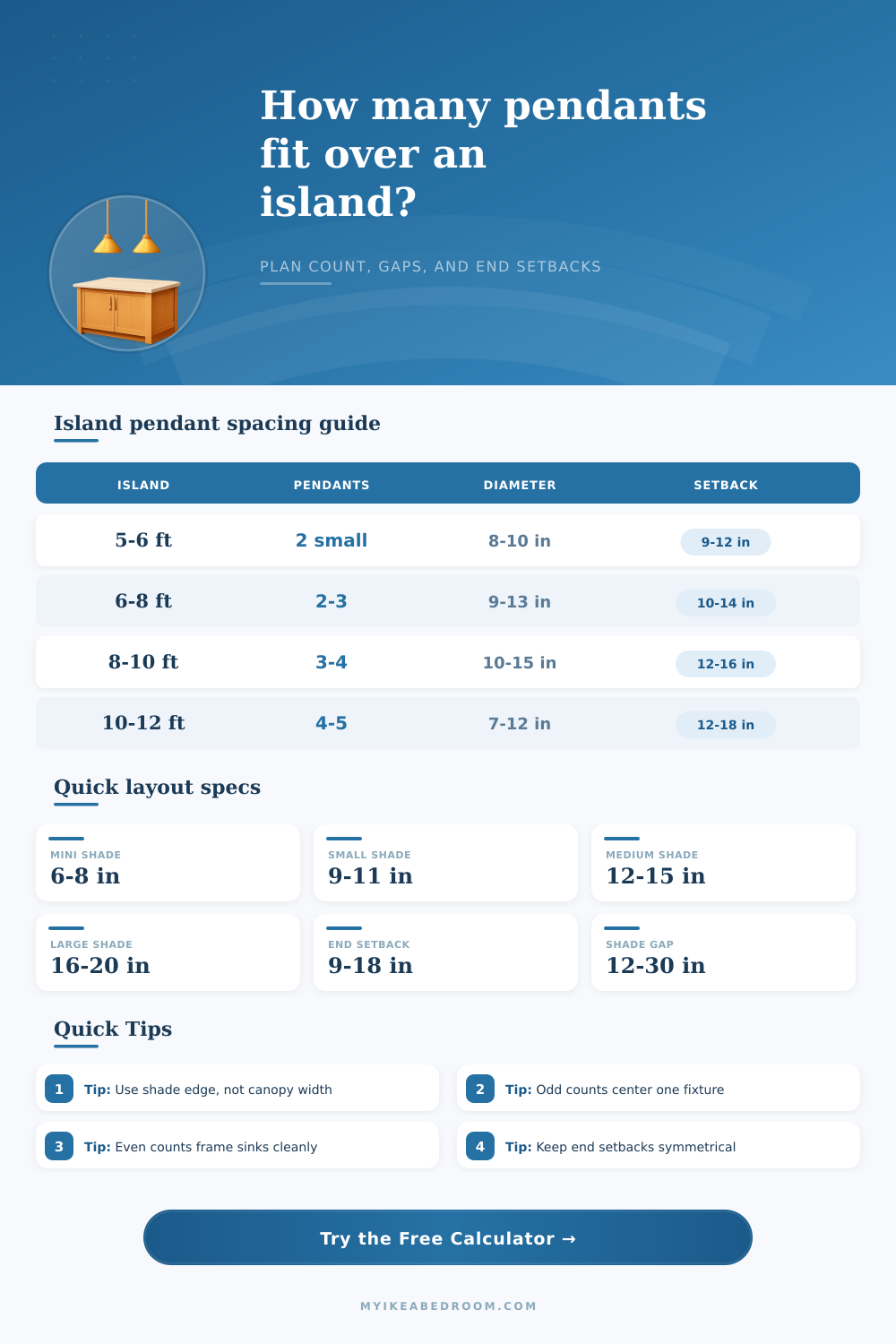
| Island length | Common count | Best layout | Typical shade diameter |
|---|---|---|---|
| 48-60 in / 122-152 cm | 1 or 2 pendants | Single centered or even pair | 8-14 in / 20-36 cm |
| 60-84 in / 152-213 cm | 2 pendants | Even pair with open center | 8-13 in / 20-33 cm |
| 84-108 in / 213-274 cm | 3 pendants | Odd layout with one centered | 9-15 in / 23-38 cm |
| 108-132 in / 274-335 cm | 3 or 4 pendants | Odd for large shades, even for slim shades | 8-16 in / 20-41 cm |
| 132-156 in / 335-396 cm | 4 or 5 pendants | Even row or odd mini-pendant row | 6-12 in / 15-30 cm |
| Shade type | Diameter range | Shade-to-shade gap | Resulting center spacing |
|---|---|---|---|
| Mini cylinder or cone | 6-8 in / 15-20 cm | 12-18 in / 30-46 cm | 18-26 in / 46-66 cm |
| Small globe or cone | 9-11 in / 23-28 cm | 14-22 in / 36-56 cm | 23-33 in / 58-84 cm |
| Medium drum or dome | 12-15 in / 30-38 cm | 16-26 in / 41-66 cm | 28-41 in / 71-104 cm |
| Large statement shade | 16-20 in / 41-51 cm | 22-34 in / 56-86 cm | 38-54 in / 97-137 cm |
| Layout type | Centerline result | Best use | Watch point |
|---|---|---|---|
| Single pendant | One fixture centered | Short islands and large shades | Can leave long islands under-filled |
| Even pair | Open centerline | Sink, cooktop, or focal line in the middle | Needs enough end setback to avoid crowding |
| Odd row | One pendant centered | Balanced islands without a central obstruction | Middle pendant may conflict with a hood or beam |
| Even row | Center gap between two pendants | Long islands and repeated slim shades | Too many large shades can look busy |
| Island condition | Minimum setback | Comfortable setback | Why it matters |
|---|---|---|---|
| Open island ends | 8-10 in / 20-25 cm | 12-14 in / 30-36 cm | Keeps shades from hanging over end seats |
| Waterfall side panels | 10-12 in / 25-30 cm | 14-16 in / 36-41 cm | Leaves visual breathing room beside vertical panels |
| Large statement shades | 12-15 in / 30-38 cm | 16-20 in / 41-51 cm | Prevents the first shade from feeling too close to the edge |
| Long multi-pendant row | 10-12 in / 25-30 cm | 12-18 in / 30-46 cm | Balances row length with usable end clearance |
Best for: 5 to 7 ft islands with medium shades.
Spacing feel: clean, open center, simple symmetry.
Best for: 7 to 10 ft islands and balanced rows.
Spacing feel: centered focal pendant with even side gaps.
Best for: long islands with slim repeated shades.
Spacing feel: architectural row with a clear middle gap.
Best for: extra-long islands and mini-pendant rhythm.
Spacing feel: bright, repeated, and visually active.
Use the shade edge for setbacks. The calculator treats end setback as island end to outside shade edge, then adds half the pendant diameter to place the first fixture center.
Choose odd or even around the island centerline. Odd rows put one pendant on center; even rows leave the center open for a sink, range hood line, or uninterrupted sightline.
To determine the number of pendants that should be included in pendant lighting for a kitchen island, several measurements needs to be taken. These include the length of the kitchen island, the diameter of the pendant shade, the gaps between the pendant shades, and the setbacks at the ends of the kitchen island. Too few pendant shades will make the kitchen island look sparse, while too many shades will make the island look crowded.
By taking each of these measurements and considering the different aspect of the kitchen island, it is possible to find the correct number of pendants. You will measure the length of the kitchen island, but this isnt the only measurement that are required. The location of the seating area, the sink, and any other obstruction in the island will play a significant role in determining whether an odd or even number of pendants will best suit the island.
How Many Pendant Lights for a Kitchen Island
If you choose an odd number of pendants, the pendant will be centered in the island. An odd number of pendants will create a sense of symmetry in the island. If the designer chooses an even number of pendants for the kitchen island, there will be a gap in the center of the island.
This may be preferred if there is a sink in the center of the island. The diameter of the pendant shades will also be measured. The diameter will show how much space each shade take up in the island.
A wider shade will take up more space in the island than a slim shade. As such, if wide shades are chosen for the kitchen island, fewer shade will fit into the island. The calculator can calculate the number of pendants by entering information about the length of the island, the diameter of the pendant shades, and the gap between each shade.
The calculator will also provide information about the spacing between the shades. The setbacks at the ends of the kitchen island will also need to be considered. The first and last pendant shade should not be too close to the ends of the kitchen island.
If it is, then the pendants will crowd the seating at the corners of the kitchen island. By adjusting the minimum setback in the kitchen pendant shade calculator, the designer can account for the physical space that individuals will need when standing on the island. Another consideration is the even or odd number of pendants.
An odd number of pendants will create a symmetrical kitchen island. The odd number will be suitable for those kitchen islands located in an open space in the house. An even number of pendants will leave a gap in the center of the island.
This will be appropriate for a kitchen island with a sink in the center. By using the pendant shade calculator, the designer can test both an even and odd number of pendants to determine which will create the bester look for the island. One more consideration is the preference for the coverage area for the pendant shades.
Some may want the shades to cover the entire length of the island, while others may only want the pendants to illuminate the dining or prep zone in the kitchen. By shortening the length of the pendant shades, the number of pendants that will fit into the kitchen island will change. A kitchen island may require three pendants for full coverage, but it may require four if the lighting is to be placed in another area of the island.
Many people will make mistakes with their measurements. For example, they may measure the width of the canopy rather than the diameter of the pendant shade. Or, they may not account for the gap between the pendant shades when making their measurements.
These types of error will lead to purchasing the incorrect number of pendants for the kitchen island. Using reference tables can help ensure that these measurements are evened out. The visual weight of the pendant shades will also play a significant role in the look of the pendant lighting.
For example, a dark shade will have more visual weight than a clear glass shade. The gap between two dark shades will appear to be smaller than the gap between two clear glass shades. By adjusting the visual weight in the pendant shade calculator, the designer ensures that the visual differences are account for in the calculations.
Once you have determined the total number of pendants that will be used for the kitchen island, the designer must also ensure that the actual kitchen island and its use is consider. For example, you will need to view the row of pendant shades from different angles to ensure they are positioned correctly. The position of the center pendant should align with the objects in the island.
Finally, ensure that the setbacks provide enough space for the individuals who will use the kitchen island to stand. These adjustment can all be made before purchasing the pendant lighting hardware.