Shelf Wall Anchor Quantity Calculator
Estimate how many wall anchors a shelf needs from loaded weight, anchor rating, stud count, bracket spacing, wall type, and safety factor before marking the wall.
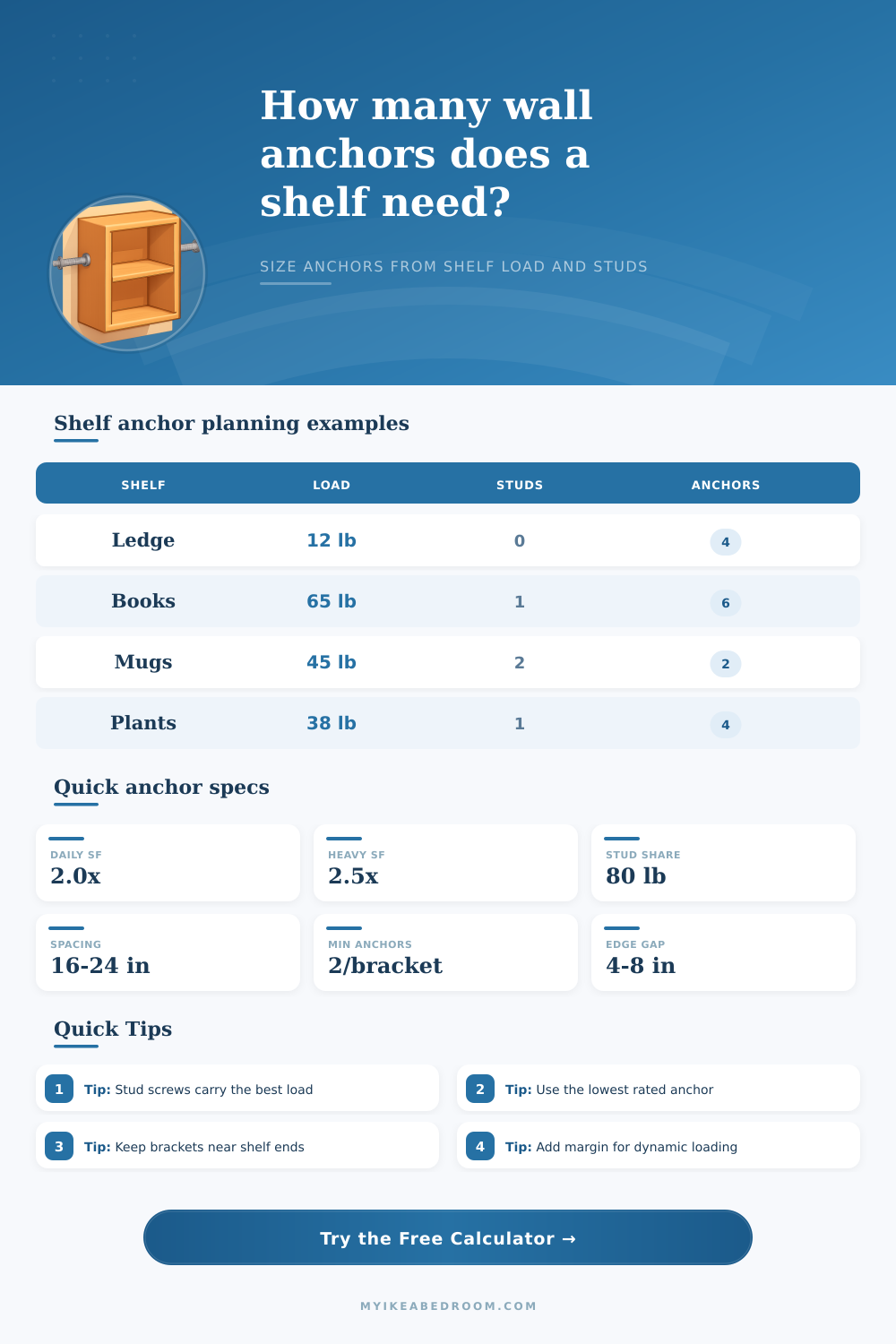
Choose a shelf situation close to yours, then adjust the load, anchor rating, stud hits, and bracket layout.
| Wall condition | Derating factor | Use when | Calculation effect |
|---|---|---|---|
| Drywall, basic hollow-wall anchors | 0.70x | Plastic, self-drilling, or basic expansion anchors in typical drywall. | Entered rating is multiplied by 0.70 before anchor count is sized. |
| Drywall, toggle or strap toggles | 0.85x | Toggles spread load behind drywall and suit heavier hollow-wall shelves. | Entered rating is multiplied by 0.85 to keep a working margin. |
| Plaster over lath | 0.60x | Older walls where brittle plaster, lath gaps, or mixed layers can vary. | Anchor rating is reduced more because the wall substrate is less predictable. |
| Masonry or concrete anchors | 0.90x | Solid masonry with correctly sized drilled anchors and suitable screws. | Most of the entered rating is retained after a modest field derating. |
| Unknown wall | 0.55x | Layered walls, uncertain drywall thickness, patch areas, or no inspection. | The calculator becomes conservative and usually asks for more anchors. |
| Load behavior | Multiplier | Typical shelf contents | Why it matters |
|---|---|---|---|
| Static display | 1.00x | Small frames, light decor, a few display objects. | Load changes little, so the safety factor handles normal variation. |
| Daily use storage | 1.15x | Books, baskets, desk items, folded clothes, or towels. | Repeated handling adds small impacts and uneven loading. |
| Dynamic or changing | 1.30x | Watered plants, mugs, kitchen items, or electronics moved often. | Loads can shift, increase, or tug forward during use. |
| Child room or bump-prone | 1.50x | Low shelves, kids books, toys, or areas near beds and desks. | Extra allowance covers bumps, grabbing, and less predictable loading. |
| Shelf situation | Depth | Loaded weight | Target spacing |
|---|---|---|---|
| Picture ledge or narrow display shelf | 4-6 in | Under 20 lb | 24-32 in between supports |
| General bedroom or office shelf | 8-10 in | 20-55 lb | 18-24 in between supports |
| Books, dishes, binders, or plant shelf | 10-12 in | 55-90 lb | 14-18 in between supports |
| Deep or very heavy storage shelf | 12-16 in | 90 lb and up | 12-16 in between supports |
| Example shelf | Typical load | Stud strategy | Anchor note |
|---|---|---|---|
| 24 in picture ledge | 8-15 lb loaded | Studs helpful but not always aligned. | Usually needs two to four hollow-wall anchors. |
| 36 in book shelf | 50-80 lb loaded | Hit at least one stud when possible. | Use strong anchors for remaining brackets. |
| 48 in kitchen mug shelf | 35-60 lb loaded | Two studs greatly improve margin. | Non-stud brackets still need rated anchors. |
| 60 in closet shelf | 70-110 lb loaded | Studs or standards are preferred. | Add brackets before relying on anchors alone. |
Best for: light displays and short shelves when studs miss the layout.
Count carefully because every pound relies on wall material and anchor grip.
Best for: common 30-48 in shelves with one bracket on framing.
The stud carries a major share, while anchors stabilize the remaining supports.
Best for: books, dishes, plants, and shelves used every day.
Stud screws provide the most reliable working capacity for typical home walls.
Best for: long storage shelves and heavy repeated loading.
A continuous rail or hidden blocking spreads fasteners across more structure.
Use the weakest link in the math. If one bracket lands on a weaker anchor or a questionable wall patch, size the non-stud side around that lower working rating instead of averaging better anchors into the result.
Spacing is part of capacity. A shelf can have enough total anchor capacity and still sag or pry forward if the brackets are too far apart for the depth and load.
When hanging a shelf on a wall, one must consider the amount of weight that the wall can carry. The weight of the items that will be on the shelf will dictate the strength of the mounting hardware for the shelf. Many people attempt to guess the amount of weight that the shelf will be able to carry.
However, guessing at the amount of weight that the shelf will take is likely to lead to errors in the selection of the mounting hardware, the guess may be to low for the weight of the items to be placed on the shelf, or the guess may be to high to account for the actual amount of weight that the items will have. If the shelf does not correctly calculate the amount of weight that the shelf is to carry prior to installing the shelf, the shelf may tilt or the drywall may crumble over time. Thus, it is important to calculate the total load that the shelf is to carry to ensure that the shelf remains secure.
How to Calculate How Much Weight a Wall Shelf Can Hold
The total load that the shelf is to carry will depend upon several different factors. For instance, the load of the items that will be placed upon the shelf, the depth of the shelf, and the material of the wall upon which the shelf is to be installed are all factors that will impact the total load. The depth of the shelf will have an impact upon the amount of leverage that is placed upon each of the mounting fasteners that the user will use to install the shelf.
The material of the wall will also have an impact upon the amount of weight that the wall can support by the anchor; the strength of the anchor that is embedded into the drywall is different than the strength of the anchor that is placed into masonry or plaster. The depth of the shelf will also have an impact upon the total load to be carried by the shelf; the deeper the shelf, the more force that is applied to each anchor. Additionally, because the strength of the anchor is different depending upon the type of drywall, it is necesary for individuals to name the type of wall upon which they are to install the shelf.
The calculator will apply a derating factor to the strength of the anchor. The strength of the anchor when tested in a laboratory will often not equal the strength of the same anchor when installed into a drywall structure. The way in which the shelf is to be used will also have an impact upon the total load that should be placed upon each of the mounting brackets.
For instance, if the shelf is to support heavy objects that will remain static upon the shelf, the load upon each of the mounting brackets will be different than a shelf that is to be used in a kitchen where the shelf will be used daily to place objects such as plates, glasses, or other kitchen utensils. The same calculation will be applied to each of these types of shelves, but with different actual usage of the shelf. For instance, a childs shelf that is to be placed in the living room may be exposed to bumps from the children that live in the home.
The factor that is applied to the stated load of the shelf will account for these types of expected uses of the shelf. Another critical component to the installation of the shelf are the studs that are to be found within the wall. The screw that is driven into a stud is stronger than an anchor that is used within the hollow wall.
Thus, the calculator allows individuals to enter the number of stud points that will be hit when the shelf is installed. Each stud point will allow for the remaining weight of the shelf to be distributed to the remaining wall anchors. Furthermore, the calculator will also check the spacing of the installed brackets.
For instance, if the shelf is too long for the distance between the brackets, the shelf may sag in the middle despite the strength of the anchors. Many shelves will make use of both studs and hollow wall anchors. The studs will be located at different portions of the shelf than where the individual might wish to install the shelf.
The calculator will output the split between the number of studs and the number of hollow wall anchors that will be used. Additionally, the calculator will provide an output of the effective load that will be placed upon each anchor after the derating factor for the drywall has been applied, as well as the credits from the studs. This effective load will help the individual to decide if the current anchors that they’re to be purchased from an appliance store are strong enough for the shelf that is to be built.
Another factor to consider in the calculation of the total load that will be placed upon each of the mounting brackets is the weight of the shelf itself. For instance, a shelf made of thick hardwood will be heavier than a shelf made of thin pine wood. Thus, the weight of the shelf will increase the total load upon each of the brackets.
Finally, the safety factor that is chosen for the load that each of the brackets will carry will impact the total load upon those brackets. A safety factor of two will typically be used for normal shelving use. However, if the items that will be placed upon the shelf are likely to be fragile, or if the shelf is to be located in a portion of the home where children may have access to the shelf, a higher safety factor should be chosen.
The output of the calculator is the margin of safety of the shelf; the margin of safety indicates the total amount of extra strength that the shelf has beyond the strength of the items that will be placed upon it. By using such a calculator, an individual can create a mounting plan for the shelf that is in accordance with the conditions of the wall and the items that will be placed upon it. The calculator allows an individual to test various amounts of brackets and different types of anchors to ensure that the individual does not under-build the shelf to install upon the wall or that they do not over-build the shelf for which they are to purchase the mounting hardware.
Thus, by utilizing such a calculation for the total load that will be placed upon each of the mounting brackets, the shelf will remain level and secure for a long period of time.