Shelf Overhang Past Bracket Calculator
Estimate whether a shelf end overhang is sensible for the bracket spacing, shelf depth, material thickness, support count, and the load you plan to place on it.
Start with a common wall-shelf scenario, then adjust the overhang, brackets, depth, and loading to match your actual plan.
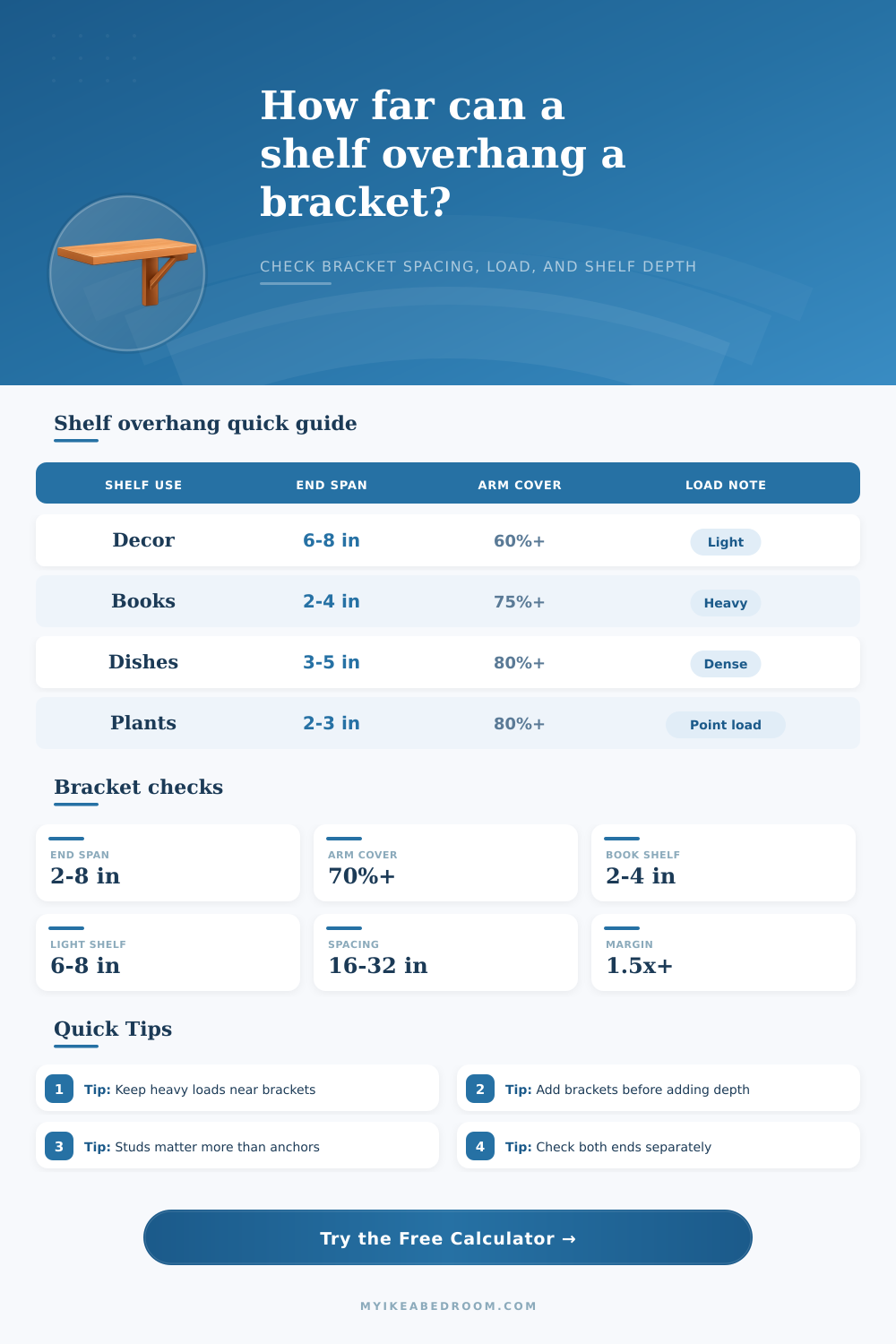
| Shelf use | Typical end overhang | Suggested bracket spacing | Load placement note |
|---|---|---|---|
| Picture ledge and small decor | 6 to 8 in if the shelf is shallow | 24 to 32 in on studs | Keep tall frames close to bracket lines. |
| Paperback or mixed books | 2 to 4 in for stiff boards | 16 to 24 in depending on board thickness | Books create dense continuous load. |
| Mugs, dishes, and glassware | 3 to 5 in with strong wall fastening | 16 to 24 in for daily handling | Reduce overhang near fragile items. |
| Plant shelf | 2 to 3 in when pots sit near ends | 16 to 20 in if watering changes weight | Wet soil is a point load, not just decor. |
| Closet bins and folded storage | 4 to 6 in if loads are soft and spread | 24 to 32 in with a cleat or extra bracket | Bins often creep toward the front edge. |
| Shelf length | Light display | Daily storage | Book or dish loading |
|---|---|---|---|
| 24 to 36 in | 2 brackets, 16 to 24 in apart | 2 brackets, 14 to 20 in apart | 2 to 3 brackets, 12 to 18 in apart |
| 36 to 48 in | 2 to 3 brackets, 20 to 28 in apart | 3 brackets, 16 to 22 in apart | 3 brackets, 14 to 18 in apart |
| 48 to 72 in | 3 brackets, 22 to 30 in apart | 3 to 4 brackets, 18 to 24 in apart | 4 brackets, 14 to 20 in apart |
| 72 to 96 in | 4 brackets, 24 to 30 in apart | 4 to 5 brackets, 18 to 24 in apart | 5 or more brackets, 14 to 20 in apart |
| Shelf depth | Light display arm | Daily-use arm | Heavy-load arm |
|---|---|---|---|
| 6 in shallow shelf | 4 in arm minimum | 5 in arm preferred | 5 to 6 in arm |
| 8 in shelf | 5 to 6 in arm | 6 to 7 in arm | 7 to 8 in arm |
| 10 to 12 in shelf | 7 to 8 in arm | 8 to 10 in arm | 10 to 12 in arm |
| 14 to 16 in shelf | 10 to 12 in arm | 12 to 14 in arm | 14 to 16 in arm |
| Scenario | Typical board | Overhang behavior | Bracket priority |
|---|---|---|---|
| Picture ledge | 36 to 48 in long, 4 to 6 in deep | Longer end overhang can work because load is light | Prevent tipping and wall pullout. |
| Bookshelf row | 48 to 72 in long, 10 to 12 in deep | Short overhang is better because books are dense | Close spacing and studs. |
| Kitchen shelf | 36 to 60 in long, 8 to 12 in deep | Moderate overhang with frequent handling | Arm coverage and fastener strength. |
| Plant shelf | 24 to 48 in long, 8 to 14 in deep | End overhang becomes sensitive to pot placement | Point-load control. |
| Closet shelf | 48 to 96 in long, 12 to 16 in deep | Overhang depends on hidden side cleats or brackets | Continuous rear support if possible. |
Current plan
Your entered bracket layout is evaluated against the load and arm coverage.
Move outer brackets outward
Shortening the cantilever usually gives the quickest improvement.
Add one bracket
Extra support reduces span between brackets and load per bracket.
Use deeper arms
Better front-to-back support helps with deep shelves and front-heavy loads.
Bracket placement tip: Measure overhang from the shelf end to the bracket centerline, then check both left and right ends. Unequal end spans can make one side feel springy even when the middle spacing looks tidy.
Loading tip: Put dense items such as books, dishes, and plant pots directly over or between brackets. Long decorative overhangs are better for light frames, small boxes, and shallow objects.
When you installs a shelf, you need to determine how much of the shelf board can extend beyond the outermost bracket. The overhang of the shelf is the distance between the outer edge of a bracket and the outer edge of the shelf board. If there is too much overhang, the shelf will dip at it’s front edge when weights is added to the shelf.
Conversely, if the overhang is too small, there will be less of a shelf for the individual to place item upon. Thus, it is important to find a balance between these two limit in order to ensure that the shelf will remain stable and will not feel springy when item are placed upon it. One factor that play a major role in the overhang of a shelf is the material of the shelf board.
How Much Shelf Can Hang Over a Bracket
For instance, a shelf board made of three quarter inch plywood will be stiffer than a three-quarter-inch shelf board made of particleboard. Thus, the shelf board made of plywood can have a longer overhang than the one made of particleboard. In determining the amount of overhang that a particular shelf board can have, its stiffness is one factor that must be considered.
In order to determine this stiffness, you can enter the type of material of the shelf board, its thickness, and the depth of the shelf board into an online calculator. This type of calculator can help to determining the stiffness of the shelf board without guessing as to the stiffness of that particular board. Another factor that will play a role in the overhang of the shelf is the use of the shelf.
For instance, a shelf that is used to display picture will have a different overhang than a shelf used to hold various kitchen utensils. This is due to the load that is place upon the shelf. The load pattern of the shelf is the location of the items that are placed upon the shelf.
If many of the item that are placed upon the shelf are placed upon the outer edge of the shelf board, the overhang will have to be limited to reduce the force that is placed upon the overhang. In addition to the type of material of the shelf board, the shelf is also limited by the type of wall brackets is attached to. For instance, if the brackets are attached directly to the studs of the wall, the shelf will be much stiffer than if the brackets are attached to drywall using wall anchors.
Thus, if the shelf brackets are attached to drywall using wall anchors, the overhang of the shelf will be limited in comparison to the shelves whose brackets is attached to the studs. Another factor that limit the overhang is the depth of the shelf board and the length of the arm of the bracket. If the shelf board is deep, the bracket must be long enough to extend to near the front edge of the shelf board.
If the length of the bracket arm is too short in comparison to the depth of the shelf, the shelf board will act as a lever that will amplify the weight that are placed upon the unsupported portion of the shelf. Tables can be referenced in order to determine the overhang limit of various types of shelf uses. These tables will list the limits of overhang for shelves of different types.
However, these limit are only guidelines; if the overhang is too great, you can adjust the shelf to account for this overhang. For instance, you can move the outer brackets closer to the ends of the shelf board, an additional bracket can be installed in the middle of the shelf board, or you can replace the shelf board with one that is stiffer. Each of these adjustment will alter the mathematical calculation that are made regarding the shelf.
Once you have determine the correct measurements for your shelf, you must use those measurements to perform the installation of the shelf. You must mark the location of the brackets onto the shelf board, and the brackets must be attached to the studs in the wall. Furthermore, the amount of overhang that projects from each side of the shelf board must be equal.
Otherwise, the shelf will appear unbalanced and may feel uneven when items are placed upon it. In either case, the shelf board should remain within the safe range of overhang in order to allow it to perform its function without causing the user of the shelf to notice the overhang of its shelf board.