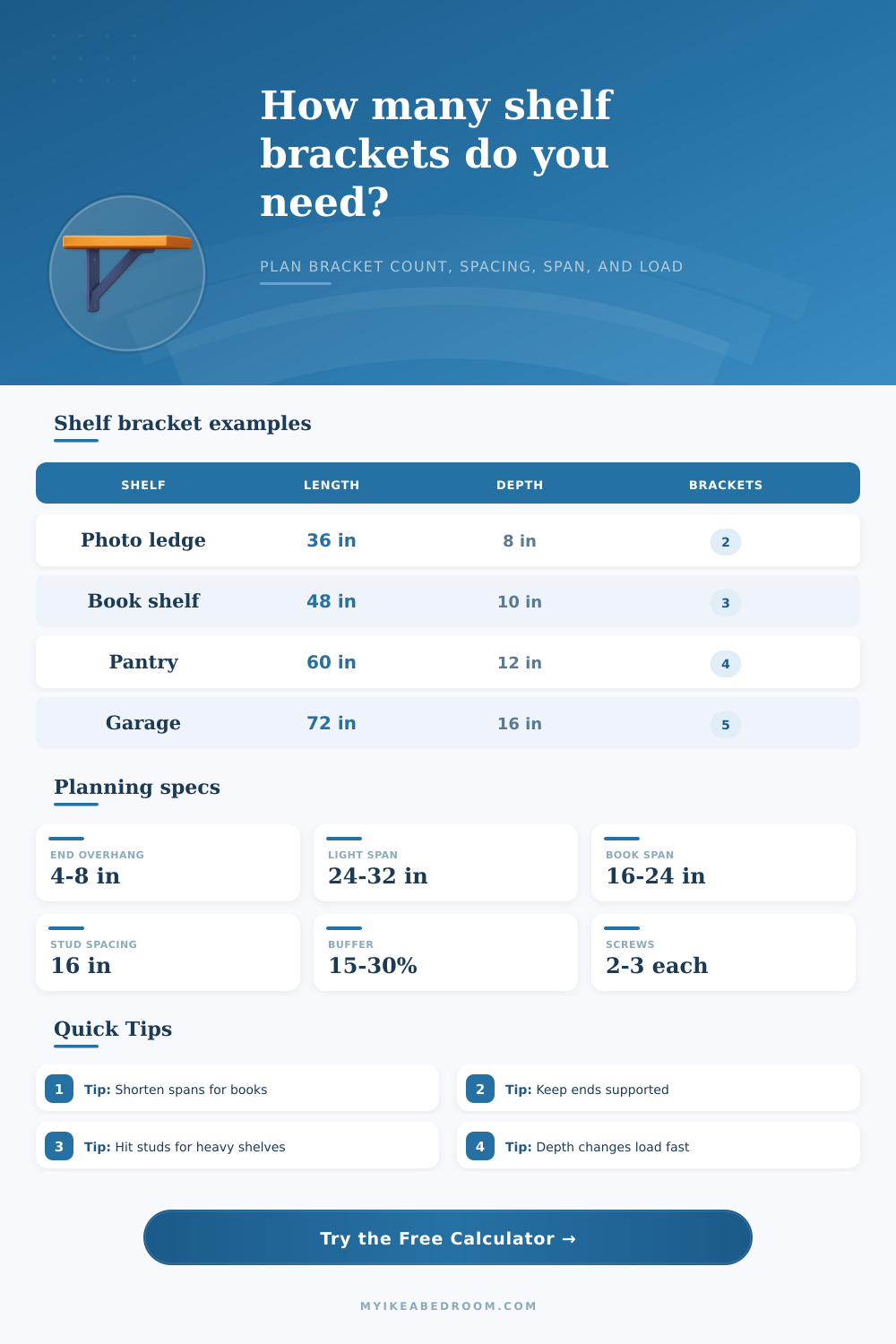
Shelf Bracket Quantity Calculator
Estimate bracket count, center spacing, end overhang, load capacity, stud alignment, and screw count for floating, decorative, pantry, closet, office, bedroom, and utility shelves.
Choose a real shelf scenario, then adjust the shelf length, depth, material, loaded weight, bracket type, wall support, and safety buffer.
| Shelf load type | Typical load density | Suggested centers | Bracket note |
|---|---|---|---|
| Light display | 5 to 10 lb per foot | 24 to 32 in | Decorative brackets can work when the shelf is shallow. |
| Frames and small objects | 10 to 15 lb per foot | 24 to 30 in | Use even spacing and keep end overhang modest. |
| Books or files | 20 to 35 lb per foot | 16 to 24 in | Count load, sag span, and bracket rating together. |
| Pantry cans and jars | 25 to 45 lb per foot | 14 to 20 in | Prefer studs, blocking, masonry, or a rail system. |
| Garage bins or tools | 35 to 60 lb per foot | 12 to 18 in | Use heavy-duty brackets and a high safety buffer. |
| Material | Relative stiffness | Default span factor | Best bracket habit |
|---|---|---|---|
| Particleboard or melamine | Lower | 0.78x | Add brackets sooner for books or wide shelves. |
| MDF board | Lower to medium | 0.84x | Limit deep shelves and point loads. |
| Plywood | Medium | 1.00x | Good general baseline for adjustable shelving. |
| Solid softwood | Medium | 1.05x | Works well for display or closet storage. |
| Solid hardwood | Higher | 1.18x | Can tolerate more span if the wall support is strong. |
| Laminated panel | Higher | 1.12x | Use consistent bracket centers to prevent twist. |
| Shelf length | Light display | Books or pantry | Utility storage |
|---|---|---|---|
| 24 in / 61 cm | 2 brackets | 2 brackets | 2 to 3 brackets |
| 36 in / 91 cm | 2 brackets | 3 brackets | 3 brackets |
| 48 in / 122 cm | 3 brackets | 3 to 4 brackets | 4 brackets |
| 60 in / 152 cm | 3 brackets | 4 brackets | 5 brackets |
| 72 in / 183 cm | 4 brackets | 5 brackets | 5 to 6 brackets |
| 96 in / 244 cm | 5 brackets | 6 to 7 brackets | 7 to 8 brackets |
| Wall layout | Bracket rhythm | What to check | Best use |
|---|---|---|---|
| 16 in studs | Every stud or every other stud | Center brackets within the shelf width and keep ends supported. | Books, pantry, closet, laundry, and office shelves. |
| 24 in studs | Each stud plus added support | A long shelf may need an extra anchor or rail between studs. | Light display or reinforced utility shelves. |
| Drywall anchors | Shorter spacing | Use lower load assumptions and avoid heavy point loads. | Frames, small decor, and shallow ledges. |
| Masonry anchors | Even layout | Place brackets to suit shelf load and drilled anchor spacing. | Dense pantry, garage, or workroom shelves. |
| Continuous rail | Rail slots | Fasten rail to studs, then place clip brackets for the shelf load. | Adjustable storage and long runs. |
Best for: ledges, frames, light bedroom shelves.
Watch: shallow arms and low bracket ratings.
Best for: books, pantry goods, laundry supplies.
Watch: spacing still matters more than strength alone.
Best for: thick display shelves with hidden supports.
Watch: depth leverage and exact stud alignment.
Best for: adjustable shelves and long storage runs.
Watch: rail fasteners carry the shared load.
Support the shelf ends first. The calculator limits end overhang before it checks center spacing, because unsupported ends make even a strong shelf feel springy.
Let the load type set the spacing. Books, jars, wet plants, and bins create dense or point loads, so the recommended count may rise even when the bracket rating looks generous.
A sagging shelf or a shelf that pull away from a wall is usually not caused by a defect in the shelf board itself. A sagging shelf or a shelf that pull away from a wall is usualy caused by the number of bracket used to hold the shelf and the placement of those brackets. A shelf will remain level under a load if you manage the spacing of the brackets, the overhang of the shelf, and the weight capacity of the wall.
These three factors are more important than thickness of the shelf board or the appearance of the brackets. The length of the shelf are one of the primary factors that affects how a shelf will behave under a load. A short shelf board may remain level on two brackets.
How to Stop a Shelf from Sagging
However, any shelf board that is longer than four feet will begin to act like a bridge. For a long shelf board, the distance between the two brackets is the limiting factor. The depth of the shelf also plays a role in how stable the shelf will be.
The depth impacts the shelf in a different way than the length of the shelf. Every additional inch of shelf depth will increase the leverage on each of the shelf brackets. For instance, a shelf that is twelve inches in depth and is loaded with can will have more leverage on each of the brackets than a shelf that is eight inches in depth and is loaded with photos.
To ensure that the shelf will be strong enough to hold the items that will be placed on the shelf, a calculator can help determine the number of brackets that is required to support the shelf. Another factor to consider when installing a shelf is the support that the wall will provide. Many people dont consider this one of the important factors in ensuring that the shelf will remain stable.
The studs in the wall are typically placed sixteen inches apart. If the wall is drywall and there are no studs, then the items on the shelf will significantly affect the safety of the shelf. The same shelf bracket can hold a lot of weight when you screw it into a stud but not hold as much weight when it is screwed into drywall.
Adding a safety buffer to the shelf will provide a margin of error in the load that the shelf will carry. Another factor that will impact the shelf is the type of bracket that is used. The style of the bracket do play a role in the shelf, but not in the way that many people may expect.
For instance, L-brackets may look great on a shelf that is narrow in width. However, they may be a poor choice for the type of shelf that is to bear heavy loads. The short arm of an L-bracket limits the load that it can take.
A triangular bracket can take more weight than an L-bracket. However, if the shelves are too far apart, a triangular shelf bracket will also not prevent the shelf from flexing. The strength of the shelf bracket and the load that it is expected to take will determine the type of bracket that must be used for the shelf.
The overhang that is placed on each end of the shelf can be a problem if it is too large. If you leave too large of an overhang on the shelf, the unsupported end of the shelf will begin to twist the fasteners that are securing the shelf to the wall. By keeping the overhang modest, you will prevent this problem.
Furthermore, the alignment of the studs in the wall is another consideration. If the brackets are placed next to a stud in the wall, the shelf will remain on the wall. However, if the shelf brackets are placed between studs, the drywall will have to bear the weight of the shelf.
A shelf that is bearing the load on drywall will have a falling capacity. Another factor that can influence the distance between the brackets on a shelf is the material that the shelf is made of. If a shelf is made of plywood or hardwood, it can tolerate a wider distance between the brackets than particleboard or MDF materials.
Plywood and hardwood shelves can bend less than particleboard or MDF shelves. This is especially true for long shelves or deep shelves. In the formula that calculates the number of brackets that will be used on a shelf, the material can be adjusted.
The calculator will change the number of brackets that is required if a certain material is selected for the shelf. Many people will keep adding brackets to a shelf until it feel sturdy to the touch. However, the load on the shelf may change in the future.
A shelf that is used to hold light items may have items of a heavier weight placed on it in the future. Items like boxes are much heavier than items like sweaters. Furthermore, a shelf that is used to hold items like spices may have to bear the load of items like gallon jars in the future.
A safety buffer can be built into the shelf design from the start so that people dont have to add more brackets to the shelf later on in the future when the load on the shelf may increase. Furthermore, a safety buffer can also account for the non-perfect dryness or centering of the shelf. To successfully install a shelf, you should measure the length and depth of the shelf.
Furthermore, the type of items that the shelf will hold should be decided. Then the type of support that the wall can provide should be checked. Once the length, depth, items, and wall support have been measured or checked, the number and placement of the shelf brackets can be calculated.
You should of checked the wall first.