Floating Shelf Hanging Height Calculator
Estimate shelf bottom height, top edge, bracket or rail wall mark, object clearance, reach comfort, and stacked shelf spacing from the measurements that matter before drilling.
Pick the closest wall situation, then adjust shelf thickness, hardware offset, furniture clearance, object height, and stacking details.
| Room use | Bottom edge range | Clearance basis | Planning note |
|---|---|---|---|
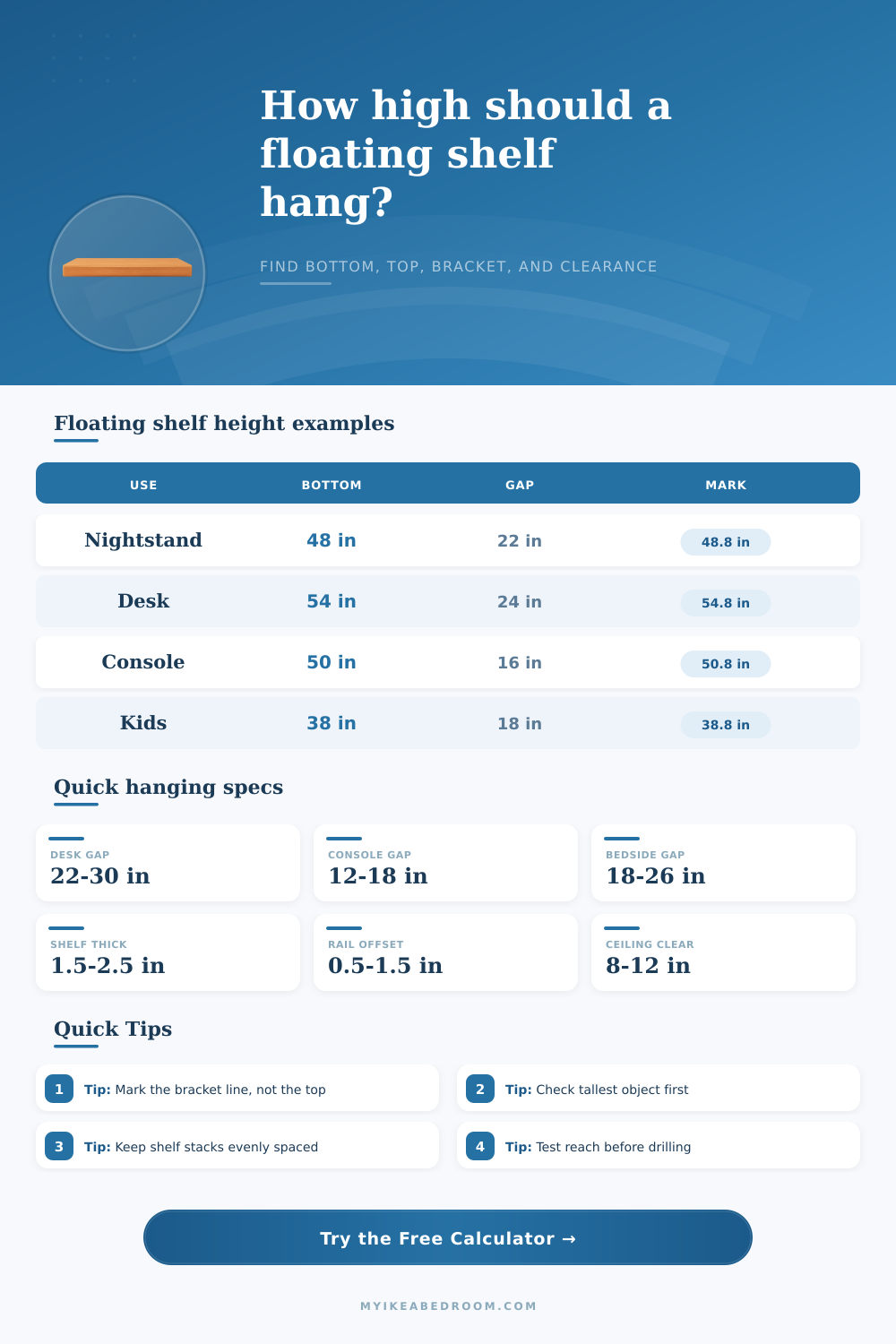
| Nightstand or bedside wall | 44-54 in | 18-26 in above top | Check lamp shade height and seated sight line. |
| Desk or home office wall | 52-62 in | 22-30 in above desktop | Leave room for monitor arms, task lights, and standing posture. |
| Entry console or sideboard | 46-58 in | 12-20 in above top | Lower shelves feel connected to the furniture below. |
| Kitchen counter shelf | 54-66 in | 18-24 in above counter | Keep mugs and jars reachable without crowding prep space. |
| Kids book display | 32-44 in | 14-22 in above low furniture | Set the first ledge low enough for the child to see covers. |
| Bathroom over toilet | 50-66 in | 10-18 in above tank | Allow tank access and towel height before setting the bracket line. |
| Mount style | Usual mark offset | Wall mark means | Measure from |
|---|---|---|---|
| Hidden rods or pins | 0.5-1.5 in above bottom | Rod centerline or bracket hole line | Shelf bottom edge upward |
| Hidden rail or cleat | 1.0-2.0 in below top | Rail screw line or cleat top reference | Shelf top or back channel |
| Keyhole slot | 0.5-1.25 in below top | Screw head centerline | Top edge down to slot center |
| Visible L-bracket | 0-0.5 in below bottom | Upper bracket screw or shelf support line | Shelf bottom edge |
| Picture ledge screw line | 0.75-1.75 in above bottom | Back lip screw line | Bottom or lower lip of ledge |
| Objects on shelf | Object height | Open gap to use | Best for |
|---|---|---|---|
| Small frames, candles, low boxes | 5-8 in | 10-12 in | Compact gallery ledges and narrow shelves. |
| Paperbacks, mugs, toiletries | 7-10 in | 12-15 in | Kitchen, bathroom, and daily storage shelves. |
| Hardcover books or tall jars | 9-12 in | 14-18 in | Office shelves and pantry-style wall storage. |
| Plants, tall frames, baskets | 12-18 in | 18-26 in | Feature walls where breathing space matters visually. |
| Project | Furniture top | Shelf bottom | Bracket mark |
|---|---|---|---|
| Bedroom nightstand shelf | 26 in | 48 in | 48.8 in hidden rod line |
| Home office desk shelf | 30 in | 54 in | 55 in rail screw line |
| Entry console shelf | 34 in | 50 in | 50.8 in keyhole line |
| Kitchen counter mug shelf | 36 in | 58 in | 58.8 in rod line |
| Kids room book ledge | 20 in | 38 in | 39.1 in ledge screw line |
Best input: furniture top plus open gap.
Use when a bed, desk, dresser, counter, toilet tank, or console visually anchors the shelf.
Best input: user height and object height.
Good for photo ledges and decorative shelves where the display center matters more than storage reach.
Best input: primary user height and reach mode.
Useful for mugs, towels, closet accessories, and other items handled often.
Best input: shelf count and shelf-to-shelf gap.
Checks the highest top edge and warns when objects, ceiling clearance, or reach get tight.
Transfer the real hardware offset. Hold the bracket, rail, keyhole slot, or ledge against the shelf and measure the mark line from the shelf bottom before using the result.
Mock up the bottom edge first. Tape the shelf bottom height on the wall, then place the tallest object below the upper limit to confirm the spacing feels usable.
Calculating the correct height for an floating shelf is important for several reason. The height of a floating shelf will affect how the floating shelf interacts with the furniture in the room and how the floating shelf function for the individual that fills the room. If a floating shelf is hung too low to the floor it will tend to crowd the furniture underneath the floating shelf.
However, if the floating shelf is hung too high to the floor it may be difficult for the individual to reach the floating shelf, or it may appear like the shelf is floating in empty space. The calculator located on this page will help to convert your current measurements of the space to be occupied by the floating shelf to the measurements that is required for installation of the floating shelf. Many individuals will begin to calculate the height for their floating shelf by measuring the furniture that is located underneath the floating shelf.
How to Find the Right Height for a Floating Shelf
The distance between the top of the piece of furniture and the bottom of the floating shelf is used to determine whether a lamp will fit beneath the shelf and whether the floating shelf should appear connected to the furniture beneath it. The calculator will request that you enter the height of the furniture that will be beneath the floating shelf and the height of the gap that you would like to create between the furniture and the floating shelf; the calculator will then provide you with the height at which the bottom of your floating shelf should be installed. The height of the gap between the furniture and the floating shelf is a critical measurement; if the gap is too narrow the floating shelf may appear crowded beneath the furniture, while if the gap is too wide the floating shelf may appear as if it do not belong to the furniture beneath it.
The thickness of the floating shelf that you plan to install is another measurement that you should consider when determining at what height you will install your floating shelf. The thickness of the shelf will impact the visual appearance of the shelf; a thick shelf may appear to occupy less height within the room than a thin shelf, even if the shelves is installed to the same height. While the calculator will request your shelf thickness separately from your bracket offset, the thickness of the shelf is a separate measurement to the offset of the shelf brackets.
The offset of the shelf brackets is the distance from the bottom of the shelf to the mark that you will make on the wall where you will install the brackets; knowing this measurement is important due to the fact that different shelf hardware will have different offsets to its brackets; installing shelf brackets to the wrong mark on the wall will result in the shelves being installed into the wrong location in the wall. In addition to calculating the height at which you will install your floating shelf, if you plan to install multiple floating shelves in your room the calculator can assist you in calculating the distance between those floating shelves. The distance between the top of one floating shelf and the bottom of the next shelf should be calculated to ensure that it can accommodate the items that you plan to store on that shelf.
Furthermore, the calculator will help to determine the distance between your objects and the next floating shelf to provide you with enough breathing room for those objects to avoid crowding the shelf beneath them. Additionally, the calculator will ensure that your highest floating shelf does not come into contact with the ceiling or hanging light fixture in the room. Another consideration in the calculation of the height of your floating shelf is the comfort of your reach to the shelf.
The calculator will request that you enter both your height in the room and your preferred reach mode; this will allow the calculator to calculate a height for your shelf that will be comfortable for you to reach. Daily use floating shelves should be placed at a lower height than those used for display purposes only; floating shelves that an individual uses more often should be placed at a lower height to that of floating shelves that are only used for display purposes. The reference tables located on this page provide typical height range for floating shelves in various types of rooms in the house; however, these tables provide no rules as to the heights that should be used for floating shelves.
These tables are merely starting points for individuals to understand some of the heights that have worked for others in the past. For instance, 48” is the typical height for a floating shelf that is to be placed next to a bed; placing the shelf at this height will allow the individual who is sleeping on the bed to reach the shelf to place items such as lamps or books upon it. Additionally, 54” is the typical height for floating shelves that are to be placed adjacent to the bed; the height of 54” will allow for the individual’s desk to remain clear of their monitor setup.
Each of these numbers will be helpful only after you have entered the heights of your furniture and the items that you would like to place upon the floating shelves. It is important to remember that the mark on the wall that represents the height of your floating shelf is not the same as the height of the top of the shelf; the top of the floating shelf may naturally be lower than the mark on the wall due to the thickness of the floating shelf. Additionally, it is important to avoid ignoring the height of the tallest object that will be placed upon the floating shelf when installing multiple floating shelves; the shelf height will need to provide enough space between floating shelves to account for that of the tallest object that will be stored on the floating shelf.
When you use the calculator on this page, you will ensure that your floating shelf feels as though it belongs in the room.