Gallery Wall Photo Quantity Calculator
Calculate how many photos, frame openings, collage mats, wall slots, and spare openings you need for a balanced gallery wall layout.
Load a real wall scenario, then tune the wall size, frame size, openings per frame, mat mix, gap, and spare slot buffer.
| Frame or mat type | Openings per frame | Best use | Counting note |
|---|---|---|---|
| Single opening frame | 1 | Portraits, art prints, travel photos | One frame equals one photo slot. |
| Double mat | 2 | Pairs, before and after, siblings | Count two photos even if it is one frame. |
| Three-opening mat | 3 | Trip sequences or theme groups | Useful for narrow hallway frames. |
| Four-opening collage | 4 | Family sets and travel clusters | Reduces frame count but increases print count. |
| Six-opening collage | 6 | Large family or yearly photo wall | Reserve extra spares so the mat does not feel unfinished. |
| Wall zone | Typical outside frame | Common gap | Likely frame grid |
|---|---|---|---|
| Small dresser wall, 48 x 32 in | 10 x 12 in | 1.5 to 2 in | 2 x 3 or 2 x 4 frames |
| Sofa wall, 84 x 48 in | 12 x 16 in | 2 to 3 in | 2 x 5 or 3 x 4 frames |
| Hallway strip, 108 x 30 in | 8 x 10 in | 1.5 to 2.5 in | 2 x 9 or 3 x 9 frames |
| Stair wall, 120 x 54 in | 11 x 14 in | 2 to 3 in | 3 x 7 with stepped alignment |
| Entry wall, 72 x 42 in | 12 x 12 in | 2 to 3 in | 3 x 4 with one anchor |
| Spare buffer | Use when | On 12 openings | On 24 openings |
|---|---|---|---|
| 0% | Finished art set with no rotation | 0 spare | 0 spare |
| 10% | One or two future photos | 2 spare | 3 spare |
| 15% | Seasonal swaps or new prints | 2 spare | 4 spare |
| 20% | Family wall that will grow | 3 spare | 5 spare |
| 25% | Rotating memory wall | 3 spare | 6 spare |
| Project | Layout target | Photo count range | Frame count range |
|---|---|---|---|
| Bedroom dresser wall | Balanced rectangle over furniture | 4 to 10 photos | 4 to 8 frames |
| Living room sofa wall | Wide rectangle or loose grid | 8 to 20 photos | 6 to 12 frames |
| Hallway memory wall | Long strip with small frames | 12 to 30 photos | 10 to 20 frames |
| Stair wall | Stepped grid or diagonal run | 10 to 28 photos | 8 to 16 frames |
| Entryway statement wall | Anchor frame plus smaller pieces | 6 to 18 photos | 5 to 10 frames |
Best for: clean grids, equal spacing, and one favorite image per frame.
Count logic: frame count and photo count are nearly the same.
Best for: family sets, trips, school years, and compact walls.
Count logic: fewer frames, more photo openings.
Best for: a focal print with smaller supporting photos around it.
Count logic: anchors use wall slots but may hold one photo.
Best for: growing family walls and seasonal print rotations.
Count logic: buy openings now, print fewer photos today.
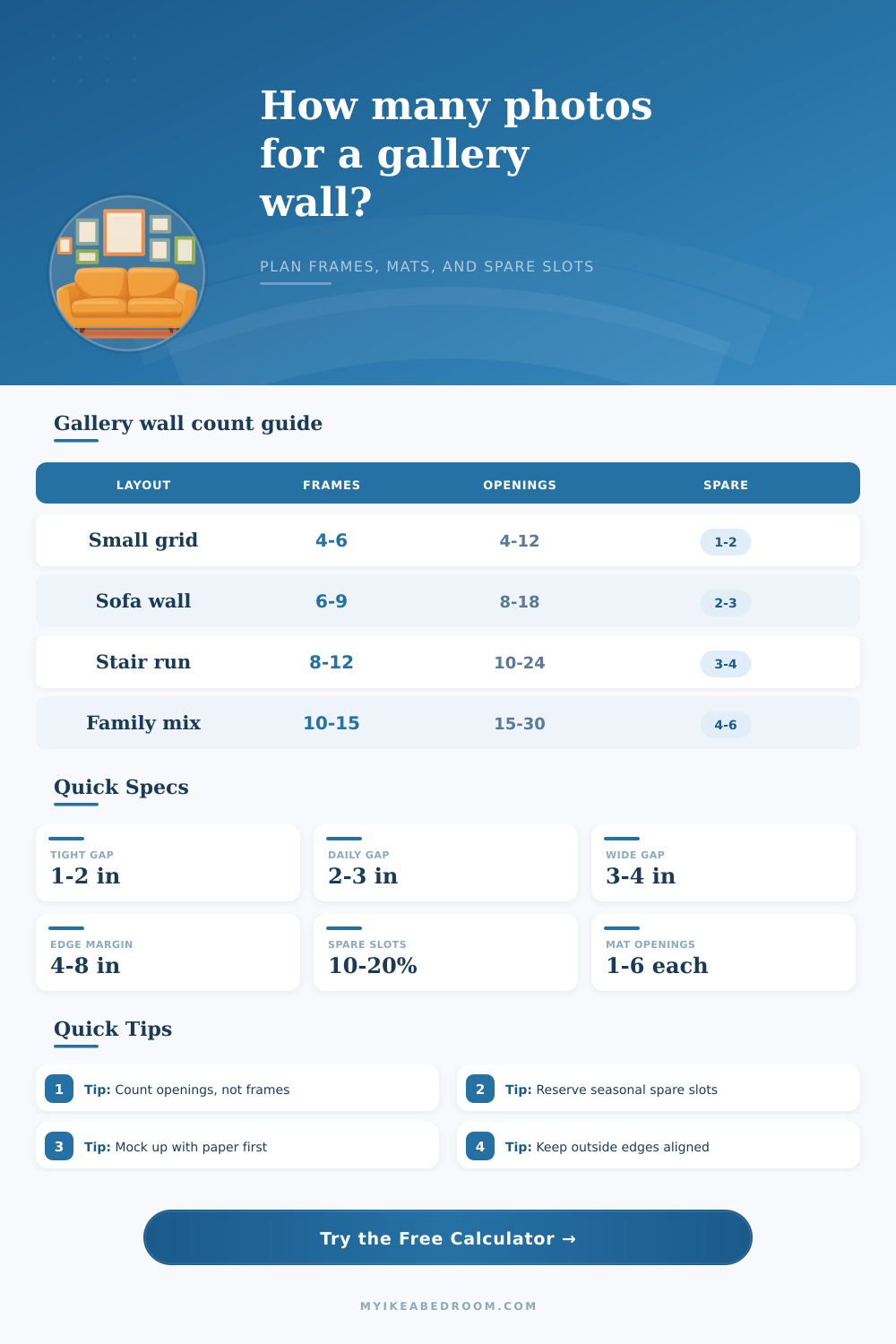
Count openings before ordering prints. A six-frame wall can need six photos, twelve photos, or more if several frames use collage mats.
Keep a small spare slot buffer. Empty openings are easier to fill later than adding mismatched frames after the wall is already hung.
Creating a gallery wall require taking precise measurement of the space and counting the item that will be on the wall. You will have to decide how many photograph will go on the wall and how many frame are required for those photographs. Creating a gallery wall can be difficult due to the various element in a room that must be accounted for when making measurements of the wall.
The usable space on the wall will determine both the number of frames that can go on the wall and the space between each frame. Ensuring that there is some space between the frames is crucial, as providing too much space between frames make the gallery wall look sparse of photographs, whereas too little space between frames makes the gallery look crowded. The best space to provide between the frames is two to three inches.
How to Plan a Gallery Wall: Frames and Photos
If using larger frame, though, it is appropriate to provide more space between the frames to allow the wall to remain visually balanced. Another visual element to consider is employing collage mats within the frames. Incorporating collage mats into the frames will alter the number of frames needed for the gallery wall and the total number of photographs to be order.
Using a collage mat will allow for multiple photographs to be place within one frame. While this reduce the total number of frames required for the wall, it will increase the number of photographs to be ordered for the wall. When creating the gallery wall, it is essential to consider both the number of frames and the number of photo slot that will be on the wall.
It is also necessary to provide some slots for photographs left empty to provide a buffer for future photographs to be added to the wall. Providing a buffer of ten to fifteen percent of the total number of slots allow for the addition of new photos later without changing the gallery wall. While some might desire there gallery wall to remain the same in their home for many years, others will desire their gallery to change with the growth of their family.
Gallery walls can incorporate anchor frames, which will replace the number of smaller frame required on the wall. Using an anchor frame is helpful for those with a specific large photograph but will reduce the number of frames that will be use on the wall. It is crucial to recognize the difference between the number of frames and the number of photo slots on the wall.
These two value are not the same. For instance, the number of frames on the wall could be six, but the total number of photos on the wall could be twenty-four if each frame include collage mats. Using a calculator to track the number of frames and the number of photo slots will allow an individual to accurate determine how many photos to order for the wall and how many slots to leave empty for the future.
Common mistakes when creating a gallery wall are treating the project as a complete project that will not change. If the frames are place tightly on the wall and if all of the photos are ordered at once, there will not be time to add more photos to the wall in the future. If there is no room for the new photos, the photos can either be crowded with the existing frames or may sit in a drawer unused.
A way to avoid this mistake is to provide a buffer of empty slots for the photos and to understand how many slots each frame will provide for the photos to be placed. In some instances, the gallery wall may have to change due to the movement of the furnitures in the room or the addition of new member to the growing family. If the family is to grow, there may be an adjustment in the number of rows of photographs or the size of the photos for the new members of the family.
It is a good idea to keep the original measurements of the wall and the count of the number of photo slots somewhere in a safe place so that adjustments may be made to the gallery wall in the future. Overall, creating a gallery wall requires consideration of the number of frames and slots for the photos to be arranged in a visual pleasing manner while leaving some slots for the future photos to be added to the wall. You should of thought about these things before you start.
Its a lot of work but it looks luxurius when its done.