Bookshelf Speaker Spacing Calculator
Plan a stereo bookshelf speaker layout from listening distance, triangle shape, toe-in aim point, rear and side wall clearance, shelf height, and tweeter position.
Pick the closest real-world setup, then tune the measurements to match your shelf, desk, media unit, or bedroom seating position.
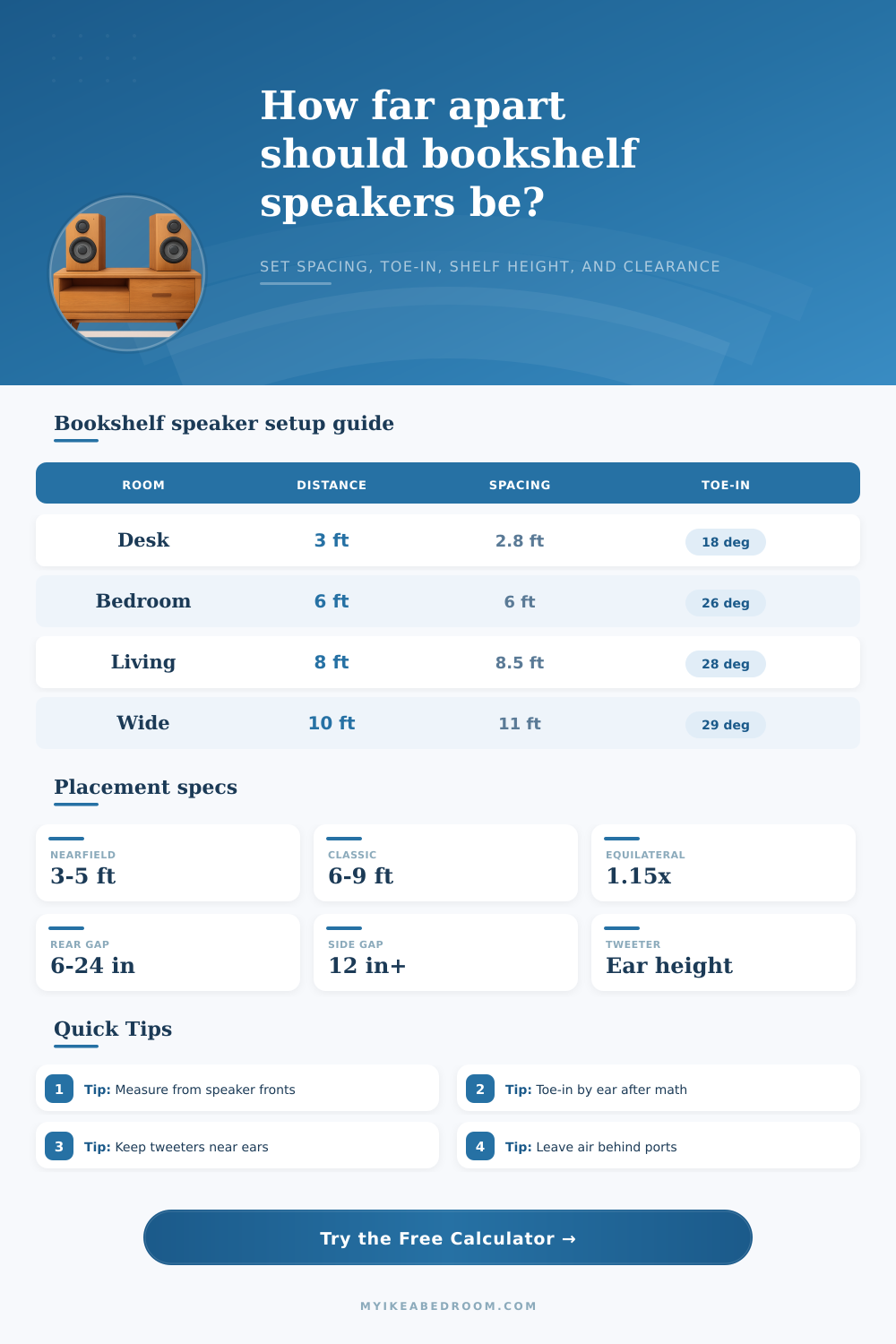
| Listener distance | Nearfield 0.95x | Classic 1.05x | Equilateral 1.15x | Wide 1.22x |
|---|---|---|---|---|
| 3 ft / 0.9 m | 2.9 ft | 3.2 ft | 3.5 ft | 3.7 ft |
| 5 ft / 1.5 m | 4.8 ft | 5.3 ft | 5.8 ft | 6.1 ft |
| 7 ft / 2.1 m | 6.7 ft | 7.4 ft | 8.1 ft | 8.5 ft |
| 9 ft / 2.7 m | 8.6 ft | 9.5 ft | 10.4 ft | 11.0 ft |
| 11 ft / 3.4 m | 10.5 ft | 11.6 ft | 12.7 ft | 13.4 ft |
| Speaker type | Rear clearance target | Side clearance target | What to listen for |
|---|---|---|---|
| Rear ported | 18-24 in / 46-61 cm | 12 in+ / 30 cm+ | Boomy upper bass when too close to the back wall. |
| Front ported | 8-12 in / 20-30 cm | 10 in+ / 25 cm+ | Usually more forgiving on shelves and media units. |
| Sealed cabinet | 6-10 in / 15-25 cm | 10 in+ / 25 cm+ | Boundary gain can help bass, but corners still thicken sound. |
| Passive radiator | 12-18 in / 30-46 cm | 12 in+ / 30 cm+ | Needs breathing room if the radiator faces rear or side. |
| Unknown type | 12-18 in / 30-46 cm | 12 in+ / 30 cm+ | Start conservative, then move by small increments. |
| Tweeter offset vs ear | Placement grade | Suggested fix | Angle note |
|---|---|---|---|
| 0-2 in / 0-5 cm | Excellent | Keep the shelf height as-is. | Little or no vertical tilt needed. |
| 3-6 in / 8-15 cm | Good | Use small isolation pads or a mild tilt. | Aim toward ear height if the sound is dull. |
| 7-12 in / 18-30 cm | Usable | Raise, lower, or angle the speaker more deliberately. | Vertical aim becomes audible near the crossover region. |
| Over 12 in / 30 cm | Needs adjustment | Use stands, lower shelf, risers, or wedge pads. | Expect weaker imaging unless the speaker is angled. |
| Aim point | Typical toe-in | Center image | Soundstage feel |
|---|---|---|---|
| Aim straight ahead | 0-8 deg | Looser center | Wider but less focused. |
| Aim just behind listener | 18-26 deg | Stable center | Balanced for many rooms. |
| Aim at listener | 22-32 deg | Strong center | Precise but can narrow stage. |
| Cross in front | 28-40 deg | Very locked center | Useful for hard side walls or close listening. |
Measure from acoustic centers when possible. Center-to-center spacing is more useful than cabinet-edge spacing, especially when the baffle is wide or the speakers sit inside shelf cubbies.
Move in small steps after calculating. Shift spacing, toe-in, and rear clearance by 1 to 2 inches at a time, then listen for center vocal focus and bass evenness.
The placement of bookshelf speaker will have a critical effect upon the sound quality that is emitted from the bookshelf speaker system. The placement of bookshelf speakers is often more important then the price of the bookshelf speaker systems. Many people attempts to place their bookshelf speakers by guessing the measurement necessary to achieve the best sound from the speakers.
Such a guess can lead to an out of focus image from the bookshelf speakers, especially in there center image and with their bass output. In order to achieve the best sound from the bookshelf speakers, you should consider the distance between the bookshelf speakers, the distance of the speakers from the wall, and the height of the speakers tweeter. One of the main suggestion for placing bookshelf speakers is that of creating an equilateral triangle between the listener and the two bookshelf speakers.
How to Place Bookshelf Speakers
The distance from the listener to each bookshelf speaker can determine the spacing between the two bookshelf speakers. The spacing between the bookshelf speakers can impact the width of the soundstage create by the speakers. For those who desire a soundstage with narrower focal point and less spread between the speakers, the speakers should be placed closer together.
For those who desire a wider soundstage, such as in a living room, the speakers should be placed further apart from each other. The angle that the bookshelf speakers are pointed can impact the sound that radiate from the speakers. This angle is referred to as toe in.
Pointing the speakers directly at the ears will create a tighter centered image from the speakers. However, if the speakers are pointed at a spot behind the head, the centered image will remain the same even if the listener move to different area within the listening area. The distance of the bookshelf speakers from the wall is another consideration in the placement of such speakers.
Bookshelf speakers that have ports on the rear of the speakers require more distance from the wall than those speakers that has ports on the front or that are sealed speakers. This is due to the need for the rear ports of those speakers to be able to move air freely. In addition to the distance of the speakers from the wall, the distance between the bookshelf speakers and the wall to the sides of the speakers also affect the sound of the speakers.
The bass portion of the speakers can become too loud if the speakers are too close to the walls to the side of the speakers. The height of the speakers should be adjusted to align with the ear of the listener. If the tweeters of the bookshelf speakers are not aligned with the ears of the listener, the vertical angle of the sound will change.
If the books are placed at too large of an angle from the listener ears, the upper frequency of the sound from the speakers can become dull. You can adjust the height of the bookshelf speakers using pads or wedge placed beneath the speakers, or by adjusting the height of the stands upon which the speakers are placed. Additionally, the shape and furniture within the listening area can impact the way that the bookshelf speakers will sound.
Such furniture as bookshelves, sofas, and curtains can impact the way that the sound reflect within the listening area. The corners of a listening area can also contain more bass than other area within the same room. These variable are difficult to calculate for each individual listening area.
Calculations can be made for the initial placement of the bookshelf speakers. Afterwards, the listeners can begin to move the speakers in increments of an inch or two until the sound is deem best. The speakers should be placed such that the center image is centered and the bass is even throughout the listening area.