TV Viewing Distance by Size Calculator
Estimate the best sofa-to-screen distance from TV diagonal, resolution, target field of view, seating depth, wall clearance, and room limits.
Choose a common room setup, then adjust the diagonal, resolution, field of view, and measured seating depth to match your layout.
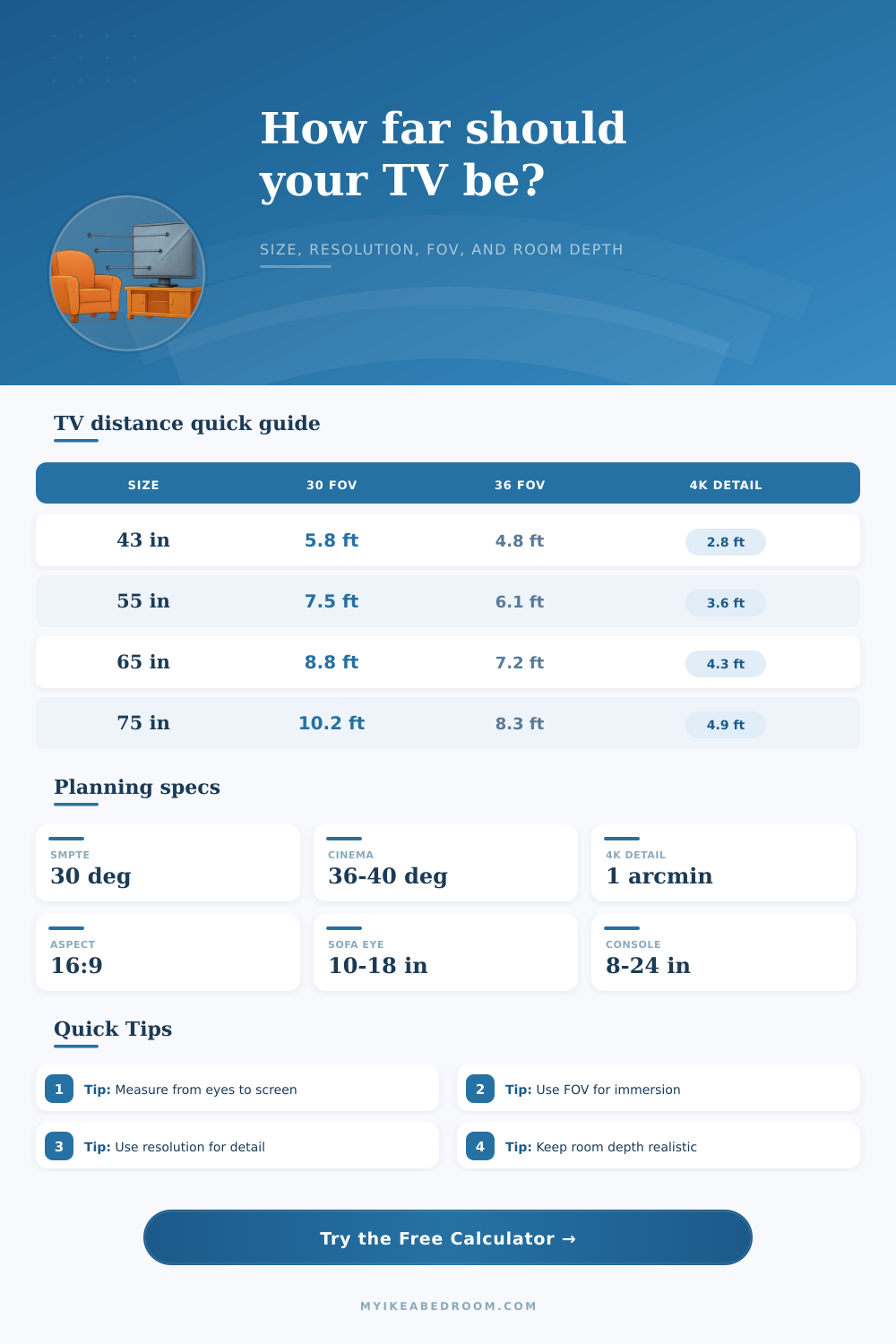
These cards compare your current TV size across common planning standards, plus the distance where resolution detail is most noticeable.
About 30 degrees, useful for news, sports, and mixed seating.
About 36 degrees, often a strong living-room movie target.
About 40 degrees, closer and more theater-like for one main row.
Distance where the selected resolution can still add visible detail.
| TV diagonal | Approx screen width | 30 deg distance | 36 deg distance | 40 deg distance |
|---|---|---|---|---|
| 43 in | 37.5 in | 5.8 ft | 4.8 ft | 4.3 ft |
| 50 in | 43.6 in | 6.8 ft | 5.6 ft | 5.0 ft |
| 55 in | 47.9 in | 7.5 ft | 6.1 ft | 5.5 ft |
| 65 in | 56.7 in | 8.8 ft | 7.3 ft | 6.5 ft |
| 75 in | 65.4 in | 10.2 ft | 8.4 ft | 7.5 ft |
| 85 in | 74.1 in | 11.5 ft | 9.5 ft | 8.5 ft |
| FOV target | Viewing feel | Best use | Room planning note |
|---|---|---|---|
| 26 to 30 deg | Relaxed and easy | Casual TV, news, sports, multipurpose rooms | Works well when seats are spread across the room. |
| 32 to 36 deg | Balanced and cinematic | Living rooms, mixed streaming and movies | A practical target for one main sofa distance. |
| 38 to 40 deg | Immersive theater feel | Movie rooms, large screens, projector walls | Can feel intense for fast games or off-axis seats. |
| 42 deg or more | Very close and enveloping | Dedicated media seats, short viewing sessions | Check comfort before buying a larger screen. |
| Resolution | Pixel columns | Detail distance rule | What it means |
|---|---|---|---|
| 720p HD | 1280 | Farthest detail distance is shorter | Sit farther and image detail will be limited by resolution. |
| 1080p Full HD | 1920 | Good for smaller TVs and moderate distances | Large screens may show softness when viewed close. |
| 4K UHD | 3840 | Supports closer seats and larger screens | Often useful when FOV is in the 34 to 40 degree range. |
| 8K UHD | 7680 | Very close detail threshold | Room size and content quality usually matter more than pixels. |
| Measurement | Typical amount | Add or subtract | Why it matters |
|---|---|---|---|
| Screen face offset | 2 to 24 in | Subtract from room depth | The distance begins at the visible screen plane, not the wall. |
| Eye setback from sofa back | 10 to 18 in | Subtract from room depth | Your eyes sit forward of the back cushion. |
| Rear recline or walkway reserve | 0 to 36 in | Subtract from room depth | Moves the seating position closer to the TV. |
| Floating sofa gap from back wall | 6 to 24 in | Subtract if measured to wall | Keeps furniture placement realistic before buying a larger TV. |
Measurement tip: Measure from the screen face to your eyes in the main seated position. Wall-to-wall room depth can overstate the real viewing distance by a foot or more.
Comfort tip: Use field of view for the overall size decision, then check resolution distance as a detail limit. A huge screen can fit mathematically and still feel too close for daily viewing.
The distance between a sofa and a television influence how a person perceives teh television picture. The distance between the sofa and the television will determine if the television screen is too large or too small for the viewing area. If the distance between the person and the television is too large, the size of the television screen will be too small to provide an adequate viewing experience.
If the distance between a person and the television is too small, the picture on the screen will be overwhelming for the person as the individual pixel on the screen will be visible. The size of the television screen that a person purchase should be based off the distance between the sofa and the television screen as this distance will determine the way in which the individual views the television picture. Another factor to consider in determining the distance between the television screen and the viewing area is the calculator’s recommendation of the depth of the room.
How to choose the right TV size for your room
In addition to the depth of the room, however, there are other measurement of the room that must also be considered. The television screen sit on a stand or mounted on the wall in such a way that it sits several inches in front of the wall. Additionally, a person’s eyes should be in front of the back of the sofa.
Thus, the distance between a person’s eyes and the television screen is slightly less than the distance between a person and the sofa. Finally, persons may need to leave space in the room for walk or reclining on the sofa. Thus, the depth of the room in which a person plans to place the television may need to be adjusted to account for these measurements as well.
As such, two rooms with the same depth may require different television screen size in order to accommodate these factors. The field of view that a television provides to a viewer is another measurement that can be used to determine the size of the television screen that is needed for the viewing area. Field of view is the measurement of the portion of a viewer’s vision that the television screen appears to occupy.
Wide fields of view are desirable for those who wish to feel more immersed in the content that is playing on the screen. Such fields of view are desirable for viewing movies but may not be desired for viewing sports or the news. Field of view calculator allow persons to test out different fields of view settings for the television to determine what field of view best fits the room in which the television screen will be placed.
The resolution of the television screen may also have an influence upon the distance between the television screen and the viewers. The resolution of the screen is the number of pixels that are visible to the viewer. Televisions with higher resolutions allow persons to sit closer to the screen without the pixels becoming visible to the viewers.
High resolution televisions will maintain the quality of the image even when the viewer is very close to the screen. Televisions with higher resolutions has more pixels on the screen. For example, a 4K television screen will have more pixels than an older television screen of the same size.
Thus, a 4K television screen can be placed closer to a viewer than an older television screen of the same size. The television screen size calculator will indicate the distance at which the additional resolution of the screen provides no additional benefit to the viewers. Beyond this distance, screen size and seating comfort become the factor to consider when purchasing a television screen.
Many individuals decide upon the size of a television screen based upon the advertised diagonal size of the screen. In many cases, however, viewers find that the size of the screen that they desire for their room does not accommodate the diagonal size of the television screens that is advertised. A television screen that is too large for the field of view that is to be created for the screen may be too large for those who wish to view the screen from close distance.
In contrast, a television screen that may appear to be small in size may end up dominating the viewing area within the room once the individual correctly measure the depth of the room. By measuring the dimensions of the room prior to purchasing a television screen, individuals can avoid potential surprise after the purchase of the screen. The priority settings within the screen size calculator allow individuals to make a choice based upon the specific need of the room in which the television screen will be placed.
Some rooms may be used for features with a wide fields of view, while other rooms may be used for other features that require the size of the television screen to be larger while taking into account the distance between the screen and the individuals who will view the screen. Additionally, other viewers may wish to place more importance upon resolution as a limiting factor when purchasing a television screen. Thus, there is no single correct answer to any screen size calculation, but instead the answer can vary based upon the way in which the room is to be used and for how long persons will sit in those viewing seat.
Once the individual has determined the distance at which the screen should be placed and the size of the screen that will fit into the viewing area, other choice become easier for the individual. For example, the person can more easily determine if the viewing area will be used for more of a relaxed viewing experience or a more cinematic viewing experience. Additionally, it will be possible to determine if the current furniture in the room allow for the screen of the size that has been calculated.
Furthermore, it will be possible to determine if moving the sofa forward in the room will provide a better field of view for those who wish to view the screen. Thus, the individual will have a better understanding of what television screen size will feel most naturaly within the room where it will be used.