Table Extension With Leaves Calculator
Plan an extendable dining table from base length, leaf count, leaf length, extension order, added seats, and storage space for loose or self-storing leaves.
Choose a table style, then adjust the measured base, individual leaf size, seating allowance, and storage slot.
Center leaves
Best when you want predictable staging: base table, then one leaf, then the next. Seating grows mostly along the long sides.
Drop leaves
Useful for compact rooms because each side can work as a separate stage. Check leg swing before counting every added seat.
Butterfly leaves
Usually self-storing, so storage count drops. The full length is still the base plus the unfolded leaf span.
| Leaf length | Typical use | Likely seat change | Planning note |
|---|---|---|---|
| 10 to 12 in | Small drop or console extension | Improves spacing or adds one tight place | Best for short meals, kids, or narrow chairs. |
| 14 to 16 in | Compact dining leaf | Often adds two side seats on longer tables | Check whether legs still leave clear knee space. |
| 18 to 20 in | Standard guest leaf | Usually adds a comfortable side-chair pair | Works well with 21 to 23 in place allowances. |
| 22 to 24 in | Large formal leaf | Adds two wider places or bigger serving gaps | Room clearance around the table becomes important. |
| Sequence | How length changes | Best for | Watch point |
|---|---|---|---|
| Base only | No leaves installed | Daily dining and small rooms | Use this count for normal chair storage. |
| One leaf | Base plus one leaf length | Adding a couple of guests | One center leaf may shift table legs or pedestal balance. |
| Two leaves | Base plus two leaf lengths | Family dinners and mixed chairs | Measure both leaf seams and latch gaps. |
| All leaves | Base plus every available leaf | Holiday or flexible gathering layouts | Check room clearance and storage for unused leaves. |
| Storage method | Leaves counted | Space to measure | Best practice |
|---|---|---|---|
| Self-storing frame | Leaves inside table do not need separate space | Internal slots and closing clearance | Confirm the table closes cleanly with each stored leaf. |
| Flat shelf storage | Every loose leaf stacks by thickness | Leaf length, width, and stacked height | Add padding between finished faces. |
| Vertical closet storage | Loose leaves stand on edge | Leaf width as height plus safe lean angle | Protect corners and avoid damp walls. |
| Mixed storage | Slots first, then loose leaves | Slot count and remaining stacked height | Label leaves if the sequence matters. |
| Mode | Place allowance behavior | Best for | Result tendency |
|---|---|---|---|
| Tight gathering | Uses your entered allowance directly | Occasional overflow, kids, flexible benches | Highest seat count, least elbow room. |
| Daily comfort | Adds a small buffer before counting | Everyday dining with normal side chairs | Balanced count for repeated use. |
| Relaxed dining | Adds extra spacing for longer meals | Adults, serving dishes, mixed chair widths | May reduce the count by one pair. |
| Formal settings | Uses the widest spacing buffer | Large plates, armchairs, full place settings | Lowest count, most comfortable layout. |
Sequence tip: Measure the table at every stage, especially if leaves are not identical. Some tables need a specific insertion order for pins, rails, or apron alignment.
Storage tip: Count only unused loose leaves in storage. Self-storing leaves reduce closet space, but they still need clean internal clearance before the table closes.
An extendable table is a piece of furnitures that can increase in length and an extendable table can decrease in length. When using an extendable table, there is several factor that must be considered, such as the added length of the extendable table, the number of people that will sits at the extendable table, and the storage requirement for the table leaves. These factors will determine whether the extendable table is functional for the user needs.
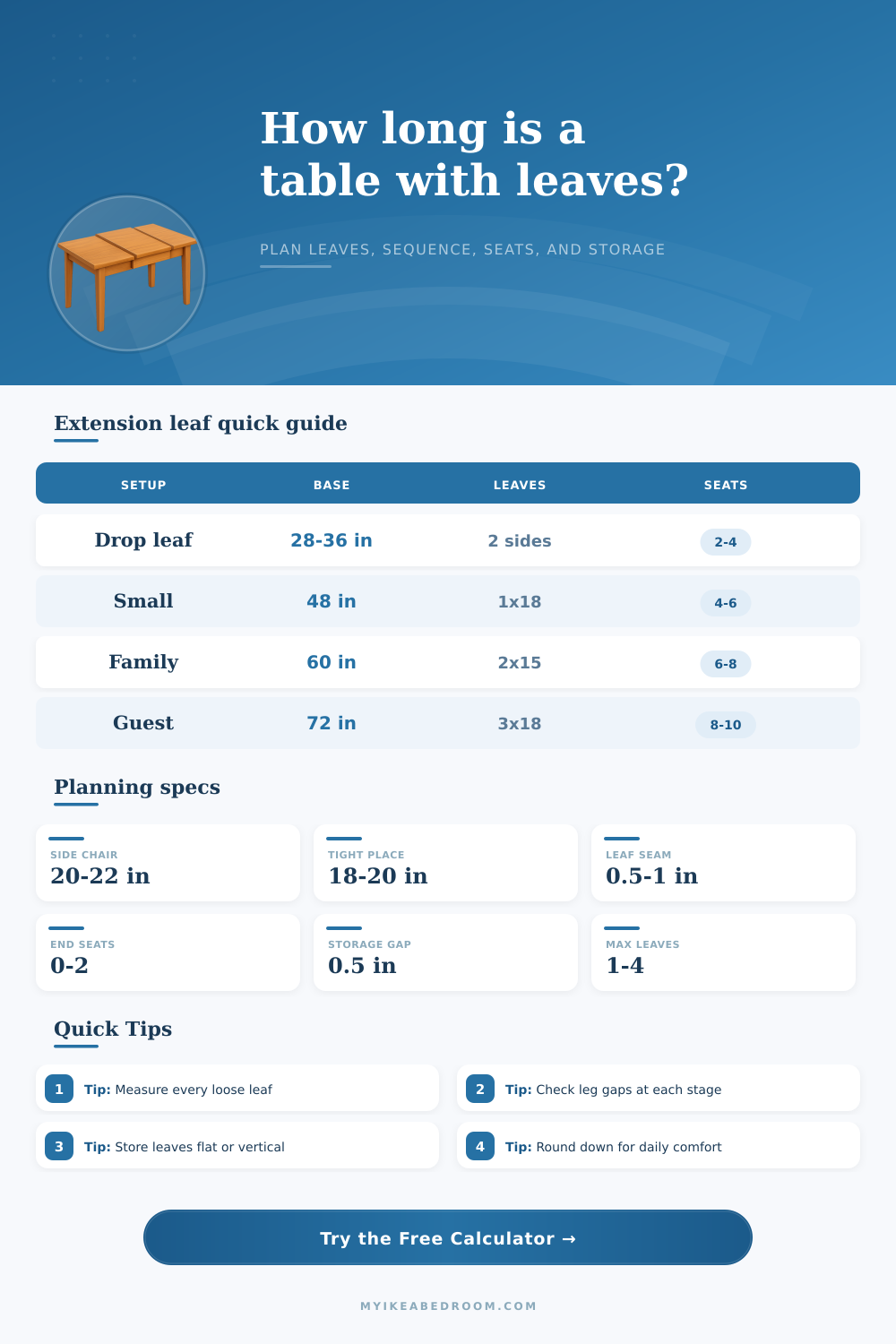
The length of the extendable table is determined by more than just the size of the table leaves. Each table leaf will have a specific measurement, but the length of the extendable table will be less than the total measurement of the table leaves due to the hardware that must be utilized to extend and contract the table. To determine the length of the extendable table that will be formed by the table leaves, a calculator can be used to account for the length of the base of the table, the size of each of the table leaves, and the amount of length that will be taken up by the seam between each leaf.
How to Choose and Measure an Extendable Table
If you determine the length of the leaves without accounting for these seams, the length measurement may be too optimistic for the extendable table. An extendable table’s seating capacity is a factor that many people tend to misjudge. An extendable table may be able to increase in length, but it does not necessarily mean that there will be an increase in the number of seat for people.
The legs or pedestal of the table may prevent individuals from sitting at one of the ends of the table. Additionally, the width of the table may not allow for a chair to be placed at one of the ends of the table when it is extended. In these cases, an extendable table that is 72 inches in length may have a seating capacity of eight when contracted, but the same extendable table may only have a seating capacity of six when extended due to the blocking of some of the length of the extendable table by its pedestal or legs.
These factors must be taken into account when purchasing an extendable table. The storage of the table leaves is one requirement that many people fail to consider until they are attempting to store their extendable table’s leaves. If the extendable table leaves are not self-storing, then you will need to store the leaves on a flat surface or a rack.
The amount of space that will be required to store the leaves will depend upon the thickness of each of the leaves and whether there is padding between each of the leaves. If the table features self-storing table leaves, the leaves will remain within the frame of the extendable table. However, self-storing leaves will require more space within the frame of the extendable table than non-self-storing leaves.
The tool can use the storage-type and slot-count fields to determine how many individual locations will be required to store each of the extendable table’s leaves. The different extensions of extendable tables include center leaves, drop leaves, and butterfly leaves. Center leaves extend the extendable table along each of its long sides.
Drop leaves are useful for small rooms since each side of the drop leaf can be raised to extend the table independently of the other side of the drop leaf. Butterfly leaves are leaves that are stored within the frame of the extendable table when not in use. The leaves will take up some of the length of the extendable table.
The reference tables will help to display the different lengths of extendable tables with the various amounts of leaves and the change in the number of seats that each of those leaves will create. The installation of the extendable table’s leaves may require that the leaves be installed in a specific order. Each extendable table may have these requirements in order for the extendable table to extend and contract proper.
The extendable table’s length and seating capacity may be measured at each stage of installing the table’s leaves. By measuring the extendable table at each stage, the user avoids the problem of one of the leaves not fitting into the extendable table. The breakdown of the extendable table on the calculator will show the length of the extendable table and the number of seats that will be created at each stage of extending the table.
This information is helpful in that the user may not need to use all of the leaves at the same time. An extendable table will be successful in fulfilling the needs of the individuals in the home if the length, the seating capacity, and storage requirement of the extendable table are all met. The tool makes it possible to see the length, the seating capacity, and storage requirements of the extendable table all at once.
Thus, by using this tool, the individual can make a decision regarding the number of leaves the extendable table should have without having to guess. It should of been easy to see the moddern design requirements. You’re going to want to check the tables size before you buy.
Its actualy a lot of work to get it right. The user should of checked the width of the room too.