Seating Capacity Round Table Calculator
Estimate how many dining chairs fit around a round table from diameter, circumference, individual place width, comfort spacing, chair arms, pedestal clearance, and the arc blocked by legs or a bulky base.
Start with a common round dining, breakfast, or meeting table, then adjust the diameter, place width, base allowance, and chair clearance to match your room.
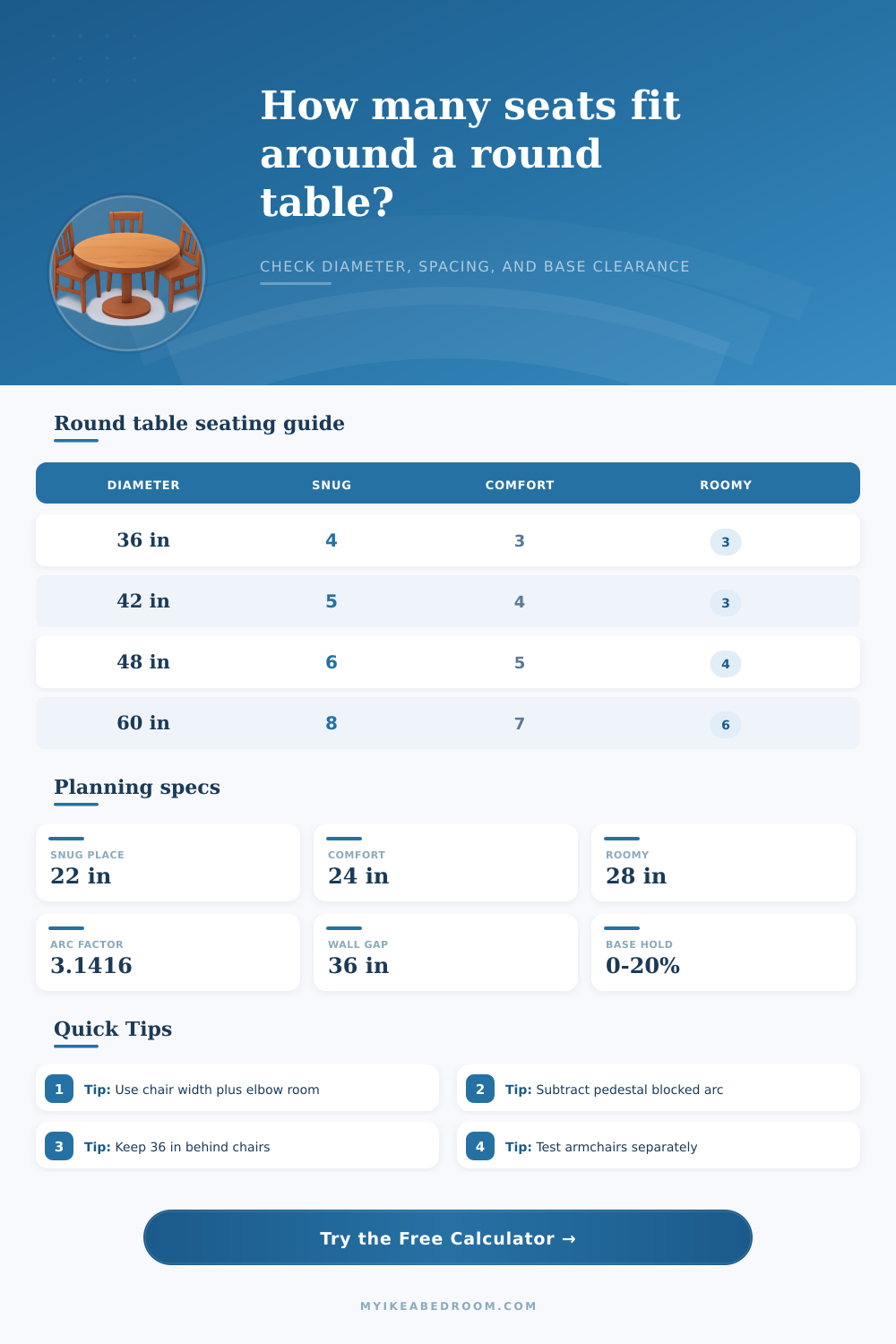
| Table diameter | Approx circumference | Comfort seating | Roomy seating |
|---|---|---|---|
| 36 in / 91 cm | 113 in / 287 cm | 3 to 4 people | 3 people |
| 42 in / 107 cm | 132 in / 335 cm | 4 to 5 people | 3 to 4 people |
| 48 in / 122 cm | 151 in / 383 cm | 5 to 6 people | 4 to 5 people |
| 54 in / 137 cm | 170 in / 431 cm | 6 people | 5 to 6 people |
| 60 in / 152 cm | 188 in / 479 cm | 7 to 8 people | 6 people |
| 72 in / 183 cm | 226 in / 574 cm | 9 people | 8 people |
| Seating style | Arc per person | Best for | Watch point |
|---|---|---|---|
| Banquet | 20 to 22 in | Short meals with narrow armless chairs | Elbows overlap quickly |
| Snug | 22 to 24 in | Occasional extra guest | Better without armchairs |
| Comfort | 24 to 26 in | Everyday dining | Check base and chair arms |
| Roomy | 28 to 30 in | Long meals and serving dishes | Capacity drops by one or two seats |
| Workspace | 30 to 34 in | Laptops, paperwork, craft tasks | Needs larger room clearance |
| Base condition | Blocked arc | Capacity effect | Use when |
|---|---|---|---|
| Slim center pedestal | 0% to 5% | Usually no seat loss | Feet tuck neatly below the center |
| Four outer legs | 5% to 10% | May pinch one place | Legs sit near chair knees |
| Cross or trestle base | 10% to 14% | Often removes one seat | Feet project toward chair positions |
| Bulky pedestal | 14% to 20% | One or two seats may feel tight | Base is wide near the floor |
| Banquette or wall side | 20% to 35% | Seating works only on open arc | Table is partly blocked by built-ins |
| Clearance target | Each side | Total room diameter | Best use |
|---|---|---|---|
| Tight pass | 30 in / 76 cm | Table diameter plus 60 in | Occasional use or small nook |
| Comfort dining | 36 in / 91 cm | Table diameter plus 72 in | Most dining rooms |
| Easy circulation | 42 in / 107 cm | Table diameter plus 84 in | Busy family dining area |
| Serving aisle | 48 in / 122 cm | Table diameter plus 96 in | Buffet, cabinets, or swinging doors |
0 seats
Uses narrower place settings and works best with armless chairs for short meals.
0 seats
Balances chair width, elbow space, and normal dinner movement around the table.
0 seats
Allows broader place settings, easier serving, and less shoulder overlap.
0 seats
Uses larger arcs for laptops, notebooks, crafts, or shared project work.
Measure the real chair width: A chair that is 19 in wide may still need 24 in or more of table arc once elbows, arms, and side movement are included.
Check the base at knee height: A round top can have enough circumference while a cross foot, outer leg, or thick pedestal still blocks the best chair positions.
When choosing the correct diameter for a round dining table, there is a variety of different measurements that must be considered. The process of choosing the correct diameter isnt a simple one. For instance, a 48-inch round dining table may appear to be large enough for six adults to dine at, but that same 48-inch diameter table may become too small for six individuals when the tables is pulled out and the elbow room are considered.
In addition to the issue of elbow room, you must also consider the size of the dishes that will be placed on the table, as must the size of a base of the table. The circumference of the round dining table is one measurement that those who wish to purchase the table must understand. The total circumference of the table is not necessarily the same than the usable circumference of the table, however.
How to choose the right size round dining table
The dining room may include features such as walls or pedestal bases that may block some of the circumference of the table. Any blocked portion of the circumference must be subtracted from the total circumference of the table to find the true usable circumference of the table. That true usable circumference can be divided by the amount of space that each person will require for there place setting at the table.
A calculator can assist in the division of these two values. Another common mistake in calculating the size of a place setting on a round dining table is the incorrect measurement of the width of the place setting. Many individuals may measure the width of the seat of the chair that they will use to dine at the table.
For instance, a chair that is 19 inches in diameter may require an arc of 24 inches in the round dining table to account for the width of the individual and to allow for the individual to not brush against the shoulder of their neighbor. If the place setting is increased to 28 inches in width, the round dining table may feel more comfortabler for those who dine at the table, but fewer individuals may be able to sit at the table. The reason for this is that the platters and bottles that you will place in the center of the round dining table during the meal will require that amount of space.
The fourth measurement that must be considered when choosing a round dining table is the style of the base of the table. Bases that are slim and centered at the round dining table will not generally block the ability of those who intend to dine at the table to sit at the table. Bases that has four legs or that are wide bases may block the ability of individuals to sit at the table in certain positions.
These different scenarios can be tested using the calculator that is available online. For instance, the calculator includes a blocked arc percentage that can provide an estimate of how the base of the table may affect the circumference of the table. If the blocked arc percentage is set to 16%, for instance, the round dining table may have 10 inches of circumference blocked by the base of the table.
The removal of 10 inches of circumference from a 60-inch table will reduce the diameter of the table to reduce the capacity of the table to include one guest. The fifth and final measurement that must be considered is the amount of clearance that is available within the room in which the round dining table will be placed. The amount of space that is required behind each seated individual is approximately 36 inches.
Many dining rooms, however, do not include 36 inches of space behind each dining room seat, that space is often occupied by a sideboard or doorway. You can use the calculator to compare the diameter of the dining room to the diameter of the round dining table and the space that will be required for chairs to be pulled out of those dining room seats. The calculator will provide individuals with an early warning should the round dining table not be able to fit into the designated dining room.
Additionally, the way in which you will use the round dining table will impact the measurements that must be made for the table. For instance, if the round dining table is to be used as a workspace for laptops, those who use that table will require wider place settings. In contrast, if the round dining table is to be used as a breakfast nook for preparing meals, the place settings at that table may be more smaller in width.
These different scenarios can be tested with the place setting presets on the calculator. These preset settings will allow individuals to see how the number of individuals that can sit at the round dining table may change. Rather than providing for the maximum number of individuals that may sit at the table, the round dining table should be sized in a way that ensures that it match the way that the individuals move and eat within that dining room.
Thus, after considering each of these individual factors (diameter of the table, place setting width, base allowance, and room clearance), the correct size for the round dining table will become apparent to those who considers each of these different factors.