Seating Capacity Rectangular Table Calculator
Estimate practical table seats from length, width, place-setting width, end seats, leg or base obstructions, and comfort spacing.
🏠Rectangular Table Presets
📏Table And Seating Inputs
Rectangular Table Seating Result
🧱Seating Comparison Grid
📊Reference Tables
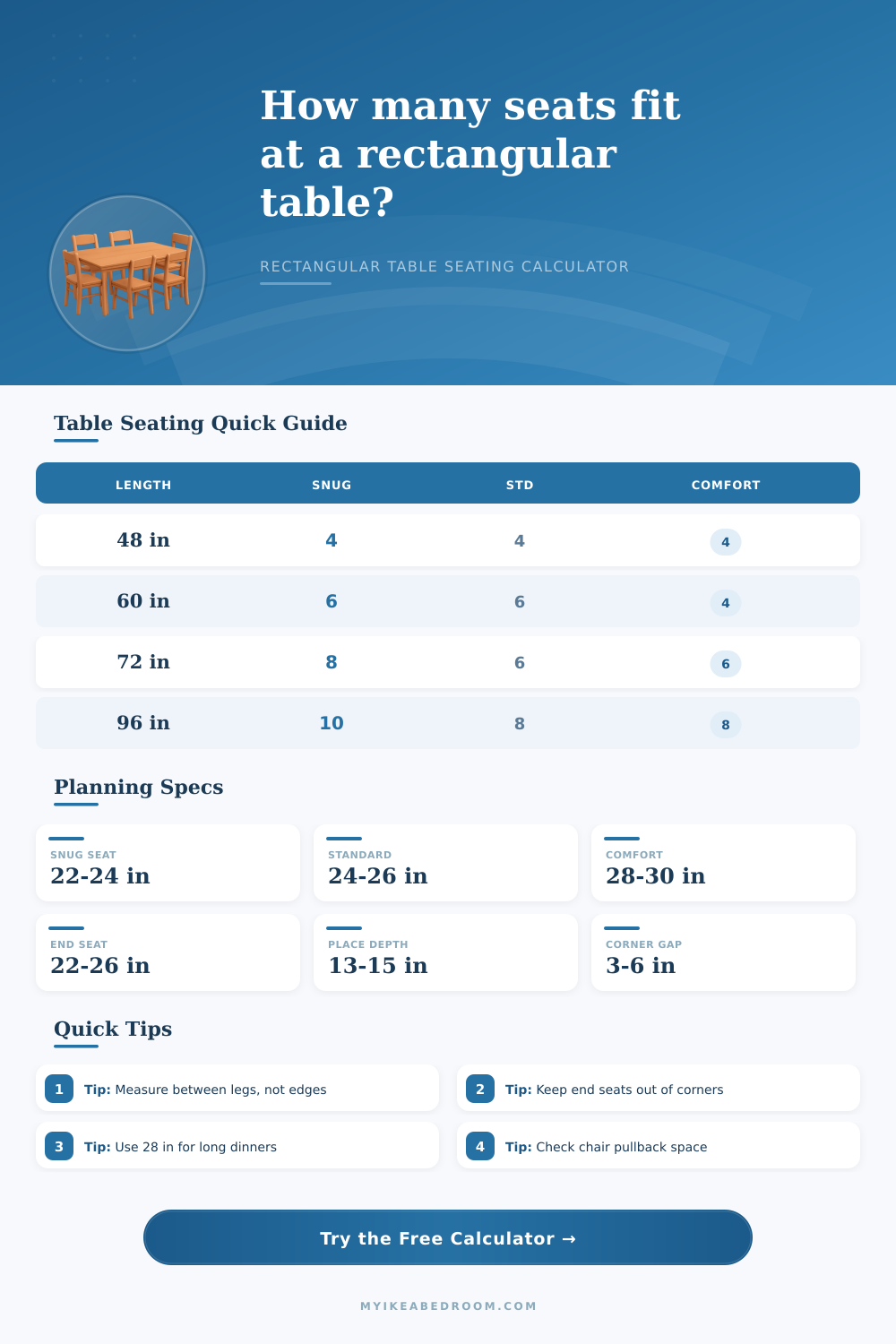
| Rectangular table size | Snug capacity | Comfort capacity | Planning note |
|---|---|---|---|
| 48 x 30 in | 4 seats | 4 seats | Two long-side seats plus two ends is typical |
| 60 x 36 in | 6 seats | 4 to 6 seats | End seats make the six-seat layout work |
| 72 x 36 in | 8 seats | 6 seats | Three per side feels better than four per side |
| 84 x 38 in | 8 seats | 8 seats | Good length for three per side plus ends |
| 96 x 40 in | 10 seats | 8 seats | Four per side is comfortable with 24 inch settings |
| 108 x 42 in | 12 seats | 10 seats | Leg placement usually decides the final count |
| Place-setting style | Width per diner | Gap allowance | Best use |
|---|---|---|---|
| Snug family meals | 22 to 24 in | 0 to 1 in | Quick meals and compact rooms |
| Everyday dining | 24 to 26 in | 1 to 2 in | Balanced capacity and comfort |
| Long dinners | 28 to 30 in | 2 to 4 in | More elbow room and glassware space |
| Bench seating | 21 to 24 in | 0 to 2 in | Works only when legs do not interrupt knees |
| Armchairs | 30 to 34 in | 2 to 4 in | Use wider spacing for arms and movement |
| Table width | Opposite place settings | End-seat fit | Center space effect |
|---|---|---|---|
| 28 to 30 in | Tight | Usually one narrow end seat | Little room for shared dishes |
| 32 to 36 in | Good | Two end seats usually fit | Small center strip remains |
| 38 to 42 in | Comfortable | Two end seats fit well | Serving dishes fit between settings |
| 44 to 48 in | Spacious | End seats have more shoulder room | Reach may feel wide for casual meals |
| Over 48 in | Very wide | Capacity is not the issue | Check reach and centerpiece scale |
| Leg or base type | Typical deduction | Where it matters | Capacity effect |
|---|---|---|---|
| Clear corner legs | 0 to 4 in | Mostly corners | Usually no lost seats |
| Bulky corner legs | 4 to 8 in | Long sides and end knees | May make end seats awkward |
| Trestle base | 10 to 18 in | Middle long-side seats | Often removes one side seat |
| Central pedestal | 12 to 20 in | Knee space near center | Can reduce both sides on short tables |
| Drawer apron | Manual check | Lap and knee clearance | Use blocked-seat input if needed |
💡Seating Capacity Tips
A rectangular table seating calculator is a tool you can use to determine the number of people who can sits at the rectangular dining table. The calculator take into account specific measurements of the table and your seating preference. These factor allow the rectangular dining table calculator to reveal to you the number of people who can sit at the rectangular dining table.
Rectangular table seating calculators is especially helpful for planning dinner or creating new dining area. The rectangular table seating calculator ask for several inputs from an individual. The length of the table and the width of the table provides the boundaries for the area where people will sit.
How to Use a Rectangular Table Seating Calculator
However, the usable space between the obstructions will determines the number of seats. The clearance at the corners of the table will prevent guests from bumping into each other at the corners of the table. The width of the place will determine whether the guests will feel uncomfortably at the table or whether they will feel relaxed at the rectangular table.
The gap between the place settings and the depth needed for the plates and glasses will determines how many people can comfortabley sit at the rectangular table. Additionally, the leg or base profile will affect the number of seats that will be able to sit at the table. For instance, if the table use a trestle or pedestal base, the seat will take up space that could otherwise be given to a guest.
Many individual consider the length of the table the most important. However, the width of the table is just as important. For instance, a narrow table might not provide enough space for the plate on each side of the guests or for the serving dish that may be located on the rectangular table in the middle.
Therefore, the rectangular table seating calculator also consider the width of the table to determine the number of guest that can comfortably dine at the rectangular table. The rectangular table seating calculator will also take into consideration the number of seat that will be available for only one long side of the rectangular table. Some table allow seats at the end of the tables.
Other table may make it awkward for guests to sit at the end due to the legs of the table or the width of the table at the head of the table. Using the rectangular table seating calculator will allow you to determine whether end seat will increase the seating capacity of the table or will create a traffic jam at the end of the table. The chairs for the guests might not be able to slide back from the guests who is seated at the table.
In that case, you may have to reduce the number of seats that will be available for the rectangular table. The meal that will be served at the table and the type of chair that will be used for the dinner might also have an impact on the number of seat that might be comfortable for the guests. Dinners that take place for a short period of time will allow for less breathing room for the guests than dinner parties that last for many hour.
Additionally, armchairs will take up more space than side chair will. This will reduce the number of guest that can sit at the table. People have different seating preference.
Some might enjoy having their shoulder touching the shoulders of others at the table while others might want to have breathing room in between the place settings of each guest. The rectangular table seating calculator will provide you with a number for the seating capacity of the table. However, your own seating preference will allow you to fine tune the number.
One of the most common seating mistake is measuring the length of the table and forgetting that the leg will take up part of the space for the table. Furthermore, the next most common mistake is to assume that the length of the table will allow for seat to be established at each end of the table, even though there might not be space for the legs or the dining room apron at each end. Using a rectangular table seating calculator will reveal these mistake before you order your dining table.
All that the rectangular dining table calculator will do is to provide you with a number that will work when the guests are accommodating for the plate, glasses, elbow, and conversation around the table. Once you understand how the rectangular dining table calculator work and what movement the guests make around the table, you can use it to assist you in your seating plan.