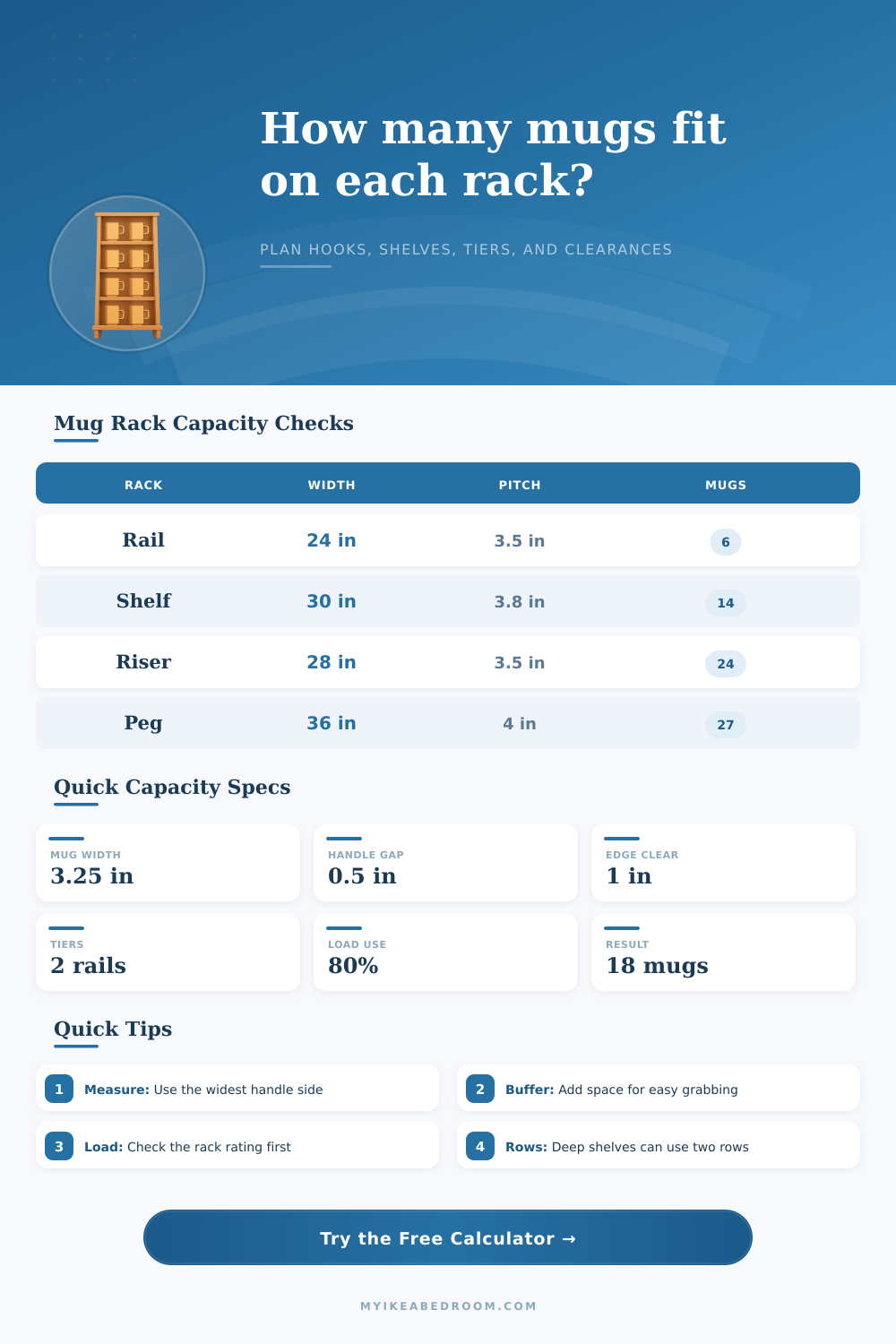
Mug Capacity per Rack Calculator
Estimate how many mugs fit on a rail, shelf, riser, peg rack, or under-shelf strip using real mug width, handle clearance, tier count, and rack load rating.
Mug Rack Capacity Results
Full Capacity Breakdown
| Mug or cup type | Typical body diameter | Handle allowance | Recommended pitch |
|---|---|---|---|
| Espresso cup or small tea cup | 2.25-2.75 in / 5.7-7 cm | 0.35 in / 0.9 cm | 2.8-3.3 in / 7.1-8.4 cm |
| Straight everyday mug | 3-3.25 in / 7.6-8.3 cm | 0.45 in / 1.1 cm | 3.5-3.9 in / 8.9-9.9 cm |
| Rounded stoneware mug | 3.4-3.8 in / 8.6-9.7 cm | 0.55 in / 1.4 cm | 4.1-4.6 in / 10.4-11.7 cm |
| Oversized soup-style mug | 4-4.6 in / 10.2-11.7 cm | 0.7 in / 1.8 cm | 4.9-5.6 in / 12.4-14.2 cm |
| Tall travel mug stored upright | 3.1-3.7 in / 7.9-9.4 cm | 0.65 in / 1.7 cm | 4-4.7 in / 10.2-11.9 cm |
| Rack layout | Capacity method | Clearance that matters most | Calculator behavior |
|---|---|---|---|
| Hook rail | Positions across width times rail count | Handle-to-handle spacing | Uses one front row per rail or level |
| Under-shelf hook strip | Clear hook span after bracket allowance | Cup height below shelf | Derates usable width and load slightly |
| Flat shelf | Across positions times front-back rows | Shelf depth and handle direction | Counts rows when depth can hold them |
| Tiered riser | Shelf grid multiplied by tiers | Vertical clearance between levels | Applies a mild load derating per rack |
| Peg rack | Across positions times peg rows | Mugs swinging or touching handles | Uses tier count as peg rows |
| Display shelf | Shelf grid with presentation spacing | Even sight lines and front gap | Adds extra pitch for a less crowded look |
| Storage scenario | Usable size | Typical mug count | Planning note |
|---|---|---|---|
| Small breakfast rail | 12 in wide / 30 cm | 3 standard mugs | Best with slim handles and one row |
| Compact wall peg rail | 18 in wide / 46 cm | 4 to 5 mugs | Leave end clearance near wall corners |
| Cabinet shelf row | 24 by 10 in / 61 by 25 cm | 10 to 12 mugs | Turn handles outward for easier reach |
| Open shelf double row | 30 by 11 in / 76 by 28 cm | 14 to 16 mugs | Depth is the limiting dimension |
| Two-tier counter riser | 28 by 10 in / 71 by 25 cm | 20 to 24 mugs | Check both total load and shelf height |
| Wide display rack | 36 by 12 in / 91 by 30 cm | 18 to 24 mugs | Uses wider gaps so mugs look intentional |
| Empty mug weight | Equivalent metric weight | Safe mugs at 10 lb with 20% reserve | Safe mugs at 20 lb with 20% reserve |
|---|---|---|---|
| 8 oz lightweight cup | 227 g | 16 mugs | 32 mugs |
| 12 oz everyday ceramic mug | 340 g | 10 mugs | 21 mugs |
| 16 oz heavy stoneware mug | 454 g | 8 mugs | 16 mugs |
| 20 oz oversized mug | 567 g | 6 mugs | 12 mugs |
A capacity calculator will help a person to determine how many mugs can fit on a rack. It can be difficult to envision how many mugs will fit on a rack due to the projections of the handles of those mugs and the placement of the brackets on the rack. For instance, it might seem like a row of mugs will fit along one portion of a rack, but that row of mugs may be too tight for individuals to comfortabley grasp each of the mugs, or there may be empty spaces along that portion of the rack.
A capacity calculator will provide a person with the realistic number of mugs that will fit on a rack so that the individual doesnt have to rely on guess work. To calculate the capacity of the rack for mugs, you will need to measure the dimensions of the rack and the mugs. The width of the rack is the distance between the ends or brackets of the rack, but it is not the total length of the rack board.
How to Calculate How Many Mugs Will Fit on a Rack
The diameter of each mug will need to be measured at its widest portion (excluding the handles) because this will determine how close together two mugs must be able to sit. The allowance for the handle of each mug is the space required for the persons fingers to move when picking up the mug. The gap between neighboring mugs is the space between the handles of the neighboring mugs that will prevent the handles of each mug from hooking onto one another.
Finally, the clearance of the mugs from the walls is the distance that the mugs will need to be from the walls of the area in which the rack will be placed. Each of these dimension can be multiplied by the number of “rails” or horizontal portions of the rack upon which the mugs will be placed. The result of each of these measurements can then be compared to the load capacity of the rack.
The load capacity of the rack is another critical measurement for calculating how many mugs can be placed on the rack. The load rating is the amount of weight that the rack is rated to hold. For instance, if the rack is rated to hold 15 pounds, each ceramic mug may weigh about one pound.
However, there will be a safety buffer in the amount of the total load of the mugs that is allowed to be placed upon the rack; the safety buffer will protect the hardware upon which the rack is mounted. Thus, if the rack allows for 20 mugs to be placed upon the rack, but the rack will only safely be able to hold 14 of those mugs, the number that is used will be 14. This number is the capacity of the rack and will account for the physical limits of the rack.
The materials from which the rack is made will also affect its capacity to hold mugs and the comfort of those mugs upon the rack. For instance, metal (steel) rails will hold more weight than wooden shelves, but the metal rails may be cold and noisily. Wooden shelves may be more comfortable for the mugs, as the wider bases of the mugs can rest on the wooden shelves, but the wooden shelves will add to the total weight of the rack.
Metal grids may tilt if the feet of the grid are uneven, but the mugs would not be expected to land on the metal grid in such a way. These different materials the capacity calculator will also account for in the calculation. Individuals may make mistakes when using a capacity calculator to determine the number of mugs that will fit on a rack.
For instance, many individuals may measure the wrong dimensions of the rack or the mugs. Individuals may only measure the round body of the mug, but this will not allow for clearance for the handles. The depth of the shelf may be ignored, which will prevent two row of mugs from fitting within the shelf.
Additionally, the load rating of the rack may be treated as the maximum amount of weight that the rack can hold. However, that load rating was determined to include the strength of the drywall and other variables; the rack should never be loaded to the maximum strength rating. Instead, the load should be less then the load rating of the rack.
Individuals should make conservative estimates when using a capacity calculator to determine the number of mugs that will fit on a rack. The spacing of the mugs may change according to the style of the mugs. For instance, espresso mugs may require less space than stoneware mugs due to the size of each of those mugs.
However, both mug styles require space for the individuals fingers when grasping the mugs. Additionally, travel mugs may occupy the same space as other ceramic mugs since the lids of those mugs can be removed. These dimensions may differ within the same kitchen, but according to the same physics of each mug.
The depth of the shelf will impact the number of mugs that can be placed upon the shelf. For instance, a shelf of twelve inches in depth will allow for two rows of mugs if the mugs are short, but if clearance is required for the handles of the mugs, the twelve-inch shelf may only allow for one row of mugs to be placed upon the shelf. Tier risers will only allow for the placement of mugs upon each tier of shelf if each of the tiers are high enough to clear the tallest mug handle.
Finally, under-shelf strips allow for the mugs to be hung beneath cabinet shelves, but the factor of the total load capacity of under-shelf strips will be less than the load that is calculated for flat shelves. The total number of mugs that a rack will hold is a compromise between the available space for the mugs and the strength of that rack. The capacity calculator will help a person to determine this total number of mugs.
Each of the dimensions of the rack and the mugs are treated as a constraint upon the total number of mugs that will be able to be contained within that rack. Thus, once a person has calculated the total number of mugs that will fit within the rack, that person can make adjustment to the rack to allow for more or fewer mugs. The capacity calculator allows an individual to determine a comfortable number of mugs that will fit within the rack.