
A living room that does not have an end table is incomplete. You might find yourself setting a drink down on the sofa, but then watching it precariously balance on the sofa’s arm. You might reach for the lamp to turn it on, but then find that the lamp cord protrudes awkwardly from the floor.
These frustrations will build up in your mind, and when frustrations build up in your mind, you feel that your living room is incomplete. The right end table will eliminate all of these frustrations, and the right end table will exhibit the personality of the living room itself. End tables comes in a variety of different shapes and styles.
Each type of end table has certain features, quirks, and characteristics that make it ideal for being placed in a specific type of living room décor. There are several main varieties of end tables, and recognizing these different varieties will allow you to avoid purchasing an end table that is likely to create frustration between the end table and your sofa in your home. The differences between end tables go beyond their color and finish; the differences in end tables also impact the way in which you utilize that end table every single day in your living room.
Common Varieties of End Tables for Your Home
1. Nesting Tables
Nesting tables are a type of end table set that includes two or three different sized end tables. Each end table in a nesting table set can slide into the next sized end table when not in use. During parties, for instance, you can pull the nesting tables apart so that each of the end tables can provide an area for drinks for each individual in each seat.
Nesting tables are especially useful for those living in apartments with limited square footage for furnishings. When the guests have left the home, for instance, the smaller end tables can be tucked into the largest end table in the set to reclaim that floor space in the living room. The only potential downside to nesting tables are if they have especially complicated joinery between each end table; the process of sliding each of the tables in and out of each other will wear at the edge of the tables over time.
2. C-Shaped Tables
C-shaped tables are helpful to those who wish to have dinners on the couch. The narrow base of the C-shaped table allows it to be placed underneath the sofa, and the flat top of the end table allows it to hover over the lap of an individual who is eating. Those who have recently undergone surgery, for instance, may find the benefits of such an end table help them to eat dinner without having to move from the couch.
Similarly, individuals that have limited mobility may also find benefit in the design of a C-shaped table. Many manufacturers also place a lip along the end of a C-shaped table so that an individual’s remote control does not slide off of the end table onto the floor. However, four inches of clearance beneath the couch is required beneath the C-shaped table for it to be of any use.
3. Drum Tables
Drum tables are those with a cylindrical shape; their name refers to their shape. The finishes for the drum tables may include leather, woven rattan, or metal. Because the tables are circular and do not have corners, they are especially useful for small children to walk around the tables without running into the corner of the end tables.
Because drum tables are small in the amount of area that they take up compared to rectangular tables, however, they are best used for those who only require a place for a lamp and a few books to be placed on the table.
4. Pedestal End Tables
Pedestal end tables are those that do not have four legs; instead, the pedestal tables has a single support for the tables. The single support for the pedestal tables allows them to appear as if they are floating in the living room.
Floating end tables are especially useful in small living rooms; they make the small rooms appear larger. Most pedestal tables have a turned wood element to the tables, or the tables may have a tapered metallic base. Because the pedestal tables have a centralized base, they allow for a basket of blankets or other items to be tucked beneath the end tables.
The downside to pedestal tables are that placing heavy items onto the pedestal tables may make them less stable than end tables that have four legs.
5. Console Tables
Console tables are those whose shape extends horizontally in the living room décor rather than vertically. Because of their shape, console tables are ideal for narrow hallways in the home, or for those who would like to place the console table behind their sofa.
The long and shallow end tables may hold photographs of the family, a lamp, or even a book. Console tables are often placed between the living and dining areas of a home. The height of a console table is typically the same as the height of the back of a sofa.
Because of the height of the tables, guests entering the home will see the console tables. Console tables are useful, however, if they are not overloaded with items that may be at risk of tipping forward onto the floor.
6. Storage Ottomans
Storage ottomans in the form of end tables allow for two benefits in one piece of furniture.
The ottoman’s cushion can be lifted, and beneath the ottoman is a designated place for items such as blankets, board games, or even the remote control for the television. Storage ottomans may be upholstered to provide additional seating to those who enter the home, or the ottomans may be wooden to allow for drinks to be placed on the storage ottoman. Storage ottomans are especially useful in the family room in the home, where there are young children or pets that may rearrange the items in the living room.
If an individual plans to use the ottoman for seating, the cushion may compress over time; in this case, it is best to purchase an ottoman that uses high-density foam for the cushioning.
7. Bunchable Tables
Bunchable tables are sets of identical tables or sets of tables of different shapes. For instance, there may be a set of three identical triangular tables in a bunchable table set.
These tables can be arranged in a variety of ways in the living room. For instance, if there are young children in the living room that would like to play games together, you may cluster the bunchable tables in the center of the living room to provide them with an area to place their drinks. If, in contrast, the individual plans to use the bunchable tables to perform exercises like yoga, however, the tables may be spread out across the living room.
These types of tables require additional thought before being purchased; they are not like one individual end table.
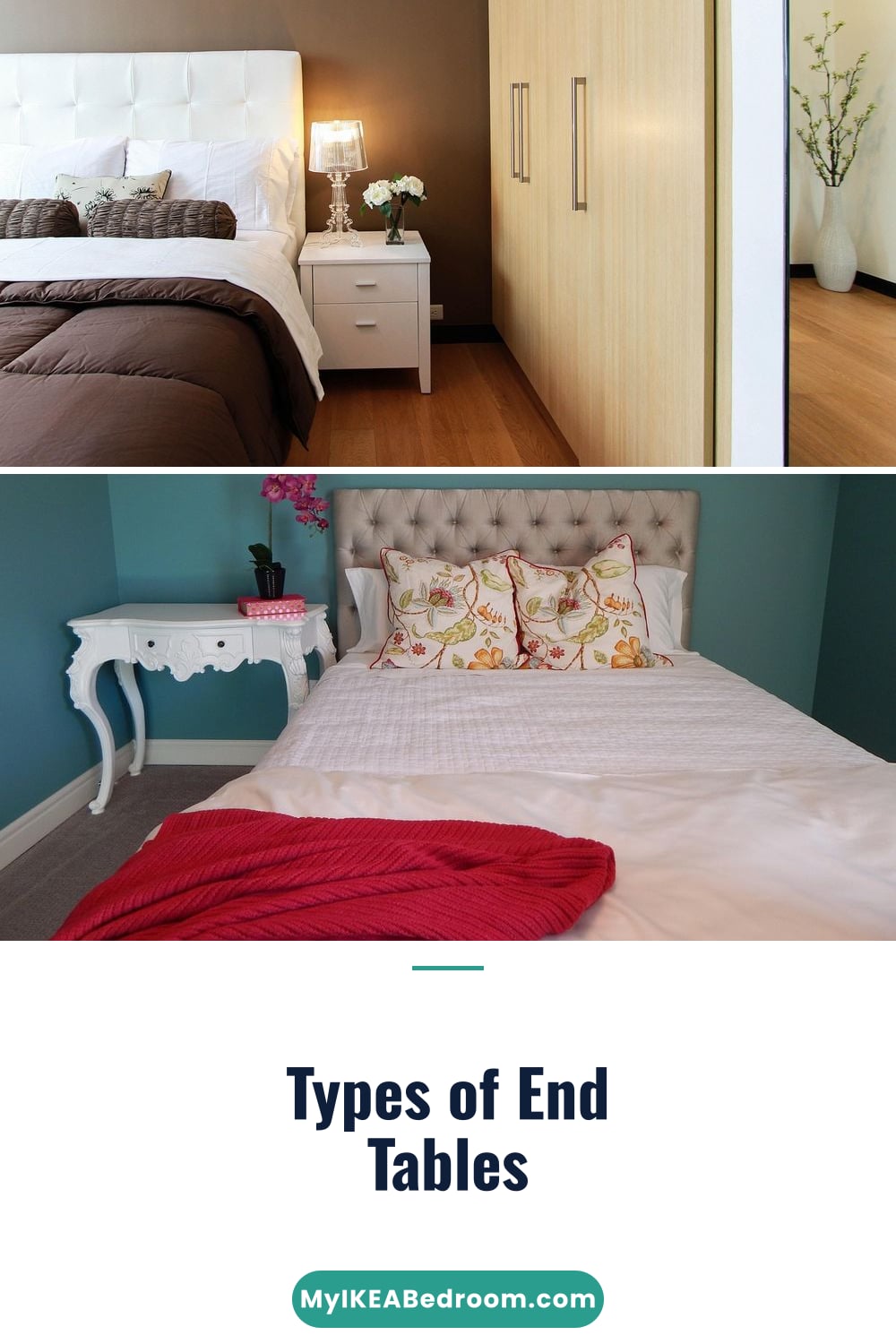
8. Nightstands
Many styles of nightstands are also useful as end tables for the living room. The drawers on many nightstands are sized to hold items like coasters, books, or reading glasses.
Many nightstands are slightly taller than end tables; their height is useful beside sofas that have deep seating. Because of their height, lamps will not be lost behind the sofa. It is also important to ensure that the size of the nightstand in the living room is balanced beside the size of the seating in the living room; otherwise, the nightstand may appear somewhat comedic beside the living room seating.
9. Demilune Tables
Demilune tables have a half-moon shape. Their curved front edges are useful for those who wish to avoid others from bumping into the edges of the tables. The flat back portion of the demilune tables can be placed against the wall of the living room décor.
Traditional demilune tables have included designs like inlay and marquetry; these types of designs are most prominent in formal living rooms. Many moddern demilune tables, in contrast, use materials like concrete or powder-coated steel to allow for the industrial décor of those modern homes. Because of the limited area of the table, however, care must be taken to ensure that the items placed upon the table are limited in number.
Your living room may have many different types of end tables, but the selection of which end tables to purchase should depend upon the way in which you and your family live in your home. For instance, a C-shaped table might be ideal for those who like to watch television and eat dinner on the couch, but a sculptural drum table might be better for those who would like their living room to include a conversation piece. Consider each of the types of end tables described above.
Sit in your favorite spot in your living room, and consider what types of items you would reach for if you were to need to place an item upon an end table. The best end table will go unnoticed when it is performing its function; when you find the right end table for your living room, however, the living room décor will finally click into place.
