Shoe Cubby Quantity Calculator
Plan a shoe cubby grid from pair width, pair height, boot exceptions, divider thickness, occupancy, and spare cubbies.
1Choose a shoe storage preset
2Enter cubby grid, pair size, and reserves
Enter shoe counts and module dimensions, then calculate.
3Current storage summary
4Shoe pair fit table
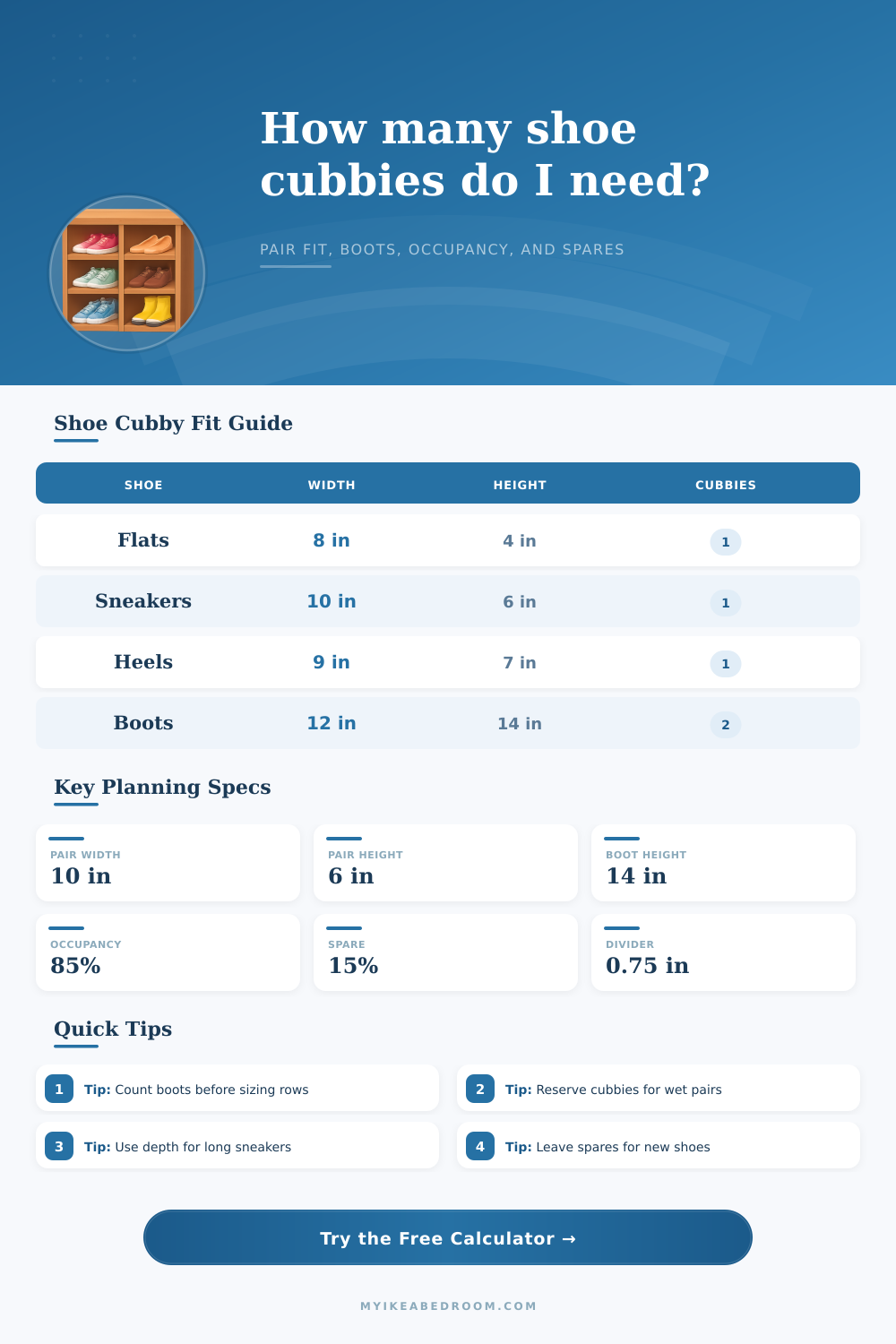
| Shoe type | Typical pair width | Typical height | Useful depth | Cubby planning note |
|---|---|---|---|---|
| Flats and sandals | 7 to 9 in / 18 to 23 cm | 3 to 4 in / 8 to 10 cm | 9 to 11 in / 23 to 28 cm | Can share wider cubbies if visibility matters less. |
| Sneakers | 9 to 11 in / 23 to 28 cm | 5 to 7 in / 13 to 18 cm | 11 to 14 in / 28 to 36 cm | Use full pair width so shoes sit side by side. |
| Heels | 8 to 10 in / 20 to 25 cm | 6 to 8 in / 15 to 20 cm | 10 to 12 in / 25 to 30 cm | Height usually limits the row more than width. |
| Ankle boots | 10 to 12 in / 25 to 30 cm | 8 to 10 in / 20 to 25 cm | 12 to 14 in / 30 to 36 cm | Often fit one cubby if rows are taller. |
| Tall boots | 10 to 13 in / 25 to 33 cm | 14 to 18 in / 36 to 46 cm | 13 to 16 in / 33 to 41 cm | Use a tall row, two cubbies, or external storage. |
5Occupancy and spare cubby guide
| Planning style | Target occupancy | Spare allowance | Best for | Result in daily use |
|---|---|---|---|---|
| Easy access | 75% | 15 to 25% | Kids and busy entries | More open cubbies, less stacking. |
| Balanced closet | 85% | 10 to 15% | Most bedroom closets | Enough spares without oversized furniture. |
| Tight hallway | 90% | 5 to 10% | Narrow units | Efficient, but shoes need consistent return spots. |
| Collection display | 80% | 20% | Sneakers or heels | Leaves space between favorite pairs. |
6Boot exception options
| Boot rule | How calculator counts it | Grid impact | Best layout | Watch point |
|---|---|---|---|---|
| Two-cubby boot pairs | Each boot pair counts as 2 cubbies | Fast capacity estimate | Uniform grid | Boots may still exceed cubby height. |
| Tall boot row | Boot pairs count normally, plus tall row count | Reserves rows with extra height | Bottom or side boot zone | Fewer regular rows may fit if you rebuild dividers. |
| External boot storage | Boot pairs are excluded from cubby need | More regular shoe capacity | Tray, bench shelf, or boot rail | Still reserve floor clearance near the unit. |
| Seasonal boot swap | Use spares for off-season pairs | Lower fixed cubby count | Closet with upper bins | Requires moving boots between seasons. |
7Current layout comparison grid
These options recalculate from your current module dimensions, shoe dimensions, boot rule, occupancy, spares, and reserved cubbies.
| Layout option | Rows x columns | Usable capacity | Clear opening | Capacity result |
|---|---|---|---|---|
| Low bench | 2 x 5 | 0 | 0 in | Waiting |
| Classic grid | 4 x 4 | 0 | 0 in | Waiting |
| Tall tower | 6 x 3 | 0 | 0 in | Waiting |
| Wide wall | 4 x 6 | 0 | 0 in | Waiting |
8Common shoe cubby sizes
| Unit scenario | Typical grid | Pair capacity | Boot handling | Planning note |
|---|---|---|---|---|
| Entry bench cubbies | 2 rows x 4 to 5 columns | 6 to 10 pairs | Boot tray nearby | Low height keeps daily shoes easy to reach. |
| Bedroom closet unit | 4 rows x 4 columns | 12 to 16 pairs | One taller bottom row | Balanced for sneakers, flats, heels, and sandals. |
| Family mudroom wall | 4 rows x 6 columns | 18 to 24 pairs | Separate wet cubbies | Reserve cubbies for each person, not only each pair. |
| Sneaker display bank | 5 rows x 5 columns | 20 to 25 pairs | Usually external | Use consistent pair width for a clean grid. |
| Narrow closet tower | 6 rows x 2 to 3 columns | 10 to 18 pairs | Bottom boot zone | Tall rows help, but wide boots may limit columns. |
9Practical shoe cubby tips
In order for you to understanding how to plan your shoe storage, you must first understand the need for careful measurement and mathematical calculation to accurately determine how many cubbies you will needs for your unit. While many person can envision the need for shoe storage for there homes when they find themselves in possession of disorganized shoes, it can be more difficult for individuals to determine the number of cubbies that will be necessary to create an efficient shoe unit. Beyond the consideration of how many pair of shoes that you own, how many pairs of shoes of what size do you own, and how many extra shoes you would like to leave within the storage unit for yourself, there is additional considerations that must be made with building an accurate calculation of how many cubbies will best fit the shoes that you will store within the unit.
Such considerations includes the width of the shoes, the height of the shoes, the depth of the shoes, the occupancy target that you would like to use for the unit, the spare allowance that you will make for your shoes, the thickness of the dividers that will separates the individual cubbies, the consideration of the storage of your boots within the unit, the consideration of how the unit will be used seasonal within your home, how many shoes you will own in the future, and the function and reliability of the unit when you utilize it within your home. Each of these considerations are essential in ensuring that your shoe unit will provide the level of function that you require within your home, despite the fact that the calculator will provide you with the mathematical means of calculating each of these parameter.
How to Measure Your Shoes and Plan Cubbies