Shoe Storage Capacity Calculator
Estimate how many pairs fit by shelf width, pair width, tier count, boot allowance, and angled versus flat storage style.
1Storage presets
2Shelf and shoe inputs
3Capacity results
4Storage profile reference
5Typical shoe widths
| Shoe type | Pair width | Suggested depth | Planning note |
|---|---|---|---|
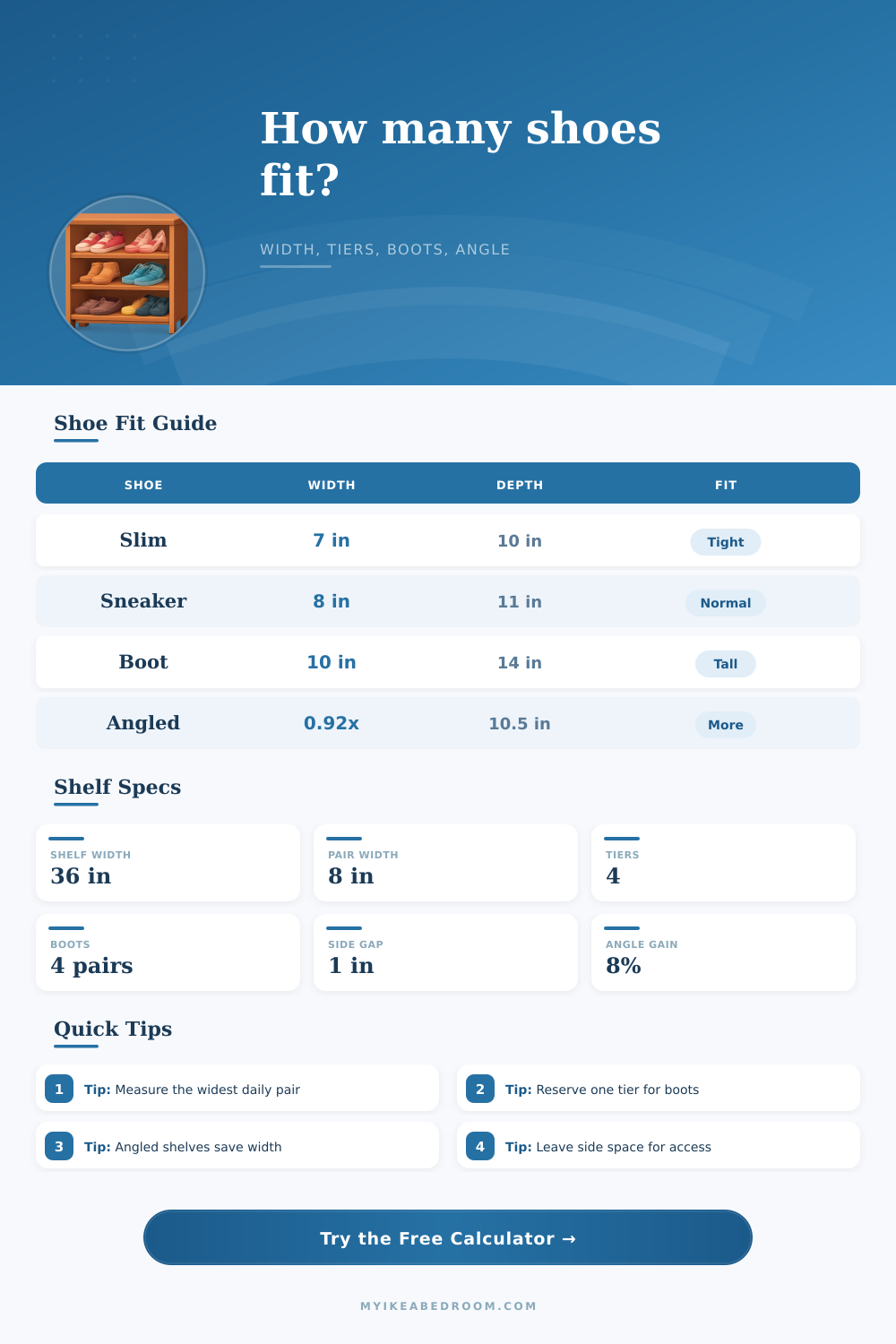
| Kids shoes | 5 to 6.5 in | 7 to 9 in | Often fits two shallow tiers in a low cubby. |
| Flats and sandals | 6.5 to 7.5 in | 9 to 10 in | Good candidate for angled shelves. |
| Adult sneakers | 7.5 to 8.5 in | 10.5 to 12 in | Use this as the default mixed household pair. |
| Wide trainers | 8.5 to 9.5 in | 11.5 to 13 in | Use a larger gap if soles are bulky. |
| Ankle boots | 9 to 10.5 in | 12 to 14 in | May fit on standard tiers if height is open. |
| Tall boots | 9.5 to 12 in | 13 to 16 in | Usually need a dedicated tall tier or floor bay. |
6Angled vs flat comparison
7Capacity by shelf width
| Clear shelf width | Flat 8 in pairs | Angled 8 in pairs | Boot pairs at 10 in |
|---|---|---|---|
| 24 in | 2 per tier | 2 per tier | 2 per tier |
| 30 in | 3 per tier | 3 per tier | 2 per tier |
| 36 in | 4 per tier | 4 per tier | 3 per tier |
| 48 in | 5 per tier | 6 per tier | 4 per tier |
| 60 in | 7 per tier | 7 per tier | 5 per tier |
8Boot allowance planning table
| Boot share | Works well for | Capacity effect | Use when |
|---|---|---|---|
| 0% | Sneaker-only racks | No tier reserved | Boots live elsewhere. |
| 20% to 25% | Mixed entry storage | Usually one tier | A few boots or high tops are included. |
| 33% | Seasonal shoe closets | One in three tiers | Boots are part of daily rotation. |
| 50% | Boot-heavy homes | Half the rack | Tall boots need dedicated clearance. |
9Common storage setups
| Setup | Typical width | Tier count | Expected capacity |
|---|---|---|---|
| Entry bench shelf | 30 to 36 in | 1 to 2 tiers | 3 to 8 regular pairs. |
| Narrow hall rack | 24 to 30 in | 3 to 4 tiers | 6 to 12 regular pairs. |
| Closet tower | 30 to 40 in | 5 to 7 tiers | 15 to 28 mixed pairs. |
| Wardrobe bay | 48 to 60 in | 4 to 6 tiers | 20 to 42 mixed pairs. |
| Mudroom rack | 48 to 72 in | 3 to 5 tiers | 12 to 35 pairs with boot space. |
10Planning tips
Shoe storage can become complex for a person who go beyond a single shoe rack. A person may start with a few pair of shoes that a person wears at all times. But at some point, a person may want to add boots or new pair of shoes for children to wear.
These new shoes will take up more space on the shoe rack. For a person who desires to store shoes on a shelf, a person must consider not just how many shoes will fit on the shelf, but how many shoes can fit while the person is still able to reach the shoes that the person wear the most often. The width of the shelves can limit the number of shoes that can fit on a shelf.
How to Measure and Organize Your Shoe Shelf
For example, if a person measure 36 inches for the width of a shelf, it may appear to be a very wider shelf for shoe storage. However, a person must provide space for there hands to reach into the shelf. Additionally, a person must store shoes in a way that allows for the bottom of the shoes to not rub against another shoe.
Therefore, a person must provide some gap between each pair of shoes. The calculator can ask a person for the width of each type of shoe that will be stored on the shelf. Another consideration with shoe storage is the depth of the shelves.
If the shelves are very shallow, the shoes on the shelf must be flat. However, deep shelves allow for shoes to be stored in different angle or heel to toe. Angled storage allow people to easily view the shoes that are on the shelf.
However, angled shoes require a rail to prevent the shoes from sliding forward. Storage heel to toe allow for more shoes to be stored on the shelf. However, when people place shoes heel to toe, people may have difficulty in accessing the shoes that are on the bottom of the shelf of a rack of shoes.
Boots tend to take up more space in terms of width and height than regular shoes. A single pair of boots may take up as much space as two tiers of shoes if the space between those two tiers is very small. Therefore, the calculator will ask how many pair of boots a person wants to store.
Additionally, the calculator may ask what percentage of the tier a person would like to assign to boots. If a person only wear the boots occasionally, this will allow for more space for other shoes. However, if a person wears a pair of boots every day, this will impact the way that a person design the shoe rack.
Tables provide information on the typical width for each type of shoes. These tables can be helpful for a person that has many different type of shoes in their collection. These measurements are just starting points for a person’s shoe collection.
A shoe may be a wider width than the average shoe if the laces are tied in a certain way, or if the shoes have wider sole. Many people tend to make mistake when measuring the width of their shoe rack. One common mistake is in measuring the outside of the cabinet that will hold the shelf, but not measuring the depth of the cabinet.
Another potential mistake is in not accounting for the depth of the shelf needed for tall boots. Instead, the bottom shelf of a shoe rack will need to have more height than the upper shelf. Additionally, people may not account for space on the sides of the shelf.
If the shelf is placed between two walls, extra space is needed on each side of the shelf so that a person can get between the rack and the wall. A person will not use every shelf for their shoes in the same way. For example, one shelf may be used for shoes that are worn every day, while other shelf may have shoes that are worn every few weeks.
Therefore, it is helpful to allow for some room on a shelf for shoes to be moved from one spot to another. Flexibility in this way allow for more ease in organizing the shoes on the rack. New shoes that are added to the collection will impact the number of shoes that can be stored on the rack.
For instance, if a person adds a pair of shoes that take up alot of space to the collection, this will take up space for other shoes. Additionally, if a person replaces a pair of shoes with another that take up less space, this will provide more space for other shoes. The widest shoes that are worn daily should be measured for the shoes that will be stored on the rack.
Measuring the widest shoes would provide a more accurate measurement of the space that would be taken up by that shoe rack, as opposed to the narrowest shoes in a persons collection. A person must also consider how often the person will rotate the shoes within the shoe collection. If the shoes will be stored for many months at a time, the shoes can be stored in tighter space.
However, if a person reaches for a different pair of shoes each day, there must be more space in between each pair. Additionally, there needs to be clear line of sight to each pair of shoes. These different type of storage allow for a person to meet different needs for their shoe collection.
A person’s shoe collection may change over time. For example, as shoes wear with time, they may need more height on the shelf to allow the shoes to hang proper. Alternatively, people may want to remove a rail from a shelf, or add another shelf to the rack.
When a person’s shoe collection change, or when a person adds new shoes to the collection, they should of run the number through the calculator. It is faster for a person to update the calculator than to attempt to reorganize the shoes in the rack. The goal with shoe storage is to find a maximum number of shoes that can be stored, but a maximum that is still usable by the person.