Hanging Space Linear Feet Calculator
Estimate closet rod length from garment count, spacing per garment, long and short split, double-hang zones, and growth allowance.
✨Closet Presets
📏Garments and Rod Layout
📊Garment Spacing Reference
👕Garment Type Table
| Garment Type | Typical Spacing | Hang Zone | Planning Note |
|---|---|---|---|
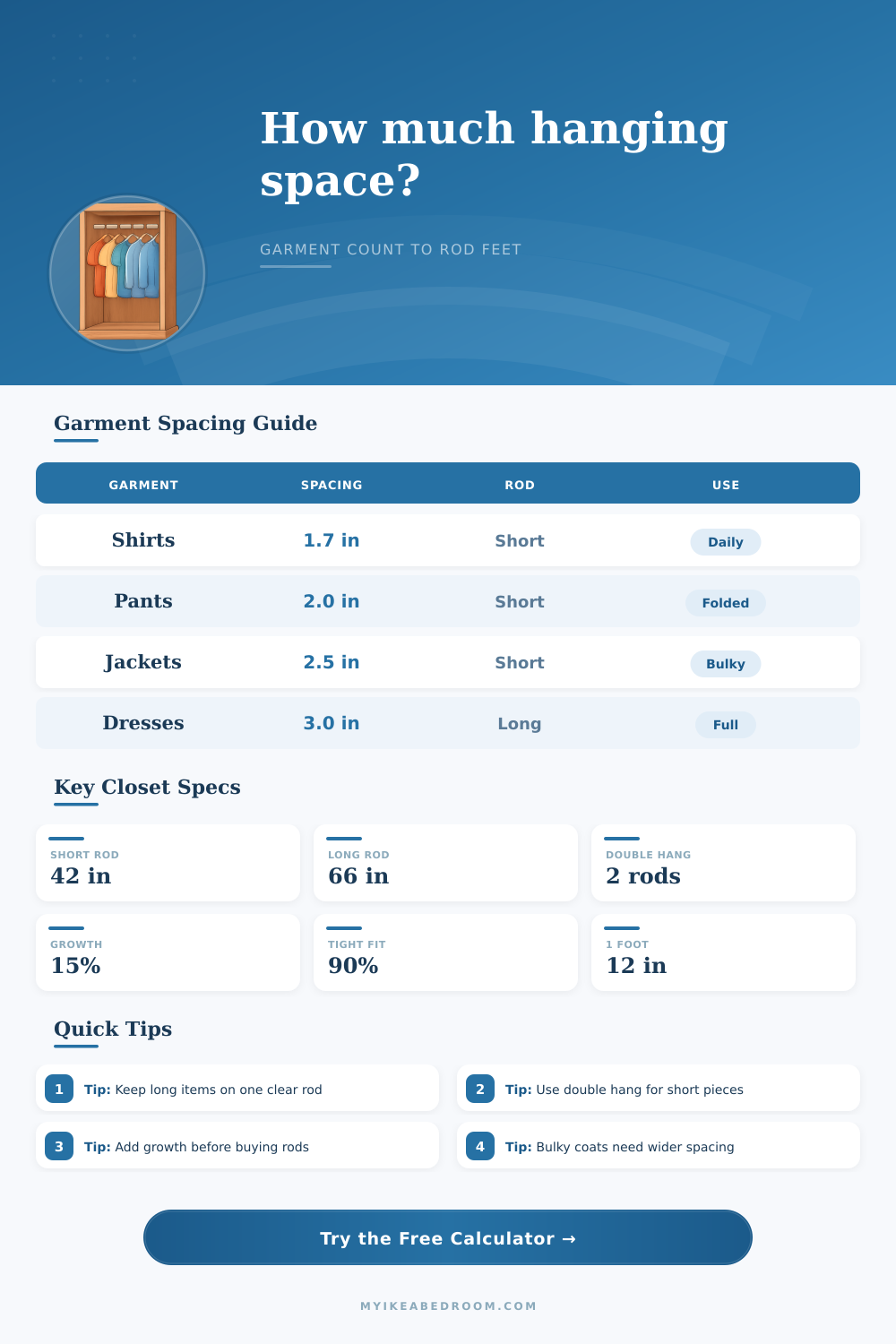
| T-shirts and thin tops | 1.2 to 1.6 in | Short or double hang | Works well on dense upper and lower rods |
| Shirts and blouses | 1.5 to 2.0 in | Short or double hang | Good default for daily bedroom closets |
| Folded trousers on hangers | 1.8 to 2.3 in | Short or double hang | Use more room for thicker trouser hangers |
| Jackets and blazers | 2.2 to 2.8 in | Usually short hang | Shoulders need breathing room to avoid crushing |
| Dresses and long coats | 2.6 to 3.4 in | Long hang only | Reserve full height and avoid lower rods below |
🧱Rod Layout Table
| Layout | Vertical Use | Rod Feet per 36 in Bay | Best Fit |
|---|---|---|---|
| Single short rod | One short-height rod | About 2.9 ft after gaps | Mixed tops above drawers or shelves |
| Double hang bay | Upper plus lower rod | About 5.8 ft after gaps | Shirts, folded pants, kids clothing |
| Single long rod | Full-height clear drop | About 2.9 ft after gaps | Dresses, coats, robes, and long items |
| Hybrid closet | Long bay plus double bays | Depends on split | Most primary bedroom wardrobes |
📋Packing and Growth Table
| Setting | What It Means | Effect on Rod Feet | Use Case |
|---|---|---|---|
| 82% airy display | 18% open space | Needs about 1.22 times spacing | Visible outfits and easy browsing |
| 88% easy browsing | 12% open space | Needs about 1.14 times spacing | Shared closets and frequent use |
| 93% tidy everyday | 7% open space | Needs about 1.08 times spacing | Most bedroom closets |
| 97% tight storage | 3% open space | Needs about 1.03 times spacing | Seasonal or less-used garments |
📐Common Closet Scenarios
| Scenario | Garment Count | Long Share | Typical Rod Plan |
|---|---|---|---|
| Capsule wardrobe | 55 to 75 pieces | 15% to 25% | One long rod plus one double bay |
| Primary bedroom closet | 110 to 160 pieces | 20% to 35% | One long bay plus two double bays |
| Shared closet | 180 to 260 pieces | 18% to 32% | Two long zones plus several double bays |
| Coat or dress closet | 35 to 90 pieces | 70% to 100% | Mostly single full-height rods |
🗂Layout Comparison Grid
Mostly Short
Double hang stretches the same bay width because upper and lower rods both carry short garments.
Balanced Split
A long bay protects dresses and coats while double bays hold daily tops, trousers, and jackets.
Long Heavy
Full-height rods become the limiting factor because long garments cannot share a lower rod zone.
Growth Ready
Allowance adds visible empty rod space before the bay count is rounded up for a practical closet plan.
💡Hanging Space Tips
When organizing a closet, the total amount of rod length that a closet has to work with is not the most important factor. Furthermore, the way that the closet owner divide the length of the rod between the long garments and the short garments within the closet is the most important factor in organizing the closet’s rods. The garments have to be divided in this way so that the dresses will not be crushed, and the shirts will not get lost in the empty space within the closet.
Many closet plans do not factor in this division of the length of the rods, which is a mistake that leads to chaotic closet. The planning process for a closet must begin with the garments that a person own. The total number of garments that will be hanging on the closet rods should be counted, but only the garments that will hang on the closet rods should be counted.
How to Plan Closet Rods for Long and Short Clothes
Items like folded sweaters, shoes, and accessories should not be included in the total count of the garments that will be hanging in the closet. After determining the total number of garments that will be hanging in the closet, it is important to determine how many of those garments will require full length on the rod. Items like long coats, maxi dress, and robes will require full length on the rod because those items cannot share a bay with another rod located beneath them in the closet.
Items like shirts, folded trousers, and blazers can share a bay with another rod located beneath them; therefore, the closet owner will place those items on the second rod to maximize the number of garments with which the closet can work. The spacing between the garment hanger will affect the length of the rods that are required to hang the clothes within the closet. For instance, shirts that are slim may only require one and a half inches between hangers, but structured garments like blazers may require two and a half inches between hangers.
These difference in the required spacing for different garments within the closet should be accounted for when determining the length of the closet rods. If the spacing within the closet is not accounted for, either the length of the rod may be wasted on delicate garments, or the bulky items may begin to wrinkle within the closet. Because there are likely to be different types of garments within an actual closet, the calculation of the spacing for the short garments and the long garments should be two separate calculation.
The decision of whether or not to use a double hang for some of the garments in the closet is another calculation that must be performed. However, not all of the short garments in the closet should be placed on double hang rods. Coats that are heavy and tend to fall on the lower portion of the closet rods can be on a double hang rod.
However, items like blazers that require the garments to remain structured should be placed on a single hang rod to avoid wrinkle. Accounting for the number of short garments that can be on a double hang is important because if too many garments are accounted for as eligible for a double hang rod, there will not be enough rod length within the closet for the garments. Another factor that must be accounted for in establishing the closet plan is the allowance for growth of the owner’s clothing collection.
While it may seem as if the allowance for growth for garments within a closet is easily skipped over, the cost of not planning for growth is costly. It is likely that an individual will acquire more garments for the closet over time. Therefore, it is a recommendation that the closet owner provide for fifteen percent extra length for the closet rods.
Building in this extra length will prevent the need for a closet renovation in six months or less. Furthermore, the allowance for growth prevents the closet owner from creating a closet where the measurements for each rod are planned to the exact inch; this allowance for growth will ensure that the closet allows for clearance for the garment hangers and their bracket. The size of the bays within the closet should be measured.
For instance, one bay may be located above the drawers in the closet, while another bay may extend to the floor. Furthermore, each bay may have different widths; this is due to the brackets that are built into the closet to support the rods, as well as to provide space for the hangers to avoid against the closet walls. Each of these variable in the closet will impact the length of the rods that are allowed within each bay.
These changes in length are small for each bay in the closet; however, they will impact the length of the rods that are required in total for the closet. Each bay should be measured for the length of the closet rods that will be used within that bay. The decision of the packing density of the garments within the closet is another variable for the closet owner.
The packing density will impact the total length of rods that are required by the closet owner. A tighter packing density will leave less space between the garments that are hanging on the rods in the closet. A higher packing density may create the sensation of a crowded closet.
However, the downside to a less dense packing is that the length of the rods will need to be longer to allow for the garments to be hung. Furthermore, a less dense packing of the garments will provide the owner with the ability to easily see each of the owner’s garments, and to pull out individual garments without affecting other garments within the closet. The decision of the packing density will depend upon the number of times that the closet owner or the individuals that share the closet will reach into the closet.
After all of the variables have been accounted for, the calculation will provide three main pieces of information for the closet owner. First, the calculation will determine the total length of rod in which the owner’s garments will require after accounting for the growth allowance and the packing density. Second, the calculation will determine how to divide the total length of the closet rods between the long garments and double hang rods.
Third, the calculation will provide information regarding whether or not the current number of closet bays is sufficient for the owner’s clothing collection. The balance figure within the calculation will indicate whether or not the closet owner is over or under the capacity of the closet for each type of hanging space. This information is important for the closet owner to understand, because shortages of long garments can not be corrected by providing more double hang space for the owner’s closet.
Individuals who make common mistake in their closets are those who fail to take into consideration the different types of garments that are within the closet. For instance, if an owner has a closet that has twelve feet of rod length for the closet, but nine feet of that length is within the double hang rods in the closet, then the long garments will have no space to hang. Another common mistake with closets is to only plan for the current garments within the closet, but to fail to provide for the growth of those garments.
Finally, the third most common mistake with closets is to assume that the wide spacing between the garments is the best for organizing the closet. Wide spacing in the closet allows for items that are bulky to be hung in the closet. However, wide spacing within the closet also wastes some of the length of the closet rods.
While the numbers that are gathered for each of these calculations are helpful for establishing the garments that will be hung on the closet rods in an optimal way, there are other factors that can be taken into consideration. For instance, it may be desirable for all of the owner’s work clothing to be stored in one section of the closet; such an organization of the closet will likely require a different length of rod for each item than if the owner chooses to place the work clothing into different sections of the closet. Likewise, it may be desirable for the lower portion of the closet rods to have a length that allows for the clothing of children to be stored within it, as well as for the upper portion of the closet rods to have a length that allows for the clothing of the adults to be stored in the closet.
These preference for the organization of the closet can be applied after the calculations have been established for the closet owner. Thus, the numbers will provide the foundation for the closet, but the owner’s habits will determine the use of that foundation that was created by the calculations. Thus, the most useful closets are those that use these calculations for the establishment of each closet rod length, the double hang rods are appropriately used, and that an allowance for growth is provided for each of the owner’s clothing items.