Basket Quantity Per Shelf Calculator
Plan how many storage baskets fit on a shelf run using clear shelf width, basket width, shelf depth, basket depth, side gaps, row gaps, and matching shelf count.
Same shelf with smaller between-basket and row gaps.
Uses your selected side gaps, row gaps, and pull clearances.
Same shelf with larger handling space around each basket.
| Basket footprint | Common shelf role | Best shelf depth | Planning note |
|---|---|---|---|
| 8 x 8 in small bin | Socks, small accessories, cords | 10 to 18 in | Often fits two rows on medium-depth shelves. |
| 10 x 10 in square basket | Linen, toys, folded basics | 12 to 24 in | Good all-purpose size for repeated shelf runs. |
| 12 x 10 in wide basket | Towels, sweaters, bulky sets | 14 to 24 in | Width becomes the limiting dimension before depth. |
| 13 x 13 in cube basket | Cube shelves and open cubbies | 13 to 15 in | Usually one basket per cube opening. |
| 15 x 12 in large basket | Blankets, seasonal storage | 16 to 30 in | Works best on wide shelves with generous pull clearance. |
| Clear shelf run | 10 in basket, 0.5 in gap | 12 in basket, 0.75 in gap | 13 in cube basket |
|---|---|---|---|
| 18 in narrow shelf | 1 across | 1 across | 1 across |
| 24 in short shelf | 2 across | 1 across | 1 across |
| 30 in bookcase shelf | 2 across | 2 across | 2 across |
| 36 in linen shelf | 3 across | 2 across | 2 across |
| 48 in closet run | 4 across | 3 across | 3 across |
| 60 in utility shelf | 5 across | 4 across | 4 across |
| Usable shelf depth | 8 in basket depth | 10 in basket depth | 12 in basket depth |
|---|---|---|---|
| 12 in shallow shelf | 1 row | 1 row | 1 row tight |
| 16 in medium shelf | 1 row plus pull space | 1 row | 1 row |
| 20 in deep shelf | 2 rows tight | 1 row plus pull space | 1 row |
| 24 in deep shelf | 2 rows | 2 rows | 1 row plus pull space |
| 30 in extra-deep shelf | 3 rows | 2 rows | 2 rows |
| Shelf scenario | Input profile | Expected fit | Planning note |
|---|---|---|---|
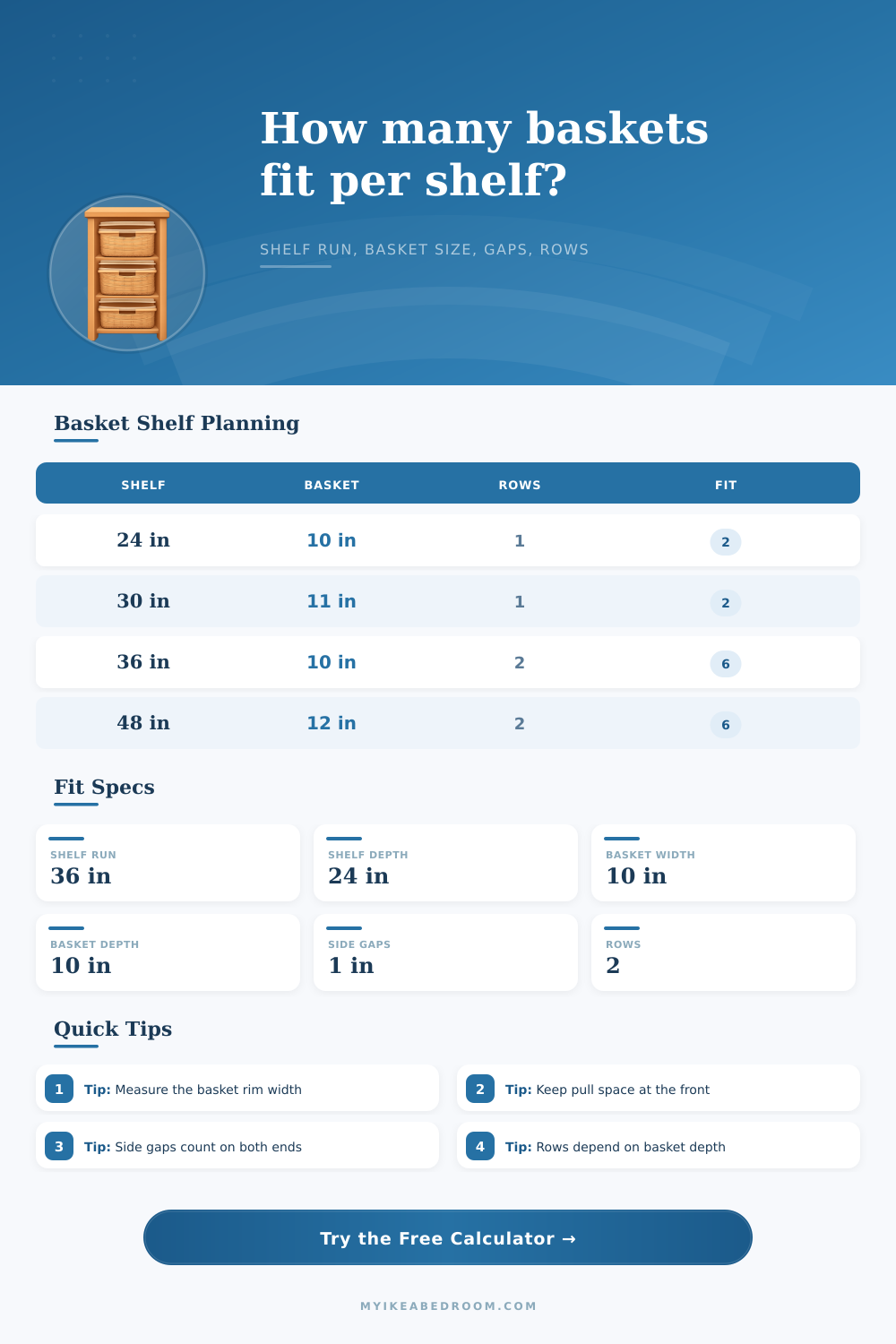
| 36 in linen shelf | 10 x 10 in baskets, 0.5 in side gaps, 24 in depth | 6 baskets per shelf | Three across and two rows when the depth is usable. |
| 13 in cube opening | 13 x 13 in cube basket, small side gaps, 13.5 in depth | 1 basket per shelf | Cube baskets should be measured at the widest rim. |
| 48 in closet shelf | 12 x 10 in baskets, 1 in side gaps, 20 in depth | 3 baskets per shelf | One reachable row may be better for daily clothing storage. |
| 24 in nightstand shelf | 8 x 10 in baskets, 0.5 in gaps, 12 in depth | 2 baskets per shelf | Depth usually limits the layout to one front row. |
| 60 in utility shelf | 12 x 12 in baskets, 1 in side gaps, 30 in depth | 8 baskets per shelf | Wide deep shelves can use two rows without crowding. |
Many baskets flare at the rim or have handles that extend past the base. Use the outside width and depth so the calculated row does not scrape the side panels.
Two rows can double capacity, but the back row is less convenient. Use auto rows for storage shelves and one front row for items pulled every day.
A basket quantity per shelf calculator are a tool that you can use to determine how many baskets will fit on a shelf. By use teh basket quantity per shelf calculator, a person can turn the guesswork of how many baskets will fit on a shelf into a process that can be repeated. Additionally, a person can use the calculator to go from the measurements of the baskets and shelves to the final count of how many baskets will fit.
To determine the number of baskets that will fit on a shelf, specific measurements is required. The shelf run width is the measurement of the shelf from one side to the other. The basket outside width is the measurement of the width of the basket from one side to the other.
How to Count Baskets on a Shelf
The side gap are the spaces between the shelves and the baskets to allow the baskets to be moved in and out of the shelf. By subtracting the side gaps from the shelf run width, the calculator can determine how many basket of the basket outside width will fit into that measurement. Additionally, it is important to measure the outside width of the basket to ensure that the basket will fit on a shelf.
Additional measurements include the depth of the shelf and the depth of the baskets. These two measurements will determine how many rows of baskets can fit on the shelf. The shelf depth is the measurement of the shelf from the front to the back.
By subtracting the space required for fingers and irregularities in the wall, the shelf creates a depth that can be divided by the basket depth to find how many row of baskets will fit on the shelf. Some people may opt for an automatic row mode for the baskets to utilize all of the available depth on the shelf. Others may choose a single row of baskets in the front of the shelf to make the baskets easily accessible to there owner.
Another measurement is the gap between the baskets. The gap between the baskets can be set to a snug fit for the baskets or a loose fit for the baskets to be easily handled. The fit style selector will adjust the gap between the baskets to reflect the number of baskets that will fit on the shelf.
The calculator will tell a person how many baskets will fit on a shelf given the dimensions of the baskets and the shelf. However, the calculator does not account for the use of the shelf. For instance, a linen closet may have baskets with towels that will not be often move.
However, another closet may have baskets with clothing that will be accessed more frequent. For these two different cases, the person may want to set the baskets up for maximum storage on the shelf or for the baskets to be easily accessible by the person who owns the baskets. These two options will allow the owner of the baskets to decide the size of the gap between each basket.
Baskets are not always perfect rectangles. Baskets may have handles that are wider than the base of the basket or they may flare open at the top of the basket. In these instances, the width of the handle or the rim of the basket should be measured for these calculation.
Not all shelves in a closet will necessarily be the same size. The depth of the shelves can vary from other shelves in the closet. The person should perform the basket quantity calculator for the average size of the shelf and the smallest shelf size to determine the range of the number of baskets that will fit on each shelf.
This number will be a helpful tool for the person who is planning to purchase baskets for the closet. The reference tables will show the different size of shelves and how many baskets of each size will fit on each shelf. These table are not rules that will be followed in all cases.
However, these tables will show the common measurements of shelves and baskets and how many of each size will fit. For example, a 36-inch shelf with 10-inch baskets will often allow for three baskets to sit on the shelf. A 24-inch shelf with 10-inch baskets will allow two row of baskets to sit on the shelf.
By increasing the number of rows of baskets on the shelf, the person who owns the baskets will find the back row harder to reach. Additionally, by decreasing the gaps between the baskets, it will be harder to move one basket without having to move the other baskets on the shelf. These tradeoffs can be seen on the calculator next to the per-shelf basket count.
If the leftover space on the shelf is smaller than one basket in width, then the baskets are efficiently arrange on the shelf. However, if the leftover space is large enough to allow for another basket, then the person may want to change the size of the baskets or the gaps between the baskets. To find the total number of baskets that will be contained within the number of shelves in the closet or closet area, the count of baskets per shelf is multiplied by the number of shelves that will be utilized for the baskets.
This multiplication will help the person who is purchasing the baskets to know how many basket to order. This multiplication will also allow the person to decide if altering the size of the gaps between the baskets will allow for an increased number of baskets to be purchased for that area. By using this calculator, the person removes the need to perform the calculation manually.
Additionally, the calculator will provide a count of the number of baskets that will fit on the shelves given the dimensions of the baskets and the shelves. This count is based on the real dimensions of the baskets and shelves, not the dimension in an idealized diagram of the baskets on the shelves. Once this calculator determines the number of baskets, the person can begin to plan their purchase of the baskets.