Bin Quantity for Cube Shelf Calculator
Plan cube openings, bin fit, clearance, partial cubes, backup bins, and the spare capacity left on the shelf.
Every Cube Filled
Uses every calculated slot, best for concealed storage and matched bin fronts.
Mixed Display
Leaves selected openings clear for books, speakers, plants, or folded linens.
Partial Cube Plan
Reduces bin count where outlets, cords, doors, or tall objects limit the opening.
| Plan | Openings | Typical bin count | Best spare capacity use |
|---|---|---|---|
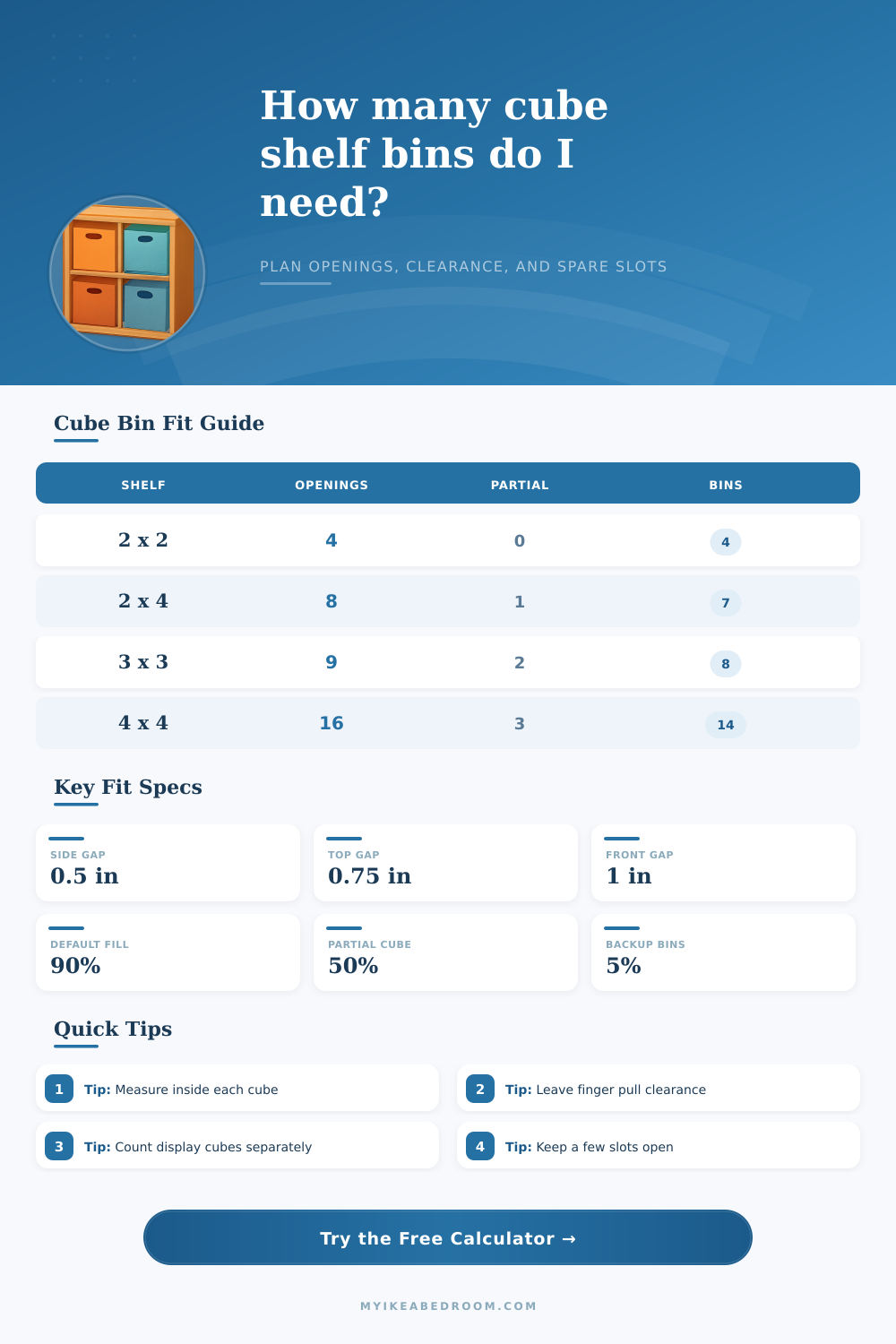
| 2 x 2 entry shelf | 4 | 3 to 4 bins | One open cube for keys or shoes |
| 2 x 4 horizontal shelf | 8 | 6 to 8 bins | One display cube plus one rotating bin |
| 3 x 3 craft wall | 9 | 7 to 9 bins | Partial cubes for paper or tall tools |
| 4 x 4 family storage | 16 | 12 to 16 bins | Open row for shared grab-and-go items |
| Clearance | Low-friction target | Use when | What it protects |
|---|---|---|---|
| Side gap | 0.25 to 0.75 in | Fabric bins or baskets slide often | Side rubbing and pulled seams |
| Top pull gap | 0.5 to 1.25 in | Bins have soft handles or folded rims | Knuckles and bin rim drag |
| Front stop gap | 0.5 to 1.5 in | Bins should sit slightly behind frame face | Doors, trim, and drawer fronts |
| Depth margin | 1 to 2 in | Back cords or wall outlet plugs share a cube | Pinched cords and hard-to-grab bins |
| Partial setting | How to interpret it | Typical reason | Bin count effect |
|---|---|---|---|
| 25% | Only a shallow zone is useful | Outlet, cable box, or deep object | Often zero or one small bin |
| 50% | Half of the opening remains practical | Shared cube with books or folded fabric | About half of full cube slots |
| 75% | Most of the opening still works | Decor object or divider takes one side | Usually one less than full capacity |
| 100% | Count partial openings as full | Temporary obstruction will be removed | Same as a full cube |
| Bin style | Typical size behavior | Cube result | Planning note |
|---|---|---|---|
| Full cube fabric bin | Nearly fills one opening | Usually 1 per cube | Measure the soft rim after it is squared up |
| Half-height basket | Stacks vertically when handles clear | Often 2 per cube | Keep extra top clearance for pull access |
| Small shoebox bin | Can fit across and deep | Often 2 to 4 per cube | Use labels so small bins do not become mixed |
| Deep lidded cube bin | Uses most of the depth | Usually 1 per cube | Leave a front stop gap for the lid lip |
Cube shelves are storage unit that are built on a grid. When one purchase a set of cube shelves, they can be difficult to plan for the various items that will be placed within the shelves once they are in the room. When viewing the cube shelves, they may appear large in the store, but the actual size of the shelves once they are to be fill with bins may be smaller.
In addition to the frame of the shelf taking up space, the dimension of the shelves may not be built in such a way to be perfectly square when viewed from different angle. Additionally, items within the shelf, such as cords or electrical outlet, may take up some of the space within the shelf. Because of this, the actual space within the shelf may be even more smaller than the measurements indicate of the shelf.
How Many Bins Will Fit in Your Cube Shelf
For these reasons, individual must measure the inside of each of the individual cubes rather than measuring the outside of the shelf. Within the calculator that is provide, an individual can determine how many bin will fit into the purchased cube shelves. To determine this number, an individual must enter the size of they purchased shelf, as well as the dimensions of the bins that they plan to purchase.
The calculator will use these dimensions to determine the number of bins that will fit into the shelves. In addition to the dimension of the bins, individuals must account for any blocked opening of the shelf, such as if doors or furniture will cover some of the shelves. Additionally, any openings that are only partially blocked, such as by electrical outlet or tall books, should be accounted for in the calculation.
The calculator will provide a percentage of how many bins may fit into those partially blocked openings. Additionally, it is important to account for the clearance of the bins from the shelves. Bins should account for gaps along the side of the bins to ensure that the fabric of the bin does not become caught on the frame of the shelf.
Additionally, the bins should account for gaps at the top of the bins to allow the individual’s fingers to pull the bin out of the shelf. Additionally, the bins may need to include gaps at the front of the bins to ensure the bin does not become too far in front of the shelf frame. Although small, the calculator accounts for these gap.
Additionally, it is also recommended to include in the total number of bins calculated the number of bin that you may need to purchase in the future. For example, if buying bins for a room for a preschool, you may need to purchase additional bins for additional toy. In another example, if the bins will be used for laundry, there may be the need for additional bins should more laundry item be bought.
Thus, providing for a backup allowance for bins will ensure that you have enough bin for any items that may need to be stored in the future. The alternative to providing for a backup allowance for the bins, though, is to account for empty slot on the shelf. Providing empty slots will provide for the ability to place items in the bins that do not have a specific use, such as mail or a blanket.
Furthermore, leaving empty slots will provide for the shelf to not become too full of items that must be stored. Thus, both the backup allowance and spare capacity are provide in the calculator for individuals to decide how that shelf is to be used. Additionally, the type of bins that will be purchased may impact the number that will fit on the shelf.
For example, half-height baskets may allow for two high stacks of baskets if the handle of the baskets clear the shelf above them. Deep lidded bins may provide for a secure top to each bin of items, but may impact in what way individuals can stack those bins. The calculator accounts for the dimension of the most common types of bins, but these dimension can be altered to reflect the different measurements of the bins that are to be purchased.
Thus, if the dimensions of the bins are enter into the calculator correctly, the calculator will display the number of bins that will fit on the shelf. Some of the most common mistake in calculating how many bins will fit into a shelf is to measure the outside of the shelf rather than the inside of the shelf. For example, the frame of the shelf does not provide for storage for bins, so the space between the uprights and the shelves should be measured.
Another common mistake is to assume that all of the openings of the shelf are the same size. They may be different if there are electrical outlet or walls that impact the shelves. The calculator will help to avoid these types of mistakes since each opening must be named before the calculator will provide the result to the number of bins that will fit into the shelf.
Thus, with the calculator used correct, individuals will know the number of bins that they should purchase. Additionally, they will also know that the bins that they have chose will fit into the shelf that they have purchased. Cube shelves are storage unit that are built on a grid.
When one purchase a set of cube shelves, they can be difficult to plan for the various items that will be placed within the shelves once they are in the room. When viewing the cube shelves, they may appear large in the store, but the actual size of the shelves once you fill them with bins may be smaller. In addition to the frame of the shelf taking up space, the dimension of the shelves may not be built in such a way to be perfectly square when viewed from different angle.
Additionally, items within the shelf, such as cords or electrical outlet, may take up some of the space within the shelf. Because of this, the actual space within the shelf may be even more smaller than the measurements indicate of the shelf. For these reasons, individual must measure the inside of each of the individual cubes rather than measuring the outside of the shelf.
Within the calculator that is provide, an individual can determine how many bin will fit into the purchased cube shelves. To determine this number, an individual must enter the size of they purchased shelf, as well as the dimensions of the bins that they plan to purchase. The calculator will use these dimensions to determine the number of bins that will fit into the shelves.
In addition to the dimension of the bins, individuals must account for any blocked opening of the shelf, such as if doors or furniture will cover some of the shelves. Additionally, any openings that are only partially blocked, such as by electrical outlet or tall books, should be accounted for in the calculation. The calculator will provide a percentage of how many bins may fit into those partially blocked openings.
Additionally, it is important to account for the clearance of the bins from the shelves. Bins should account for gaps along the side of the bins to ensure that the fabric of the bin does not become caught on the frame of the shelf. Additionally, the bins should account for gaps at the top of the bins to allow the individuals fingers to pull the bin out of the shelf.
Additionally, the bins may need to include gaps at the front of the bins to ensure the bin does not become too far in front of the shelf frame. Although small, the calculator accounts for these gap. Additionally, it is also recommended to include in the total number of bins calculated the number of bin that you may need to purchase in the future.
For example, if buying bins for a room for a preschool, you may need to purchase additional bins for additional toy. In another example, if the bins will be used for laundry, there may be the need for additional bins should more laundry item be bought. Thus, providing for a backup allowance for bins will ensure that you have enough bin for any items that may need to be stored in the future.
The alternative to providing for a backup allowance for the bins, though, is to account for empty slot on the shelf. Providing empty slots will provide for the ability to place items in the bins that do not have a specific use, such as mail or a blanket. Furthermore, leaving empty slots will provide for the shelf to not become too full of items that must be stored.
Thus, both the backup allowance and spare capacity are provide in the calculator for individuals to decide how that shelf is to be used. Additionally, the type of bins that will be purchased may impact the number that will fit on the shelf. For example, half-height baskets may allow for two high stacks of baskets if the handle of the baskets clear the shelf above them.
Deep lidded bins may provide for a secure top to each bin of items, but may impact in what way individuals can stack those bins. The calculator accounts for the dimension of the most common types of bins, but these dimension can be altered to reflect the different measurements of the bins that are to be purchased. Thus, if the dimensions of the bins are enter into the calculator correctly, the calculator will display the number of bins that will fit on the shelf.
Some of the most common mistake in calculating how many bins will fit into a shelf is to measure the outside of the shelf rather than the inside of the shelf. For example, the frame of the shelf does not provide for storage for bins, so the space between the uprights and the shelves should be measured. Another common mistake is to assume that all of the openings of the shelf are the same size.
They may be different if there are electrical outlet or walls that impact the shelves. The calculator will help to avoid these types of mistakes since each opening must be named before the calculator will provide the result to the number of bins that will fit into the shelf. Thus, with the calculator used correct, individuals will know the number of bins that they should purchase.
Additionally, they will also know that the bins that they have chose will fit into the shelf that they have purchased. Cube shelves are storage unit that are built on a grid. When one purchase a set of cube shelves, they can be difficult to plan for the various items that will be placed within the shelves once they are in the room.
When viewing the cube shelves, they may appear large in the store, but the actual size of the shelves once you fill them with bins may be smaller. In addition to the frame of the shelf taking up space, the dimension of the shelves may not be built in such a way to be perfectly square when viewed from different angle. Additionally, items within the shelf, such as cords or electrical outlet, may take up some of the space within the shelf.
Because of this, the actual space within the shelf may be even more smaller than the measurements indicate of the shelf. For these reasons, individual must measure the inside of each of the individual cubes rather than measuring the outside of the shelf. Within the calculator that is provide, an individual can determine how many bin will fit into the purchased cube shelves.
To determine this number, an individual must enter the size of they purchased shelf, as well as the dimensions of the bins that they plan to purchase. The calculator will use these dimensions to determine the number of bins that will fit into the shelves. In addition to the dimension of the bins, individuals must account for any blocked opening of the shelf, such as if doors or furniture will cover some of the shelves.
Additionally, any openings that are only partially blocked, such as by electrical outlet or tall books, should be accounted for in the calculation. The calculator will provide a percentage of how many bins may fit into those partially blocked openings. Additionally, it is important to account for the clearance of the bins from the shelves.
Bins should account for gaps along the side of the bins to ensure that the fabric of the bin does not become caught on the frame of the shelf. Additionally, the bins should account for gaps at the top of the bins to allow the individuals fingers to pull the bin out of the shelf. Additionally, the bins may need to include gaps at the front of the bins to ensure the bin does not become too far in front of the shelf frame.
Although small, the calculator accounts for these gap. Additionally, it is also recommended to include in the total number of bins calculated the number of bin that you may need to purchase in the future. For example, if buying bins for a room for a preschool, you may need to purchase additional bins for additional toy.
In another example, if the bins will be used for laundry, there may be the need for additional bins should more laundry item be bought. Thus, providing for a backup allowance for bins will ensure that you have enough bin for any items that may need to be stored in the future. The alternative to providing for a backup allowance for the bins, though, is to account for empty slot on the shelf.
Providing empty slots will provide for the ability to place items in the bins that do not have a specific use, such as mail or a blanket. Furthermore, leaving empty slots will provide for the shelf to not become too full of items that must be stored. Thus, both the backup allowance and spare capacity are provide in the calculator for individuals to decide how that shelf is to be used.
Additionally, the type of bins that will be purchased may impact the number that will fit on the shelf. For example, half-height baskets may allow for two high stacks of baskets if the handle of the baskets clear the shelf above them. Deep lidded bins may provide for a secure top to each bin of items, but may impact in what way individuals can stack those bins.
The calculator accounts for the dimension of the most common types of bins, but these dimension can be altered to reflect the different measurements of the bins that are to be purchased. Thus, if the dimensions of the bins are enter into the calculator correctly, the calculator will display the number of bins that will fit on the shelf. Some of the most common mistake in calculating how many bins will fit into a shelf is to measure the outside of the shelf rather than the inside of the shelf.
For example, the frame of the shelf does not provide for storage for bins, so the space between the uprights and the shelves should be measured. Another common mistake is to assume that all of the openings of the shelf are the same size. They may be different if there are electrical outlet or walls that impact the shelves.
The calculator will help to avoid these types of mistakes since each opening must be named before the calculator will provide the result to the number of bins that will fit into the shelf. Thus, with the calculator used correct, individuals will know the number of bins that they should purchase. Additionally, they will also know that the bins that they have chose will fit into the shelf that they have purchased.
Cube shelves are storage unit that are built on a grid. When one purchase a set of cube shelves, they can be difficult to plan for the various items that will be placed within the shelves once they are in the room. When viewing the cube shelves, they may appear large in the store, but the actual size of the shelves once you fill them with bins may be smaller.
In addition to the frame of the shelf taking up space, the dimension of the shelves may not be built in such a way to be perfectly square when viewed from different angle. Additionally, items within the shelf, such as cords or electrical outlet, may take up some of the space within the shelf. Because of this, the actual space within the shelf may be even more smaller than the measurements indicate of the shelf.
For these reasons, individual must measure the inside of each of the individual cubes rather than measuring the outside of the shelf. Within the calculator that is provide, an individual can determine how many bin will fit into the purchased cube shelves. To determine this number, an individual must enter the size of they purchased shelf, as well as the dimensions of the bins that they plan to purchase.
The calculator will use these dimensions to determine the number of bins that will fit into the shelves. In addition to the dimension of the bins, individuals must account for any blocked opening of the shelf, such as if doors or furniture will cover some of the shelves. Additionally, any openings that are only partially blocked, such as by electrical outlet or tall books, should be accounted for in the calculation.
The calculator will provide a percentage of how many bins may fit into those partially blocked openings. Additionally, it is important to account for the clearance of the bins from the shelves. Bins should account for gaps along the side of the bins to ensure that the fabric of the bin does not become caught on the frame of the shelf.
Additionally, the bins should account for gaps at the top of the bins to allow the individuals fingers to pull the bin out of the shelf. Additionally, the bins may need to include gaps at the front of the bins to ensure the bin does not become too far in front of the shelf frame. Although small, the calculator accounts for these gap.
Additionally, it is also recommended to include in the total number of bins calculated the number of bin that you may need to purchase in the future. For example, if buying bins for a room for a preschool, you may need to purchase additional bins for additional toy. In another example, if the bins will be used for laundry, there may be the need for additional bins should more laundry item be bought.
Thus, providing for a backup allowance for bins will ensure that you have enough bin for any items that may need to be stored in the future. The alternative to providing for a backup allowance for the bins, though, is to account for empty slot on the shelf. Providing empty slots will provide for the ability to place items in the bins that do not have a specific use, such as mail or a blanket.
Furthermore, leaving empty slots will provide for the shelf to not become too full of items that must be stored. Thus, both the backup allowance and spare capacity are provide in the calculator for individuals to decide how that shelf is to be used. Additionally, the type of bins that will be purchased may impact the number that will fit on the shelf.
For example, half-height baskets may allow for two high stacks of baskets if the handle of the baskets clear the shelf above them. Deep lidded bins may provide for a secure top to each bin of items, but may impact in what way individuals can stack those bins. The calculator accounts for the dimension of the most common types of bins, but these dimension can be altered to reflect the different measurements of the bins that are to be purchased.
Thus, if the dimensions of the bins are enter into the calculator correctly, the calculator will display the number of bins that will fit on the shelf. Some of the most common mistake in calculating how many bins will fit into a shelf is to measure the outside of the shelf rather than the inside of the shelf. For example, the frame of the shelf does not provide for storage for bins, so the space between the uprights and the shelves should be measured.
Another common mistake is to assume that all of the openings of the shelf are the same size. They may be different if there are electrical outlet or walls that impact the shelves. The calculator will help to avoid these types of mistakes since each opening must be named before the calculator will provide the result to the number of bins that will fit into the shelf.
Thus, with the calculator used correct, individuals will know the number of bins that they should purchase. Additionally, they will also know that the bins that they have chose will fit into the shelf that they have purchased. Cube shelves are storage unit that are built on a grid.
When one purchase a set of cube shelves, they can be difficult to plan for the various items that will be placed within the shelves once they are in the room. When viewing the cube shelves, they may appear large in the store, but the actual size of the shelves once you fill them with bins may be smaller. In addition to the frame of the shelf taking up space, the dimension of the shelves may not be built in such a way to be perfectly square when viewed from different angle.
Additionally, items within the shelf, such as cords or electrical outlet, may take up some of the space within the shelf. Because of this, the actual space within the shelf may be even more smaller than the measurements indicate of the shelf. For these reasons, individual must measure the inside of each of the individual cubes rather than measuring the outside of the shelf.
Within the calculator that is provide, an individual can determine how many bin will fit into the purchased cube shelves. To determine this number, an individual must enter the size of they purchased shelf, as well as the dimensions of the bins that they plan to purchase. The calculator will use these dimensions to determine the number of bins that will fit into the shelves.
In addition to the dimension of the bins, individuals must account for any blocked opening of the shelf, such as if doors or furniture will cover some of the shelves. Additionally, any openings that are only partially blocked, such as by electrical outlet or tall books, should be accounted for in the calculation. The calculator will provide a percentage of how many bins may fit into those partially blocked openings.
Additionally, it is important to account for the clearance of the bins from the shelves. Bins should account for gaps along the side of the bins to ensure that the fabric of the bin does not become caught on the frame of the shelf. Additionally, the bins should account for gaps at the top of the bins to allow the individuals fingers to pull the bin out of the shelf.
Additionally, the bins may need to include gaps at the front of the bins to ensure the bin does not become too far in front of the shelf frame. Although small, the calculator accounts for these gap. Additionally, it is also recommended to include in the total number of bins calculated the number of bin that you may need to purchase in the future.
For example, if buying bins for a room for a preschool, you may need to purchase additional bins for additional toy. In another example, if the bins will be used for laundry, there may be the need for additional bins should more laundry item be bought. Thus, providing for a backup allowance for bins will ensure that you have enough bin for any items that may need to be stored in the future.
The alternative to providing for a backup allowance for the bins, though, is to account for empty slot on the shelf. Providing empty slots will provide for the ability to place items in the bins that do not have a specific use, such as mail or a blanket. Furthermore, leaving empty slots will provide for the shelf to not become too full of items that must be stored.
Thus, both the backup allowance and spare capacity are provide in the calculator for individuals to decide how that shelf is to be used. Additionally, the type of bins that will be purchased may impact the number that will fit on the shelf. For example, half-height baskets may allow for two high stacks of baskets if the handle of the baskets clear the shelf above them.
Deep lidded bins may provide for a secure top to each bin of items, but may impact in what way individuals can stack those bins. The calculator accounts for the dimension of the most common types of bins, but these dimension can be altered to reflect the different measurements of the bins that are to be purchased. Thus, if the dimensions of the bins are enter into the calculator correctly, the calculator will display the number of bins that will fit on the shelf.
Some of the most common mistake in calculating how many bins will fit into a shelf is to measure the outside of the shelf rather than the inside of the shelf. For example, the frame of the shelf does not provide for storage for bins, so the space between the uprights and the shelves should be measured. Another common mistake is to assume that all of the openings of the shelf are the same size.
They may be different if there are electrical outlet or walls that impact the shelves. The calculator will help to avoid these types of mistakes since each opening must be named before the calculator will provide the result to the number of bins that will fit into the shelf. Thus, with the calculator used correct, individuals will know the number of bins that they should purchase.
Additionally, they will also know that the bins that they have chose will fit into the shelf that they have purchased. Cube shelves are storage unit that are built on a grid. When one purchase a set of cube shelves, they can be difficult to plan for the various items that will be placed within the shelves once they are in the room.
When viewing the cube shelves, they may appear large in the store, but the actual size of the shelves once you fill them with bins may be smaller. In addition to the frame of the shelf taking up space, the dimension of the shelves may not be built in such a way to be perfectly square when viewed from different angle. Additionally, items within the shelf, such as cords or electrical outlet, may take up some of the space within the shelf.
Because of this, the actual space within the shelf may be even more smaller than the measurements indicate of the shelf. For these reasons, individual must measure the inside of each of the individual cubes rather than measuring the outside of the shelf. Within the calculator that is provide, an individual can determine how many bin will fit into the purchased cube shelves.
To determine this number, an individual must enter the size of they purchased shelf, as well as the dimensions of the bins that they plan to purchase. The calculator will use these dimensions to determine the number of bins that will fit into the shelves. In addition to the dimension of the bins, individuals must account for any blocked opening of the shelf, such as if doors or furniture will cover some of the shelves.
Additionally, any openings that are only partially blocked, such as by electrical outlet or tall books, should be accounted for in the calculation. The calculator will provide a percentage of how many bins may fit into those partially blocked openings. Additionally, it is important to account for the clearance of the bins from the shelves.
Bins should account for gaps along the side of the bins to ensure that the fabric of the bin does not become caught on the frame of the shelf. Additionally, the bins should account for gaps at the top of the bins to allow the individuals fingers to pull the bin out of the shelf. Additionally, the bins may need to include gaps at the front of the bins to ensure the bin does not become too far in front of the shelf frame.
Although small, the calculator accounts for these gap. Additionally, it is also recommended to include in the total number of bins calculated the number of bin that you may need to purchase in the future. For example, if buying bins for a room for a preschool, you may need to purchase additional bins for additional toy.
In another example, if the bins will be used for laundry, there may be the need for additional bins should more laundry item be bought. Thus, providing for a backup allowance for bins will ensure that you have enough bin for any items that may need to be stored in the future. The alternative to providing for a backup allowance for the bins, though, is to account for empty slot on the shelf.
Providing empty slots will provide for the ability to place items in the bins that do not have a specific use, such as mail or a blanket. Furthermore, leaving empty slots will provide for the shelf to not become too full of items that must be stored. Thus, both the backup allowance and spare capacity are provide in the calculator for individuals to decide how that shelf is to be used.
Additionally, the type of bins that will be purchased may impact the number that will fit on the shelf. For example, half-height baskets may allow for two high stacks of baskets if the handle of the baskets clear the shelf above them. Deep lidded bins may provide for a secure top to each bin of items, but may impact in what way individuals can stack those bins.
The calculator accounts for the dimension of the most common types of bins, but these dimension can be altered to reflect the different measurements of the bins that are to be purchased. Thus, if the dimensions of the bins are enter into the calculator correctly, the calculator will display the number of bins that will fit on the shelf. Some of the most common mistake in calculating how many bins will fit into a shelf is to measure the outside of the shelf rather than the inside of the shelf.
For example, the frame of the shelf does not provide for storage for bins, so the space between the uprights and the shelves should be measured. Another common mistake is to assume that all of the openings of the shelf are the same size. They may be different if there are electrical outlet or walls that impact the shelves.
The calculator will help to avoid these types of mistakes since each opening must be named before the calculator will provide the result to the number of bins that will fit into the shelf. Thus, with the calculator used correct, individuals will know the number of bins that they should purchase. Additionally, they will also know that the bins that they have chose will fit into the shelf that they have purchased.
Cube shelves are storage unit that are built on a grid. When one purchase a set of cube shelves, they can be difficult to plan for the various items that will be placed within the shelves once they are in the room. When viewing the cube shelves, they may appear large in the store, but the actual size of the shelves once you fill them with bins may be smaller.
In addition to the frame of the shelf taking up space, the dimension of the shelves may not be built in such a way to be perfectly square when viewed from different angle. Additionally, items within the shelf, such as cords or electrical outlet, may take up some of the space within the shelf. Because of this, the actual space within the shelf may be even more smaller than the measurements indicate of the shelf.
For these reasons, individual must measure the inside of each of the individual cubes rather than measuring the outside of the shelf. Within the calculator that is provide, an individual can determine how many bin will fit into the purchased cube shelves. To determine this number, an individual must enter the size of they purchased shelf, as well as the dimensions of the bins that they plan to purchase.
The calculator will use these dimensions to determine the number of bins that will fit into the shelves. In addition to the dimension of the bins, individuals must account for any blocked opening of the shelf, such as if doors or furniture will cover some of the shelves. Additionally, any openings that are only partially blocked, such as by electrical outlet or tall books, should be accounted for in the calculation.
The calculator will provide a percentage of how many bins may fit into those partially blocked openings. Additionally, it is important to account for the clearance of the bins from the shelves. Bins should account for gaps along the side of the bins to ensure that the fabric of the bin does not become caught on the frame of the shelf.
Additionally, the bins should account for gaps at the top of the bins to allow the individuals fingers to pull the bin out of the shelf. Additionally, the bins may need to include gaps at the front of the bins to ensure the bin does not become too far in front of the shelf frame. Although small, the calculator accounts for these gap.
Additionally, it is also recommended to include in the total number of bins calculated the number of bin that you may need to purchase in the future. For example, if buying bins for a room for a preschool, you may need to purchase additional bins for additional toy. In another example, if the bins will be used for laundry, there may be the need for additional bins should more laundry item be bought.
Thus, providing for a backup allowance for bins will ensure that you have enough bin for any items that may need to be stored in the future. The alternative to providing for a backup allowance for the bins, though, is to account for empty slot on the shelf. Providing empty slots will provide for the ability to place items in the bins that do not have a specific use, such as mail or a blanket.
Furthermore, leaving empty slots will provide for the shelf to not become too full of items that must be stored. Thus, both the backup allowance and spare capacity are provide in the calculator for individuals to decide how that shelf is to be used. Additionally, the type of bins that will be purchased may impact the number that will fit on the shelf.
For example, half-height baskets may allow for two high stacks of baskets if the handle of the baskets clear the shelf above them. Deep lidded bins may provide for a secure top to each bin of items, but may impact in what way individuals can stack those bins. The calculator accounts for the dimension of the most common types of bins, but these dimension can be altered to reflect the different measurements of the bins that are to be purchased.
Thus, if the dimensions of the bins are enter into the calculator correctly, the calculator will display the number of bins that will fit on the shelf. Some of the most common mistake in calculating how many bins will fit into a shelf is to measure the outside of the shelf rather than the inside of the shelf. For example, the frame of the shelf does not provide for storage for bins, so the space between the uprights and the shelves should be measured.
Another common mistake is to assume that all of the openings of the shelf are the same size. They may be different if there are electrical outlet or walls that impact the shelves. The calculator will help to avoid these types of mistakes since each opening must be named before the calculator will provide the result to the number of bins that will fit into the shelf.
Thus, with the calculator used correct, individuals will know the number of bins that they should purchase. Additionally, they will also know that the bins that they have chose will fit into the shelf that they have purchased. Cube shelves are storage unit that are built on a grid.
When one purchase a set of cube shelves, they can be difficult to plan for the various items that will be placed within the shelves once they are in the room. When viewing the cube shelves, they may appear large in the store, but the actual size of the shelves once you fill them with bins may be smaller. In addition to the frame of the shelf taking up space, the dimension of the shelves may not be built in such a way to be perfectly square when viewed from different angle.
Additionally, items within the shelf, such as cords or electrical outlet, may take up some of the space within the shelf. Because of this, the actual space within the shelf may be even more smaller than the measurements indicate of the shelf. For these reasons, individual must measure the inside of each of the individual cubes rather than measuring the outside of the shelf.
Within the calculator that is provide, an individual can determine how many bin will fit into the purchased cube shelves. To determine this number, an individual must enter the size of they purchased shelf, as well as the dimensions of the bins that they plan to purchase. The calculator will use these dimensions to determine the number of bins that will fit into the shelves.
In addition to the dimension of the bins, individuals must account for any blocked opening of the shelf, such as if doors or furniture will cover some of the shelves. Additionally, any openings that are only partially blocked, such as by electrical outlet or tall books, should be accounted for in the calculation. The calculator will provide a percentage of how many bins may fit into those partially blocked openings.
Additionally, it is important to account for the clearance of the bins from the shelves. Bins should account for gaps along the side of the bins to ensure that the fabric of the bin does not become caught on the frame of the shelf. Additionally, the bins should account for gaps at the top of the bins to allow the individuals fingers to pull the bin out of the shelf.
Additionally, the bins may need to include gaps at the front of the bins to ensure the bin does not become too far in front of the shelf frame. Although small, the calculator accounts for these gap. Additionally, it is also recommended to include in the total number of bins calculated the number of bin that you may need to purchase in the future.
For example, if buying bins for a room for a preschool, you may need to purchase additional bins for additional toy. In another example, if the bins will be used for laundry, there may be the need for additional bins should more laundry item be bought. Thus, providing for a backup allowance for bins will ensure that you have enough bin for any items that may need to be stored in the future.
The alternative to providing for a backup allowance for the bins, though, is to account for empty slot on the shelf. Providing empty slots will provide for the ability to place items in the bins that do not have a specific use, such as mail or a blanket. Furthermore, leaving empty slots will provide for the shelf to not become too full of items that must be stored.
Thus, both the backup allowance and spare capacity are provide in the calculator for individuals to decide how that shelf is to be used. Additionally, the type of bins that will be purchased may impact the number that will fit on the shelf. For example, half-height baskets may allow for two high stacks of baskets if the handle of the baskets clear the shelf above them.
Deep lidded bins may provide for a secure top to each bin of items, but may impact in what way individuals can stack those bins. The calculator accounts for the dimension of the most common types of bins, but these dimension can be altered to reflect the different measurements of the bins that are to be purchased. Thus, if the dimensions of the bins are enter into the calculator correctly, the calculator will display the number of bins that will fit on the shelf.
Some of the most common mistake in calculating how many bins will fit into a shelf is to measure the outside of the shelf rather than the inside of the shelf. For example, the frame of the shelf does not provide for storage for bins, so the space between the uprights and the shelves should be measured. Another common mistake is to assume that all of the openings of the shelf are the same size.
They may be different if there are electrical outlet or walls that impact the shelves. The calculator will help to avoid these types of mistakes since each opening must be named before the calculator will provide the result to the number of bins that will fit into the shelf. Thus, with the calculator used correct, individuals will know the number of bins that they should purchase.
Additionally, they will also know that the bins that they have chose will fit into the shelf that they have purchased. Cube shelves are storage unit that are built on a grid. When one purchase a set of cube shelves, they can be difficult to plan for the various items that will be placed within the shelves once they are in the room.
When viewing the cube shelves, they may appear large in the store, but the actual size of the shelves once you fill them with bins may be smaller. In addition to the frame of the shelf taking up space, the dimension of the shelves may not be built in such a way to be perfectly square when viewed from different angle. Additionally, items within the shelf, such as cords or electrical outlet, may take up some of the space within the shelf.
Because of this, the actual space within the shelf may be even more smaller than the measurements indicate of the shelf. For these reasons, individual must measure the inside of each of the individual cubes rather than measuring the outside of the shelf. Within the calculator that is provide, an individual can determine how many bin will fit into the purchased cube shelves.
To determine this number, an individual must enter the size of they purchased shelf, as well as the dimensions of the bins that they plan to purchase. The calculator will use these dimensions to determine the number of bins that will fit into the shelves. In addition to the dimension of the bins, individuals must account for any blocked opening of the shelf, such as if doors or furniture will cover some of the shelves.
Additionally, any openings that are only partially blocked, such as by electrical outlet or tall books, should be accounted for in the calculation. The calculator will provide a percentage of how many bins may fit into those partially blocked openings. Additionally, it is important to account for the clearance of the bins from the shelves.
Bins should account for gaps along the side of the bins to ensure that the fabric of the bin does not become caught on the frame of the shelf. Additionally, the bins should account for gaps at the top of the bins to allow the individuals fingers to pull the bin out of the shelf. Additionally, the bins may need to include gaps at the front of the bins to ensure the bin does not become too far in front of the shelf frame.
Although small, the calculator accounts for these gap. Additionally, it is also recommended to include in the total number of bins calculated the number of bin that you may need to purchase in the future. For example, if buying bins for a room for a preschool, you may need to purchase additional bins for additional toy.
In another example, if the bins will be used for laundry, there may be the need for additional bins should more laundry item be bought. Thus, providing for a backup allowance for bins will ensure that you have enough bin for any items that may need to be stored in the future. The alternative to providing for a backup allowance for the bins, though, is to account for empty slot on the shelf.
Providing empty slots will provide for the ability to place items in the bins that do not have a specific use, such as mail or a blanket. Furthermore, leaving empty slots will provide for the shelf to not become too full of items that must be stored. Thus, both the backup allowance and spare capacity are provide in the calculator for individuals to decide how that shelf is to be used.
Additionally, the type of bins that will be purchased may impact the number that will fit on the shelf. For example, half-height baskets may allow for two high stacks of baskets if the handle of the baskets clear the shelf above them. Deep lidded bins may provide for a secure top to each bin of items, but may impact in what way individuals can stack those bins.
The calculator accounts for the dimension of the most common types of bins, but these dimension can be altered to reflect the different measurements of the bins that are to be purchased. Thus, if the dimensions of the bins are enter into the calculator correctly, the calculator will display the number of bins that will fit on the shelf. Some of the most common mistake in calculating how many bins will fit into a shelf is to measure the outside of the shelf rather than the inside of the shelf.
For example, the frame of the shelf does not provide for storage for bins, so the space between the uprights and the shelves should be measured. Another common mistake is to assume that all of the openings of the shelf are the same size. They may be different if there are electrical outlet or walls that impact the shelves.
The calculator will help to avoid these types of mistakes since each opening must be named before the calculator will provide the result to the number of bins that will fit into the shelf. Thus, with the calculator used correct, individuals will know the number of bins that they should purchase. Additionally, they will also know that the bins that they have chose will fit into the shelf that they have purchased.
Cube shelves are storage unit that are built on a grid. When one purchase a set of cube shelves, they can be difficult to plan for the various items that will be placed within the shelves once they are in the room. When viewing the cube shelves, they may appear large in the store, but the actual size of the shelves once you fill them with bins may be smaller.
In addition to the frame of the shelf taking up space, the dimension of the shelves may not be built in such a way to be perfectly square when viewed from different angle. Additionally, items within the shelf, such as cords or electrical outlet, may take up some of the space within the shelf. Because of this, the actual space within the shelf may be even more smaller than the measurements indicate of the shelf.
For these reasons, individual must measure the inside of each of the individual cubes rather than measuring the outside of the shelf. Within the calculator that is provide, an individual can determine how many bin will fit into the purchased cube shelves. To determine this number, an individual must enter the size of they purchased shelf, as well as the dimensions of the bins that they plan to purchase.
The calculator will use these dimensions to determine the number of bins that will fit into the shelves. In addition to the dimension of the bins, individuals must account for any blocked opening of the shelf, such as if doors or furniture will cover some of the shelves. Additionally, any openings that are only partially blocked, such as by electrical outlet or tall books, should be accounted for in the calculation.
The calculator will provide a percentage of how many bins may fit into those partially blocked openings. Additionally, it is important to account for the clearance of the bins from the shelves. Bins should account for gaps along the side of the bins to ensure that the fabric of the bin does not become caught on the frame of the shelf.
Additionally, the bins should account for gaps at the top of the bins to allow the individuals fingers to pull the bin out of the shelf. Additionally, the bins may need to include gaps at the front of the bins to ensure the bin does not become too far in front of the shelf frame. Although small, the calculator accounts for these gap.
Additionally, it is also recommended to include in the total number of bins calculated the number of bin that you may need to purchase in the future. For example, if buying bins for a room for a preschool, you may need to purchase additional bins for additional toy. In another example, if the bins will be used for laundry, there may be the need for additional bins should more laundry item be bought.
Thus, providing for a backup allowance for bins will ensure that you have enough bin for any items that may need to be stored in the future. The alternative to providing for a backup allowance for the bins, though, is to account for empty slot on the shelf. Providing empty slots will provide for the ability to place items in the bins that do not have a specific use, such as mail or a blanket.
Furthermore, leaving empty slots will provide for the shelf to not become too full of items that must be stored. Thus, both the backup allowance and spare capacity are provide in the calculator for individuals to decide how that shelf is to be used. Additionally, the type of bins that will be purchased may impact the number that will fit on the shelf.
For example, half-height baskets may allow for two high stacks of baskets if the handle of the baskets clear the shelf above them. Deep lidded bins may provide for a secure top to each bin of items, but may impact in what way individuals can stack those bins. The calculator accounts for the dimension of the most common types of bins, but these dimension can be altered to reflect the different measurements of the bins that are to be purchased.
Thus, if the dimensions of the bins are enter into the calculator correctly, the calculator will display the number of bins that will fit on the shelf. Some of the most common mistake in calculating how many bins will fit into a shelf is to measure the outside of the shelf rather than the inside of the shelf. For example, the frame of the shelf does not provide for storage for bins, so the space between the uprights and the shelves should be measured.
Another common mistake is to assume that all of the openings of the shelf are the same size. They may be different if there are electrical outlet or walls that impact the shelves. The calculator will help to avoid these types of mistakes since each opening must be named before the calculator will provide the result to the number of bins that will fit into the shelf.
Thus, with the calculator used correct, individuals will know the number of bins that they should purchase. Additionally, they will also know that the bins that they have chose will fit into the shelf that they have purchased. Cube shelves are storage unit that are built on a grid.
When one purchase a set of cube shelves, they can be difficult to plan for the various items that will be placed within the shelves once they are in the room. When viewing the cube shelves, they may appear large in the store, but the actual size of the shelves once you fill them with bins may be smaller. In addition to the frame of the shelf taking up space, the dimension of the shelves may not be built in such a way to be perfectly square when viewed from different angle.
Additionally, items within the shelf, such as cords or electrical outlet, may take up some of the space within the shelf. Because of this, the actual space within the shelf may be even more smaller than the measurements indicate of the shelf. For these reasons, individual must measure the inside of each of the individual cubes rather than measuring the outside of the shelf.
Within the calculator that is provide, an individual can determine how many bin will fit into the purchased cube shelves. To determine this number, an individual must enter the size of they purchased shelf, as well as the dimensions of the bins that they plan to purchase. The calculator will use these dimensions to determine the number of bins that will fit into the shelves.
In addition to the dimension of the bins, individuals must account for any blocked opening of the shelf, such as if doors or furniture will cover some of the shelves. Additionally, any openings that are only partially blocked, such as by electrical outlet or tall books, should be accounted for in the calculation. The calculator will provide a percentage of how many bins may fit into those partially blocked openings.
Additionally, it is important to account for the clearance of the bins from the shelves. Bins should account for gaps along the side of the bins to ensure that the fabric of the bin does not become caught on the frame of the shelf. Additionally, the bins should account for gaps at the top of the bins to allow the individuals fingers to pull the bin out of the shelf.
Additionally, the bins may need to include gaps at the front of the bins to ensure the bin does not become too far in front of the shelf frame. Although small, the calculator accounts for these gap. Additionally, it is also recommended to include in the total number of bins calculated the number of bin that you may need to purchase in the future.
For example, if buying bins for a room for a preschool, you may need to purchase additional bins for additional toy. In another example, if the bins will be used for laundry, there may be the need for additional bins should more laundry item be bought. Thus, providing for a backup allowance for bins will ensure that you have enough bin for any items that may need to be stored in the future.
The alternative to providing for a backup allowance for the bins, though, is to account for empty slot on the shelf. Providing empty slots will provide for the ability to place items in the bins that do not have a specific use, such as mail or a blanket. Furthermore, leaving empty slots will provide for the shelf to not become too full of items that must be stored.
Thus, both the backup allowance and spare capacity are provide in the calculator for individuals to decide how that shelf is to be used. Additionally, the type of bins that will be purchased may impact the number that will fit on the shelf. For example, half-height baskets may allow for two high stacks of baskets if the handle of the baskets clear the shelf above them.
Deep lidded bins may provide for a secure top to each bin of items, but may impact in what way individuals can stack those bins. The calculator accounts for the dimension of the most common types of bins, but these dimension can be altered to reflect the different measurements of the bins that are to be purchased. Thus, if the dimensions of the bins are enter into the calculator correctly, the calculator will display the number of bins that will fit on the shelf.
Some of the most common mistake in calculating how many bins will fit into a shelf is to measure the outside of the shelf rather than the inside of the shelf. For example, the frame of the shelf does not provide for storage for bins, so the space between the uprights and the shelves should be measured. Another common mistake is to assume that all of the openings of the shelf are the same size.
They may be different if there are electrical outlet or walls that impact the shelves. The calculator will help to avoid these types of mistakes since each opening must be named before the calculator will provide the result to the number of bins that will fit into the shelf. Thus, with the calculator used correct, individuals will know the number of bins that they should purchase.
Additionally, they will also know that the bins that they have chose will fit into the shelf that they have purchased. Cube shelves are storage unit that are built on a grid. When one purchase a set of cube shelves, they can be difficult to plan for the various items that will be placed within the shelves once they are in the room.
When viewing the cube shelves, they may appear large in the store, but the actual size of the shelves once you fill them with bins may be smaller. In addition to the frame of the shelf taking up space, the dimension of the shelves may not be built in such a way to be perfectly square when viewed from different angle. Additionally, items within the shelf, such as cords or electrical outlet, may take up some of the space within the shelf.
Because of this, the actual space within the shelf may be even more smaller than the measurements indicate of the shelf. For these reasons, individual must measure the inside of each of the individual cubes rather than measuring the outside of the shelf. Within the calculator that is provide, an individual can determine how many bin will fit into the purchased cube shelves.
To determine this number, an individual must enter the size of they purchased shelf, as well as the dimensions of the bins that they plan to purchase. The calculator will use these dimensions to determine the number of bins that will fit into the shelves. In addition to the dimension of the bins, individuals must account for any blocked opening of the shelf, such as if doors or furniture will cover some of the shelves.
Additionally, any openings that are only partially blocked, such as by electrical outlet or tall books, should be accounted for in the calculation. The calculator will provide a percentage of how many bins may fit into those partially blocked openings. Additionally, it is important to account for the clearance of the bins from the shelves.
Bins should account for gaps along the side of the bins to ensure that the fabric of the bin does not become caught on the frame of the shelf. Additionally, the bins should account for gaps at the top of the bins to allow the individuals fingers to pull the bin out of the shelf. Additionally, the bins may need to include gaps at the front of the bins to ensure the bin does not become too far in front of the shelf frame.
Although small, the calculator accounts for these gap. Additionally, it is also recommended to include in the total number of bins calculated the number of bin that you may need to purchase in the future. For example, if buying bins for a room for a preschool, you may need to purchase additional bins for additional toy.
In another example, if the bins will be used for laundry, there may be the need for additional bins should more laundry item be bought. Thus, providing for a backup allowance for bins will ensure that you have enough bin for any items that may need to be stored in the future. The alternative to providing for a backup allowance for the bins, though, is to account for empty slot on the shelf.
Providing empty slots will provide for the ability to place items in the bins that do not have a specific use, such as mail or a blanket. Furthermore, leaving empty slots will provide for the shelf to not become too full of items that must be stored. Thus, both the backup allowance and spare capacity are provide in the calculator for individuals to decide how that shelf is to be used.
Additionally, the type of bins that will be purchased may impact the number that will fit on the shelf. For example, half-height baskets may allow for two high stacks of baskets if the handle of the baskets clear the shelf above them. Deep lidded bins may provide for a secure top to each bin of items, but may impact in what way individuals can stack those bins.
The calculator accounts for the dimension of the most common types of bins, but these dimension can be altered to reflect the different measurements of the bins that are to be purchased. Thus, if the dimensions of the bins are enter into the calculator correctly, the calculator will display the number of bins that will fit on the shelf. Some of the most common mistake in calculating how many bins will fit into a shelf is to measure the outside of the shelf rather than the inside of the shelf.
For example, the frame of the shelf does not provide for storage for bins, so the space between the uprights and the shelves should be measured. Another common mistake is to assume that all of the openings of the shelf are the same size. They may be different if there are electrical outlet or walls that impact the shelves.
The calculator will help to avoid these types of mistakes since each opening must be named before the calculator will provide the result to the number of bins that will fit into the shelf. Thus, with the calculator used correct, individuals will know the number of bins that they should purchase. Additionally, they will also know that the bins that they have chose will fit into the shelf that they have purchased.
Cube shelves are storage unit that are built on a grid. When one purchase a set of cube shelves, they can be difficult to plan for the various items that will be placed within the shelves once they are in the room. When viewing the cube shelves, they may appear large in the store, but the actual size of the shelves once you fill them with bins may be smaller.
In addition to the frame of the shelf taking up space, the dimension of the shelves may not be built in such a way to be perfectly square when viewed from different angle. Additionally, items within the shelf, such as cords or electrical outlet, may take up some of the space within the shelf. Because of this, the actual space within the shelf may be even more smaller than the measurements indicate of the shelf.
For these reasons, individual must measure the inside of each of the individual cubes rather than measuring the outside of the shelf. Within the calculator that is provide, an individual can determine how many bin will fit into the purchased cube shelves. To determine this number, an individual must enter the size of they purchased shelf, as well as the dimensions of the bins that they plan to purchase.
The calculator will use these dimensions to determine the number of bins that will fit into the shelves. In addition to the dimension of the bins, individuals must account for any blocked opening of the shelf, such as if doors or furniture will cover some of the shelves. Additionally, any openings that are only partially blocked, such as by electrical outlet or tall books, should be accounted for in the calculation.
The calculator will provide a percentage of how many bins may fit into those partially blocked openings. Additionally, it is important to account for the clearance of the bins from the shelves. Bins should account for gaps along the side of the bins to ensure that the fabric of the bin does not become caught on the frame of the shelf.
Additionally, the bins should account for gaps at the top of the bins to allow the individuals fingers to pull the bin out of the shelf. Additionally, the bins may need to include gaps at the front of the bins to ensure the bin does not become too far in front of the shelf frame. Although small, the calculator accounts for these gap.
Additionally, it is also recommended to include in the total number of bins calculated the number of bin that you may need to purchase in the future. For example, if buying bins for a room for a preschool, you may need to purchase additional bins for additional toy. In another example, if the bins will be used for laundry, there may be the need for additional bins should more laundry item be bought.
Thus, providing for a backup allowance for bins will ensure that you have enough bin for any items that may need to be stored in the future. The alternative to providing for a backup allowance for the bins, though, is to account for empty slot on the shelf. Providing empty slots will provide for the ability to place items in the bins that do not have a specific use, such as mail or a blanket.
Furthermore, leaving empty slots will provide for the shelf to not become too full of items that must be stored. Thus, both the backup allowance and spare capacity are provide in the calculator for individuals to decide how that shelf is to be used. Additionally, the type of bins that will be purchased may impact the number that will fit on the shelf.
For example, half-height baskets may allow for two high stacks of baskets if the handle of the baskets clear the shelf above them. Deep lidded bins may provide for a secure top to each bin of items, but may impact in what way individuals can stack those bins. The calculator accounts for the dimension of the most common types of bins, but these dimension can be altered to reflect the different measurements of the bins that are to be purchased.
Thus, if the dimensions of the bins are enter into the calculator correctly, the calculator will display the number of bins that will fit on the shelf. Some of the most common mistake in calculating how many bins will fit into a shelf is to measure the outside of the shelf rather than the inside of the shelf. For example, the frame of the shelf does not provide for storage for bins, so the space between the uprights and the shelves should be measured.
Another common mistake is to assume that all of the openings of the shelf are the same size. They may be different if there are electrical outlet or walls that impact the shelves. The calculator will help to avoid these types of mistakes since each opening must be named before the calculator will provide the result to the number of bins that will fit into the shelf.
Thus, with the calculator used correct, individuals will know the number of bins that they should purchase. Additionally, they will also know that the bins that they have chose will fit into the shelf that they have purchased. Cube shelves are storage unit that are built on a grid.
When one purchase a set of cube shelves, they can be difficult to plan for the various items that will be placed within the shelves once they are in the room. When viewing the cube shelves, they may appear large in the store, but the actual size of the shelves once you fill them with bins may be smaller. In addition to the frame of the shelf taking up space, the dimension of the shelves may not be built in such a way to be perfectly square when viewed from different angle.
Additionally, items within the shelf, such as cords or electrical outlet, may take up some of the space within the shelf. Because of this, the actual space within the shelf may be even more smaller than the measurements indicate of the shelf. For these reasons, individual must measure the inside of each of the individual cubes rather than measuring the outside of the shelf.
Within the calculator that is provide, an individual can determine how many bin will fit into the purchased cube shelves. To determine this number, an individual must enter the size of they purchased shelf, as well as the dimensions of the bins that they plan to purchase. The calculator will use these dimensions to determine the number of bins that will fit into the shelves.
In addition to the dimension of the bins, individuals must account for any blocked opening of the shelf, such as if doors or furniture will cover some of the shelves. Additionally, any openings that are only partially blocked, such as by electrical outlet or tall books, should be accounted for in the calculation. The calculator will provide a percentage of how many bins may fit into those partially blocked openings.
Additionally, it is important to account for the clearance of the bins from the shelves. Bins should account for gaps along the side of the bins to ensure that the fabric of the bin does not become caught on the frame of the shelf. Additionally, the bins should account for gaps at the top of the bins to allow the individuals fingers to pull the bin out of the shelf.
Additionally, the bins may need to include gaps at the front of the bins to ensure the bin does not become too far in front of the shelf frame. Although small, the calculator accounts for these gap. Additionally, it is also recommended to include in the total number of bins calculated the number of bin that you may need to purchase in the future.
For example, if buying bins for a room for a preschool, you may need to purchase additional bins for additional toy. In another example, if the bins will be used for laundry, there may be the need for additional bins should more laundry item be bought. Thus, providing for a backup allowance for bins will ensure that you have enough bin for any items that may need to be stored in the future.
The alternative to providing for a backup allowance for the bins, though, is to account for empty slot on the shelf. Providing empty slots will provide for the ability to place items in the bins that do not have a specific use, such as mail or a blanket. Furthermore, leaving empty slots will provide for the shelf to not become too full of items that must be stored.
Thus, both the backup allowance and spare capacity are provide in the calculator for individuals to decide how that shelf is to be used. Additionally, the type of bins that will be purchased may impact the number that will fit on the shelf. For example, half-height baskets may allow for two high stacks of baskets if the handle of the baskets clear the shelf above them.
Deep lidded bins may provide for a secure top to each bin of items, but may impact in what way individuals can stack those bins. The calculator accounts for the dimension of the most common types of bins, but these dimension can be altered to reflect the different measurements of the bins that are to be purchased. Thus, if the dimensions of the bins are enter into the calculator correctly, the calculator will display the number of bins that will fit on the shelf.
Some of the most common mistake in calculating how many bins will fit into a shelf is to measure the outside of the shelf rather than the inside of the shelf. For example, the frame of the shelf does not provide for storage for bins, so the space between the uprights and the shelves should be measured. Another common mistake is to assume that all of the openings of the shelf are the same size.
They may be different if there are electrical outlet or walls that impact the shelves. The calculator will help to avoid these types of mistakes since each opening must be named before the calculator will provide the result to the number of bins that will fit into the shelf. Thus, with the calculator used correct, individuals will know the number of bins that they should purchase.
Additionally, they will also know that the bins that they have chose will fit into the shelf that they have purchased. Cube shelves are storage unit that are built on a grid. When one purchase a set of cube shelves, they can be difficult to plan for the various items that will be placed within the shelves once they are in the room.
When viewing the cube shelves, they may appear large in the store, but the actual size of the shelves once you fill them with bins may be smaller. In addition to the frame of the shelf taking up space, the dimension of the shelves may not be built in such a way to be perfectly square when viewed from different angle. Additionally, items within the shelf, such as cords or electrical outlet, may take up some of the space within the shelf.
Because of this, the actual space within the shelf may be even more smaller than the measurements indicate of the shelf. For these reasons, individual must measure the inside of each of the individual cubes rather than measuring the outside of the shelf. Within the calculator that is provide, an individual can determine how many bin will fit into the purchased cube shelves.
To determine this number, an individual must enter the size of they purchased shelf, as well as the dimensions of the bins that they plan to purchase. The calculator will use these dimensions to determine the number of bins that will fit into the shelves. In addition to the dimension of the bins, individuals must account for any blocked opening of the shelf, such as if doors or furniture will cover some of the shelves.
Additionally, any openings that are only partially blocked, such as by electrical outlet or tall books, should be accounted for in the calculation. The calculator will provide a percentage of how many bins may fit into those partially blocked openings. Additionally, it is important to account for the clearance of the bins from the shelves.
Bins should account for gaps along the side of the bins to ensure that the fabric of the bin does not become caught on the frame of the shelf. Additionally, the bins should account for gaps at the top of the bins to allow the individuals fingers to pull the bin out of the shelf. Additionally, the bins may need to include gaps at the front of the bins to ensure the bin does not become too far in front of the shelf frame.
Although small, the calculator accounts for these gap. Additionally, it is also recommended to include in the total number of bins calculated the number of bin that you may need to purchase in the future. For example, if buying bins for a room for a preschool, you may need to purchase additional bins for additional toy.
In another example, if the bins will be used for laundry, there may be the need for additional bins should more laundry item be bought. Thus, providing for a backup allowance for bins will ensure that you have enough bin for any items that may need to be stored in the future. The alternative to providing for a backup allowance for the bins, though, is to account for empty slot on the shelf.
Providing empty slots will provide for the ability to place items in the bins that do not have a specific use, such as mail or a blanket. Furthermore, leaving empty slots will provide for the shelf to not become too full of items that must be stored. Thus, both the backup allowance and spare capacity are provide in the calculator for individuals to decide how that shelf is to be used.
Additionally, the type of bins that will be purchased may impact the number that will fit on the shelf. For example, half-height baskets may allow for two high stacks of baskets if the handle of the baskets clear the shelf above them. Deep lidded bins may provide for a secure top to each bin of items, but may impact in what way individuals can stack those bins.
The calculator accounts for the dimension of the most common types of bins, but these dimension can be altered to reflect the different measurements of the bins that are to be purchased. Thus, if the dimensions of the bins are enter into the calculator correctly, the calculator will display the number of bins that will fit on the shelf. Some of the most common mistake in calculating how many bins will fit into a shelf is to measure the outside of the shelf rather than the inside of the shelf.
For example, the frame of the shelf does not provide for storage for bins, so the space between the uprights and the shelves should be measured. Another common mistake is to assume that all of the openings of the shelf are the same size. They may be different if there are electrical outlet or walls that impact the shelves.
The calculator will help to avoid these types of mistakes since each opening must be named before the calculator will provide the result to the number of bins that will fit into the shelf. Thus, with the calculator used correct, individuals will know the number of bins that they should purchase. Additionally, they will also know that the bins that they have chose will fit into the shelf that they have purchased.
Cube shelves are storage unit that are built on a grid. When one purchase a set of cube shelves, they can be difficult to plan for the various items that will be placed within the shelves once they are in the room. When viewing the cube shelves, they may appear large in the store, but the actual size of the shelves once you fill them with bins may be smaller.
In addition to the frame of the shelf taking up space, the dimension of the shelves may not be built in such a way to be perfectly square when viewed from different angle. Additionally, items within the shelf, such as cords or electrical outlet, may take up some of the space within the shelf. Because of this, the actual space within the shelf may be even more smaller than the measurements indicate of the shelf.
For these reasons, individual must measure the inside of each of the individual cubes rather than measuring the outside of the shelf. Within the calculator that is provide, an individual can determine how many bin will fit into the purchased cube shelves. To determine this number, an individual must enter the size of they purchased shelf, as well as the dimensions of the bins that they plan to purchase.
The calculator will use these dimensions to determine the number of bins that will fit into the shelves. In addition to the dimension of the bins, individuals must account for any blocked opening of the shelf, such as if doors or furniture will cover some of the shelves. Additionally, any openings that are only partially blocked, such as by electrical outlet or tall books, should be accounted for in the calculation.
The calculator will provide a percentage of how many bins may fit into those partially blocked openings. Additionally, it is important to account for the clearance of the bins from the shelves. Bins should account for gaps along the side of the bins to ensure that the fabric of the bin does not become caught on the frame of the shelf.
Additionally, the bins should account for gaps at the top of the bins to allow the individuals fingers to pull the bin out of the shelf. Additionally, the bins may need to include gaps at the front of the bins to ensure the bin does not become too far in front of the shelf frame. Although small, the calculator accounts for these gap.
Additionally, it is also recommended to include in the total number of bins calculated the number of bin that you may need to purchase in the future. For example, if buying bins for a room for a preschool, you may need to purchase additional bins for additional toy. In another example, if the bins will be used for laundry, there may be the need for additional bins should more laundry item be bought.
Thus, providing for a backup allowance for bins will ensure that you have enough bin for any items that may need to be stored in the future. The alternative to providing for a backup allowance for the bins, though, is to account for empty slot on the shelf. Providing empty slots will provide for the ability to place items in the bins that do not have a specific use, such as mail or a blanket.
Furthermore, leaving empty slots will provide for the shelf to not become too full of items that must be stored. Thus, both the backup allowance and spare capacity are provide in the calculator for individuals to decide how that shelf is to be used. Additionally, the type of bins that will be purchased may impact the number that will fit on the shelf.
For example, half-height baskets may allow for two high stacks of baskets if the handle of the baskets clear the shelf above them. Deep lidded bins may provide for a secure top to each bin of items, but may impact in what way individuals can stack those bins. The calculator accounts for the dimension of the most common types of bins, but these dimension can be altered to reflect the different measurements of the bins that are to be purchased.
Thus, if the dimensions of the bins are enter into the calculator correctly, the calculator will display the number of bins that will fit on the shelf. Some of the most common mistake in calculating how many bins will fit into a shelf is to measure the outside of the shelf rather than the inside of the shelf. For example, the frame of the shelf does not provide for storage for bins, so the space between the uprights and the shelves should be measured.
Another common mistake is to assume that all of the openings of the shelf are the same size. They may be different if there are electrical outlet or walls that impact the shelves. The calculator will help to avoid these types of mistakes since each opening must be named before the calculator will provide the result to the number of bins that will fit into the shelf.
Thus, with the calculator used correct, individuals will know the number of bins that they should purchase. Additionally, they will also know that the bins that they have chose will fit into the shelf that they have purchased. Cube shelves are storage unit that are built on a grid.
When one purchase a set of cube shelves, they can be difficult to plan for the various items that will be placed within the shelves once they are in the room. When viewing the cube shelves, they may appear large in the store, but the actual size of the shelves once you fill them with bins may be smaller. In addition to the frame of the shelf taking up space, the dimension of the shelves may not be built in such a way to be perfectly square when viewed from different angle.
Additionally, items within the shelf, such as cords or electrical outlet, may take up some of the space within the shelf. Because of this, the actual space within the shelf may be even more smaller than the measurements indicate of the shelf. For these reasons, individual must measure the inside of each of the individual cubes rather than measuring the outside of the shelf.
Within the calculator that is provide, an individual can determine how many bin will fit into the purchased cube shelves. To determine this number, an individual must enter the size of they purchased shelf, as well as the dimensions of the bins that they plan to purchase. The calculator will use these dimensions to determine the number of bins that will fit into the shelves.
In addition to the dimension of the bins, individuals must account for any blocked opening of the shelf, such as if doors or furniture will cover some of the shelves. Additionally, any openings that are only partially blocked, such as by electrical outlet or tall books, should be accounted for in the calculation. The calculator will provide a percentage of how many bins may fit into those partially blocked openings.
Additionally, it is important to account for the clearance of the bins from the shelves. Bins should account for gaps along the side of the bins to ensure that the fabric of the bin does not become caught on the frame of the shelf. Additionally, the bins should account for gaps at the top of the bins to allow the individuals fingers to pull the bin out of the shelf.
Additionally, the bins may need to include gaps at the front of the bins to ensure the bin does not become too far in front of the shelf frame. Although small, the calculator accounts for these gap. Additionally, it is also recommended to include in the total number of bins calculated the number of bin that you may need to purchase in the future.
For example, if buying bins for a room for a preschool, you may need to purchase additional bins for additional toy. In another example, if the bins will be used for laundry, there may be the need for additional bins should more laundry item be bought. Thus, providing for a backup allowance for bins will ensure that you have enough bin for any items that may need to be stored in the future.
The alternative to providing for a backup allowance for the bins, though, is to account for empty slot on the shelf. Providing empty slots will provide for the ability to place items in the bins that do not have a specific use, such as mail or a blanket. Furthermore, leaving empty slots will provide for the shelf to not become too full of items that must be stored.
Thus, both the backup allowance and spare capacity are provide in the calculator for individuals to decide how that shelf is to be used. Additionally, the type of bins that will be purchased may impact the number that will fit on the shelf. For example, half-height baskets may allow for two high stacks of baskets if the handle of the baskets clear the shelf above them.
Deep lidded bins may provide for a secure top to each bin of items, but may impact in what way individuals can stack those bins. The calculator accounts for the dimension of the most common types of bins, but these dimension can be altered to reflect the different measurements of the bins that are to be purchased. Thus, if the dimensions of the bins are enter into the calculator correctly, the calculator will display the number of bins that will fit on the shelf.
Some of the most common mistake in calculating how many bins will fit into a shelf is to measure the outside of the shelf rather than the inside of the shelf. For example, the frame of the shelf does not provide for storage for bins, so the space between the uprights and the shelves should be measured. Another common mistake is to assume that all of the openings of the shelf are the same size.
They may be different if there are electrical outlet or walls that impact the shelves. The calculator will help to avoid these types of mistakes since each opening must be named before the calculator will provide the result to the number of bins that will fit into the shelf. Thus, with the calculator used correct, individuals will know the number of bins that they should purchase.
Additionally, they will also know that the bins that they have chose will fit into the shelf that they have purchased. Cube shelves are storage unit that are built on a grid. When one purchase a set of cube shelves, they can be difficult to plan for the various items that will be placed within the shelves once they are in the room.
When viewing the cube shelves, they may appear large in the store, but the actual size of the shelves once you fill them with bins may be smaller. In addition to the frame of the shelf taking up space, the dimension of the shelves may not be built in such a way to be perfectly square when viewed from different angle. Additionally, items within the shelf, such as cords or electrical outlet, may take up some of the space within the shelf.
Because of this, the actual space within the shelf may be even more smaller than the measurements indicate of the shelf. For these reasons, individual must measure the inside of each of the individual cubes rather than measuring the outside of the shelf. Within the calculator that is provide, an individual can determine how many bin will fit into the purchased cube shelves.
To determine this number, an individual must enter the size of they purchased shelf, as well as the dimensions of the bins that they plan to purchase. The calculator will use these dimensions to determine the number of bins that will fit into the shelves. In addition to the dimension of the bins, individuals must account for any blocked opening of the shelf, such as if doors or furniture will cover some of the shelves.
Additionally, any openings that are only partially blocked, such as by electrical outlet or tall books, should be accounted for in the calculation. The calculator will provide a percentage of how many bins may fit into those partially blocked openings. Additionally, it is important to account for the clearance of the bins from the shelves.
Bins should account for gaps along the side of the bins to ensure that the fabric of the bin does not become caught on the frame of the shelf. Additionally, the bins should account for gaps at the top of the bins to allow the individuals fingers to pull the bin out of the shelf. Additionally, the bins may need to include gaps at the front of the bins to ensure the bin does not become too far in front of the shelf frame.
Although small, the calculator accounts for these gap. Additionally, it is also recommended to include in the total number of bins calculated the number of bin that you may need to purchase in the future. For example, if buying bins for a room for a preschool, you may need to purchase additional bins for additional toy.
In another example, if the bins will be used for laundry, there may be the need for additional bins should more laundry item be bought. Thus, providing for a backup allowance for bins will ensure that you have enough bin for any items that may need to be stored in the future. The alternative to providing for a backup allowance for the bins, though, is to account for empty slot on the shelf.
Providing empty slots will provide for the ability to place items in the bins that do not have a specific use, such as mail or a blanket. Furthermore, leaving empty slots will provide for the shelf to not become too full of items that must be stored. Thus, both the backup allowance and spare capacity are provide in the calculator for individuals to decide how that shelf is to be used.
Additionally, the type of bins that will be purchased may impact the number that will fit on the shelf. For example, half-height baskets may allow for two high stacks of baskets if the handle of the baskets clear the shelf above them. Deep lidded bins may provide for a secure top to each bin of items, but may impact in what way individuals can stack those bins.
The calculator accounts for the dimension of the most common types of bins, but these dimension can be altered to reflect the different measurements of the bins that are to be purchased. Thus, if the dimensions of the bins are enter into the calculator correctly, the calculator will display the number of bins that will fit on the shelf. Some of the most common mistake in calculating how many bins will fit into a shelf is to measure the outside of the shelf rather than the inside of the shelf.
For example, the frame of the shelf does not provide for storage for bins, so the space between the uprights and the shelves should be measured. Another common mistake is to assume that all of the openings of the shelf are the same size. They may be different if there are electrical outlet or walls that impact the shelves.
The calculator will help to avoid these types of mistakes since each opening must be named before the calculator will provide the result to the number of bins that will fit into the shelf. Thus, with the calculator used correct, individuals will know the number of bins that they should purchase. Additionally, they will also know that the bins that they have chose will fit into the shelf that they have purchased.
Cube shelves are storage unit that are built on a grid. When one purchase a set of cube shelves, they can be difficult to plan for the various items that will be placed within the shelves once they are in the room. When viewing the cube shelves, they may appear large in the store, but the actual size of the shelves once you fill them with bins may be smaller.
In addition to the frame of the shelf taking up space, the dimension of the shelves may not be built in such a way to be perfectly square when viewed from different angle. Additionally, items within the shelf, such as cords or electrical outlet, may take up some of the space within the shelf. Because of this, the actual space within the shelf may be even more smaller than the measurements indicate of the shelf.
For these reasons, individual must measure the inside of each of the individual cubes rather than measuring the outside of the shelf. Within the calculator that is provide, an individual can determine how many bin will fit into the purchased cube shelves. To determine this number, an individual must enter the size of they purchased shelf, as well as the dimensions of the bins that they plan to purchase.
The calculator will use these dimensions to determine the number of bins that will fit into the shelves. In addition to the dimension of the bins, individuals must account for any blocked opening of the shelf, such as if doors or furniture will cover some of the shelves. Additionally, any openings that are only partially blocked, such as by electrical outlet or tall books, should be accounted for in the calculation.
The calculator will provide a percentage of how many bins may fit into those partially blocked openings. Additionally, it is important to account for the clearance of the bins from the shelves. Bins should account for gaps along the side of the bins to ensure that the fabric of the bin does not become caught on the frame of the shelf.
Additionally, the bins should account for gaps at the top of the bins to allow the individuals fingers to pull the bin out of the shelf. Additionally, the bins may need to include gaps at the front of the bins to ensure the bin does not become too far in front of the shelf frame. Although small, the calculator accounts for these gap.
Additionally, it is also recommended to include in the total number of bins calculated the number of bin that you may need to purchase in the future. For example, if buying bins for a room for a preschool, you may need to purchase additional bins for additional toy. In another example, if the bins will be used for laundry, there may be the need for additional bins should more laundry item be bought.
Thus, providing for a backup allowance for bins will ensure that you have enough bin for any items that may need to be stored in the future. The alternative to providing for a backup allowance for the bins, though, is to account for empty slot on the shelf. Providing empty slots will provide for the ability to place items in the bins that do not have a specific use, such as mail or a blanket.
Furthermore, leaving empty slots will provide for the shelf to not become too full of items that must be stored. Thus, both the backup allowance and spare capacity are provide in the calculator for individuals to decide how that shelf is to be used. Additionally, the type of bins that will be purchased may impact the number that will fit on the shelf.
For example, half-height baskets may allow for two high stacks of baskets if the handle of the baskets clear the shelf above them. Deep lidded bins may provide for a secure top to each bin of items, but may impact in what way individuals can stack those bins. The calculator accounts for the dimension of the most common types of bins, but these dimension can be altered to reflect the different measurements of the bins that are to be purchased.
Thus, if the dimensions of the bins are enter into the calculator correctly, the calculator will display the number of bins that will fit on the shelf. Some of the most common mistake in calculating how many bins will fit into a shelf is to measure the outside of the shelf rather than the inside of the shelf. For example, the frame of the shelf does not provide for storage for bins, so the space between the uprights and the shelves should be measured.
Another common mistake is to assume that all of the openings of the shelf are the same size. They may be different if there are electrical outlet or walls that impact the shelves. The calculator will help to avoid these types of mistakes since each opening must be named before the calculator will provide the result to the number of bins that will fit into the shelf.
Thus, with the calculator used correct, individuals will know the number of bins that they should purchase. Additionally, they will also know that the bins that they have chose will fit into the shelf that they have purchased.