Pouf Quantity for Living Room Calculator
Estimate how many poufs fit your lounge by room size, seating count, pouf shape, and clear walking space.
✨Living Room Presets
📏Room and Pouf Details
🧮Pouf Size Reference
📊Clearance and Capacity Table
| Pouf Size | Best Use | Clearance Range | Effective Zone |
|---|---|---|---|
| 16 to 18 in | Accent, footrest, child seat | 18 to 24 in | 12 to 18 sq ft |
| 20 to 22 in | Standard spare seat | 24 to 30 in | 18 to 26 sq ft |
| 24 to 26 in | Shared ottoman or lounge seat | 24 to 36 in | 24 to 36 sq ft |
| 30 in plus | Statement pouf or low table substitute | 30 to 36 in | 36 to 52 sq ft |
🏠Common Living Room Plans
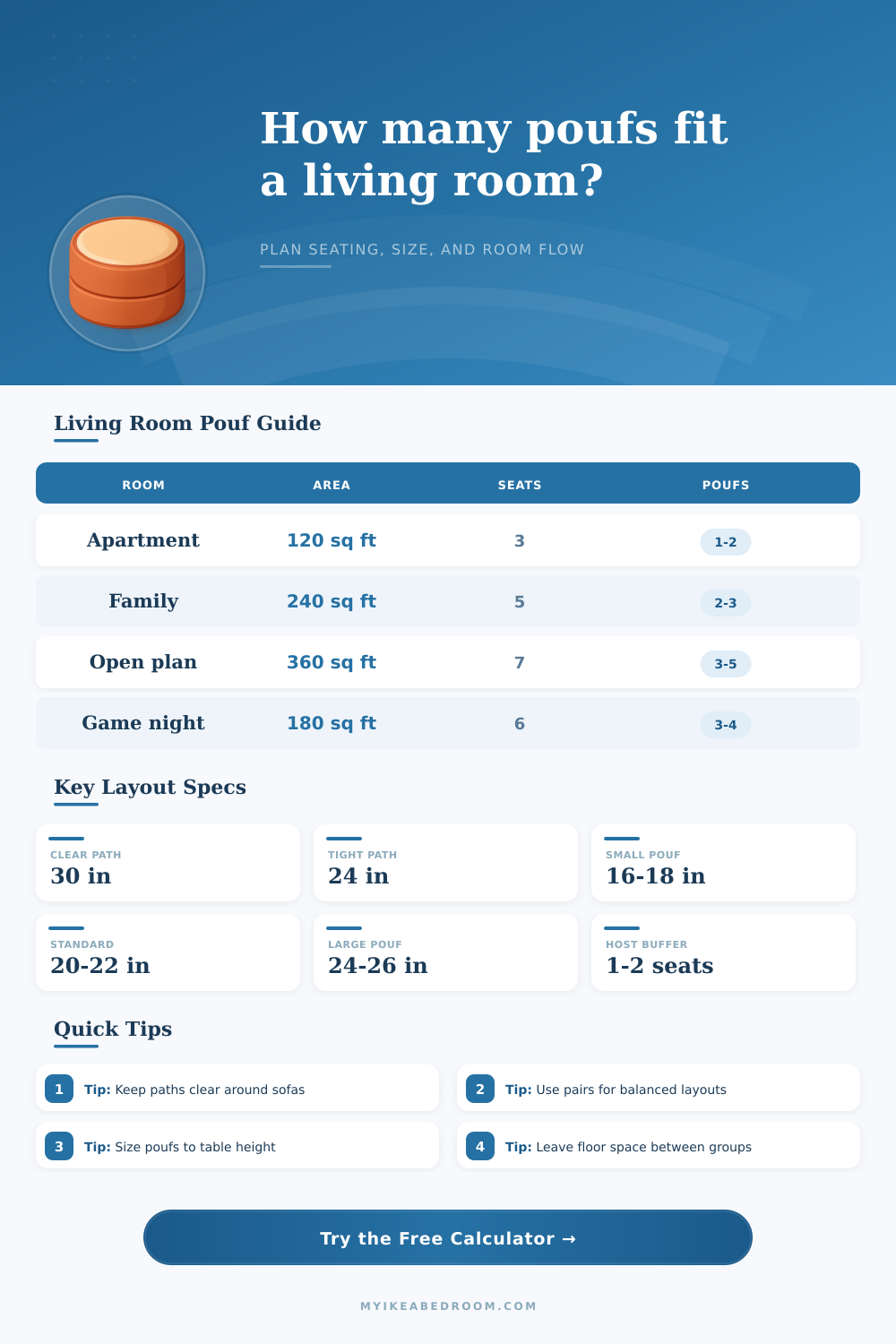
| Living Room Type | Typical Area | Existing Seats | Useful Pouf Range |
|---|---|---|---|
| Studio seating wall | 90 to 130 sq ft | 2 to 3 | 1 to 2 poufs |
| Apartment sofa room | 130 to 190 sq ft | 3 to 4 | 1 to 3 poufs |
| Family sectional room | 200 to 280 sq ft | 5 to 6 | 2 to 4 poufs |
| Open plan lounge | 300 to 450 sq ft | 6 to 8 | 3 to 6 poufs |
🛋Pouf Role Comparison
Accent Pair
Best for symmetry near a sofa, fireplace, or media wall without turning the room into full extra seating.
Ottoman Pouf
Works when one larger pouf can serve feet, tray use, and occasional seating for one person.
Hosting Set
Uses several smaller poufs that can spread around a coffee table during games or casual visits.
Kids Lounge
Allows a higher count because small poufs can sit closer together and move out of the main path.
📐Shape and Footprint Table
| Shape | Typical Size | Top Footprint | Layout Strength |
|---|---|---|---|
| Round | 20 in diameter | 2.2 sq ft | Easy to rotate and cluster |
| Square | 20 by 20 in | 2.8 sq ft | Clean pair beside sofa |
| Rectangular | 24 by 18 in | 3.0 sq ft | Ottoman feel in front of seats |
| Oversized | 30 in diameter | 4.9 sq ft | Single statement floor seat |
💡Layout Tips
When you move into a new living room, there may already be a sofa and chair in the room. You will need to calculates how many additional seat to add to the living room. Poufs can be used as additional seats for the living room.
Poufs can also be used as footrest for people who use the living room as a spot to relax. Additionally, you can easy be moved out of the living room if more floor space is needed. However, poufs do take up some of the floor space in the living room.
How Many Poufs Do You Need in Your Living Room
Depending on the size of the living room, there may not be enough space for several pouf. Additionally, if there are several walking path in the living room for people to walk through, there may not be enough space for poufs to take up too much of that floor space. Thus, determining the correct number of poufs to buy for the living room is a difficult task.
The calculator provided above use mathematical formulas to determine the number of poufs that a living room should have. The calculator will ask for the size of the living room. It will also ask for the area that is taken up by the furniture that cannot be moved out of the living room.
The calculator will ask for the number of existing seat in the living room. Additionally, it will ask for the number of extra guest that you would like to accommodate in the living room. Using this information, the calculator can determine how many pouf zone can exist in the living room without taking up too much of the open floor space in that area.
If these measurements are not provided, the calculator will provide an estimate as to the number of poufs that may be needed, but it will be a guess. The size of the poufs that you are to be purchased will also impact the number of poufs that can be placed in the living room. For instance, if you are to be purchased poufs that are 16 inches in diameter, they may be used in areas like near armchairs where there is limited need for people to walk through the living room.
If poufs are 24 inches in diameter, it is possible that these poufs can be used as coffee tables in the living room. The calculator will ask for the pouf size since the area that the pouf will occupy will take up some of the living room floor space. Additionally, if you are to be used poufs as accent chair next to the sofa, it may be better to use round poufs that require less floor space than rectangular poufs.
The pouf size will also impact the primary function that the poufs will be used for. The function of the poufs will determine the number of poufs that should be bought for the living room. Poufs can be used as accent chairs to sit next to the sofa.
Alternatively, poufs can be used as temporary chairs for guests to sit on. The role selector will ask for the primary function that the poufs will be used for in the living room. For instance, if the living room is to be used for hosting guest, there will need to be more poufs to accommodate the extra bodies in the living room.
Additionally, if the poufs are only to be used for accent purposes, there will be fewer poufs needed for the living room. Thus, the layout of the living room will impact the number of poufs that are needed for that area. Additionally, the layout that is host-focused will require more floor space than a pouf layout that is only to be used for accent purposes.
The amount of clearance that is required around each pouf in the living room will also impact the number of poufs that will fit in that area. For instance, in a corner of the living room that no one walks through, it may be appropriate to provide clearance of only 18 inches around each pouf. However, if children who want to run through the living room are to be used the living room, there must be clearance of 24 inches around each pouf.
The calculator will ask for the amount of clearance that will be provided around each pouf. The person who is calculating the number of poufs that will be bought will build the pouf zones around each pouf using the clearance measurement provided. The number of poufs that will be calculated for the living room may be low if the clearance for each pouf is too high.
In this instance, the clearance setting for the poufs should of been changed to a lower number so that more pouf zones can be built in the living room. Additionally, the number of poufs that can fit in the living room can be increased if there are storage options for the poufs or if the poufs can be nested. For instance, poufs can be purchased that can be stacked on top of each other so that when not in use they do not take up the floor space in the living room.
The calculator will ask if there are any nesting options for the poufs. This will allow the recommended poufs to be a higher number than if the poufs cannot be nested or stored in another location in the living room. The reason for this input box is that the calculator will not suggest that a certain number of poufs will work for a living room if those poufs can be stored elsewhere in the living room.
Additionally, some floor space in the living room may need to be left open for people to walk through the living room. Twenty-five percent of the open floor space in the living room should remain untouched to allow for movement in the living room. If the living room is part of a larger open-plan space, it is possible to leave 35 percent of the floor space in the living room untouched.
The calculator will calculate the percentage of open floor space that will remain clear after the area that is taken up by the living room furniture is subtracted from the total area of the living room. The way that the living room is laid out may also impact the number of poufs that will fit in that area. For instance, people may want to have an even number of poufs in the living room so that they appear symmetrical in the living area.
Alternatively, there may be a preference for having only a single pouf in the living room. The pairing option will ask for a preference for how many poufs should be in the living room. However, this will not change the number of poufs that can exist in the living room based on the area of the living room.
The effectiveness of the poufs in the living room can be tested after the poufs have been in the living room for one week. After one week, it is possible to push the poufs against the walls in the living room if there are any empty spots next to the sofa for people to sit on. In this instance, there were too many poufs for the living room.
However, if the guests of the homeowner have no place to sit on the poufs, then there were too few poufs for the living room. Thus, the pouf calculator provides a good suggestion for the number of poufs that can be bought, but it cannot account for how the living room will be used. Therefore, it is best to enter the actual measurements of the living room into the calculator and to adjust only one variable at a time to see what the best number of poufs is for that specific living room.