Rug Overhang Under Bed Calculator
Estimate side overhang, foot extension, visible rug area, and layout balance for common bedroom rug placements.
Two-thirds under bed
Best for queen and king rooms where nightstands stay off the rug. It usually starts 18 to 30 inches below the headboard.
Full rug under bed
Best when the rug anchors nightstands too. It needs more rug length at the head and still needs enough foot extension.
Foot-only accent
Best for compact bedrooms. It shows at the foot but gives less soft landing along the sides when getting out of bed.
| Bed size | Mattress inches | Common rug | Typical side overhang |
|---|---|---|---|
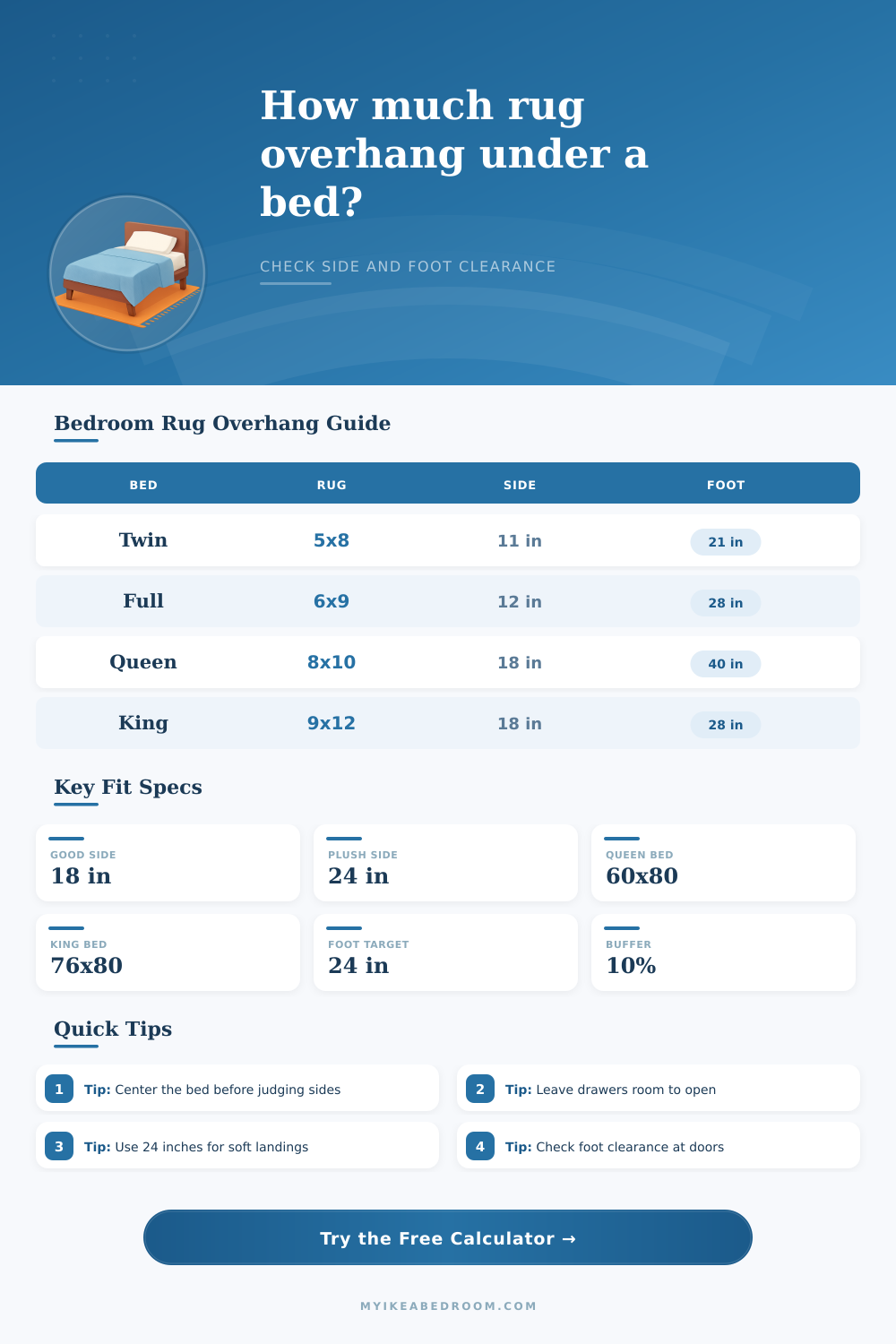
| Twin | 38 x 75 | 5 x 8 ft | 11 in each side |
| Full | 54 x 75 | 6 x 9 ft | 9 to 18 in each side |
| Queen | 60 x 80 | 8 x 10 ft | 18 in each side |
| Queen wide | 60 x 80 | 9 x 12 ft | 24 in each side |
| King | 76 x 80 | 9 x 12 ft | 16 to 22 in each side |
| Cal king | 72 x 84 | 9 x 12 ft | 18 to 24 in each side |
| Layout | Start below headboard | Works well for | Watch point |
|---|---|---|---|
| Full under bed | 0 to 6 in | Nightstands on rug | Needs long rug |
| Two-thirds under | 18 to 30 in | Queen and king beds | Center side overhang |
| Lower half under | 34 to 46 in | Small rooms | Less side landing |
| Foot-only accent | 50 to 66 in | Benches and chests | Minimal bedside softness |
| Rug size | Queen bed result | King bed result | Best use |
|---|---|---|---|
| 4 x 6 ft | Foot accent only | Too narrow under bed | Daybed or small twin |
| 5 x 8 ft | Short side reveal | Too narrow under bed | Twin bed or bedside layer |
| 6 x 9 ft | Compact queen fit | Too narrow for sides | Full bed or small queen |
| 8 x 10 ft | Balanced queen fit | Compact king fit | Two-thirds layout |
| 9 x 12 ft | Generous queen fit | Balanced king fit | Larger bedrooms |
| 10 x 14 ft | Room-scale queen | Generous king fit | Full under-bed layout |
| Measured overhang | Side feel | Foot feel | Layout note |
|---|---|---|---|
| Under 6 in | Mostly hidden | Very tight | Use as accent only |
| 6 to 11 in | Light reveal | Short reveal | Acceptable for small rooms |
| 12 to 17 in | Usable landing | Moderate reveal | Good compact choice |
| 18 to 23 in | Balanced | Strong reveal | Works for most bedrooms |
| 24 in or more | Plush | Room anchoring | Best for larger layouts |
When placing a rug under an bed in a bedroom, the placement of the rug can impact the way that the floor feel when walking in the bedroom. Rugs is often purchased for their appearance, but the most important factor when choosing a rug and the way that it will be placed on the bedroom floor is the overhang of the rug. The overhang of a rug is the measurement of how much of the rug extends beyond the sides of the mattress and the foot of the mattress.
The overhang will impact whether a person’s nightstand will sit upon the rug, and whether the rug feels large or small within the bedroom. In determining the overhang of the rug, a person must consider the proportions of the rug in relation to the bed and the bedroom. For instance, if the rug is too narrow in relation to the bed, a person may step upon the floor instead of the rug when stepping out of bed.
Where to put a rug under your bed
Too wide a rug may result in the placement of nightstands upon the edge of the rug, or upon the floor entirely. A rug calculator can help a person determine these measurement for there specific bedroom; the rug calculator will ask for the dimensions of the mattress, the rug, and the depth at which the rug should be placed in the bedroom relative to the headboard. Many bedroom layout feature a rug placed at the two-thirds mark along the bed.
For instance, the rug may begin at a depth of between 18 and 30 inches from the headboard. A rug placed at this depth will ensure that the nightstands do not land upon the rug, and will leave space along the foot of the bed for a bench or walkway. Another option is to place the entire bed upon the rug.
Rug calculators will recommend that the rug is longer if it is to cover the entire bed frame. An alternative to placing a rug upon the entire bed is to place only the rug at the foot of the bed. However, this placement will mean that the person has to step upon the rug when stepping out of bed in the morning, or upon the floor upon waking.
The side overhang of the rug should be at least 18 inches; an overhang of only 12 inches may appear sufficient for covering the sides of the bed frame; however, due to the thick edge of the mattress, a person may find themselves stepping upon the floor instead of the rug if only 12 inches of rug extends beyond the side of the mattress. An overhang of 24 inches will provide a feeling of more substantial than the rug within the bedroom. Rug calculators typically permit a person to input their target overhang of the rug, as well as applying a percentage to that target that accounts for any potential deviation of the bed from the center of the rug.
The foot overhang of the rug determine whether a footrest or bench will sit upon the rug. Additionally, when viewing the rug from the doorway of the bedroom, the foot overhang of the rug can impact the appearance of the rug. A common target for rug foot overhang is 24 inches.
Rug calculators can compare the foot overhang that the rug will create to the target foot overhang, and account for a certain buffer in their calculations to allow for placement of the bed into the bedroom. Another measurement that may surprise many individuals is the visible rug area. For instance, if the bed covers the majority of the rug, the visible rug area will be smaller than the rug of which the bed is covering it.
Rug calculators ask for the dimensions of the rug and the bed; the calculator will automatically calculate the visible area of the rug. This measurement is especially helpful for those who are considering two different size rug; the visible rug area will indicate the amount of rug pattern that will be visible within the bedroom. Rug calculators also ask for the width of the nightstands.
This dimension is requested because rug calculators will help to determine whether the nightstands will sit upon the rug; if the individual intends to purchase nightstands that are wider than the current width of the nightstands in the bedroom, the individual will enter the wider dimensions into the rug calculator to help determine whether the rug will remain balanced. Many individuals make two common errors when inputting rug dimensions into the rug calculator. First, individuals often measure the distance from the wall to the bed frame instead of measuring the width of the bed upon which the rug will land.
Second, individuals often do not account for the dimensions of their bed frame. For instance, the bed frame may extend beyond the mattress; in such instances, the rug will cover more of the rug than the bed alone. Therefore, the dimensions of the bed frame will impact the rug calculation.
The material from which the rug is made will impact the rug’s appearance. Rug calculators do not ask for the material from which the rug is made; however, rugs with high piles, such as thick wool rugs, may require less overhang than rugs with low piles, such as flatweave rugs. Additionally, rugs with low rugs may require more visible rug area to provide an appearance of intentional within the bedroom.
Finally, placing tape upon the bedroom floor will assist the individual in determining whether the rug calculations are correct prior to purchase of the rug. The rug calculator will provide the measurements that should be used to purchase a rug to place under the bed; however, walking upon the bedroom floor with the rug calculations will allow an individual to determine whether the rug placement is correct for there bedroom.