Blind Ladder Cord Length Calculator
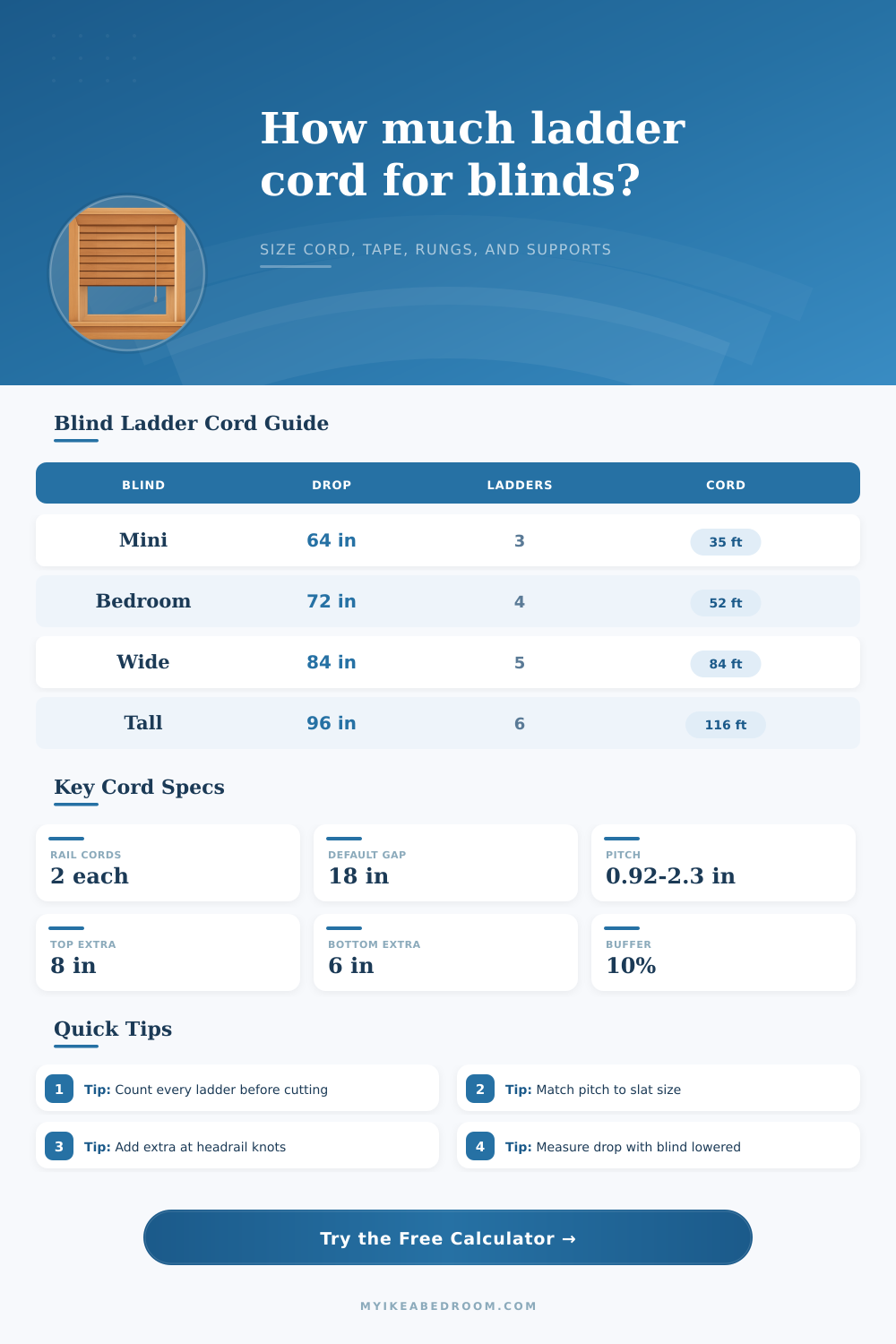
Estimate replacement ladder cord or ladder tape for horizontal blinds using drop, slat pitch, ladder count, rung span, and knot allowance.
📌Real Blind Presets
📏Blind Measurements
🧵Material Comparison Grid
📊Slat Pitch Reference
| Slat type | Typical pitch | Metric pitch | Use in calculator |
|---|---|---|---|
| 1 in aluminum mini slat | 0.92 in | 23 mm | Dense ladder rungs |
| 1 in vinyl slat | 1.00 in | 25 mm | Simple 1:1 count |
| 2 in wood or faux slat | 1.85 in | 47 mm | Common bedroom blinds |
| 2.5 in wide slat | 2.30 in | 58 mm | Fewer rungs per drop |
🖼Ladder Count by Blind Width
| Finished blind width | Suggested ladders | Average spacing | Replacement note |
|---|---|---|---|
| Up to 24 in / 61 cm | 2 ladders | About 12 in | Small sash or side window |
| 25-36 in / 64-91 cm | 3 ladders | 12-18 in | Most single bedroom windows |
| 37-54 in / 94-137 cm | 4 ladders | 13-18 in | Wider single blind |
| 55-72 in / 140-183 cm | 5 ladders | 14-18 in | Large window or patio blind |
| 73-96 in / 185-244 cm | 6 ladders | 15-19 in | Wide blind, verify count |
🔧Cord, Tape, and Allowance Table
| Material | Rung span value | Top allowance | Best measured from |
|---|---|---|---|
| Fine mini-blind ladder cord | 1.00 in per rung | 6-8 in | Headrail cord exit |
| Standard braided ladder cord | 1.25 in per rung | 8-10 in | Old ladder knot path |
| Heavy wood-blind ladder cord | 1.50 in per rung | 10-12 in | Tilt drum to bottom rail |
| Decorative ladder tape | 0 in in this calculator | 10-14 in | Front tape face |
📝Preset Output Examples
| Scenario | Blind size | Material setting | Typical final length |
|---|---|---|---|
| Mini blind, narrow sash | 23 x 64 in | Fine cord, 2 ladders | About 24 ft |
| Bedroom single window | 30 x 64 in | Standard cord, 3 ladders | About 37 ft |
| Wood slat bedroom blind | 39 x 72 in | Heavy cord, 4 ladders | About 58 ft |
| Wide tape ladder blind | 60 x 72 in | 1.5 in tape, 5 ladders | About 70 ft |
| Tall patio door blind | 72 x 84 in | Standard cord, 5 ladders | About 86 ft |
💡Measurement Tips
When ladder cords stop working proper, the issue is not usualy with the slats on the blind but with the ladder cords that holds the slats. These thin cords run the full length of the blind. Additionally, the ladder cords carries the small cross rungs that keep each slat from sag.
Over time, the ladder cords can stretch and wear down to the point where they no longer hold the slats properly. If you are to replace the ladder cords on a blind, you must find the right amount of ladder cord material for your blind. If you buy too little ladder cord material, you will not have enough to complete the job.
How to Measure and Calculate Ladder Cord for Your Blinds
However, if you buy to much ladder cord material, you will waste your money buying material that you will not use on the blind. The amount of ladder cord material you need involve more than measuring the drop measurement of your blind. To make it easier, blind repair professionals uses a dedicated calculator that allows them to account for all the different measurements of a blind at once.
The drop of a blind is the first measurement that should be used when calculating how much ladder cord material is needed to replace the cords on a blind. The drop measurement is taken from the headrail of the blind to the bottom rail of the blind when it is lowered to the floor. However, the length of ladder cord needed also takes into account the two vertical rails on every blind.
The ladder cord also needs to account for the top and bottom section of the blind that disappear into the knots. If you simply multipliy the drop measurement by two, you will not account for the ladder cord material that goes into the knots. Using a calculator will save you the trouble of having to calculate this yourself.
Slat pitch is the second most importantly measurement that is used to calculate the amount of ladder cord material that is needed for a blind. The slat pitch is the distance between two neighboring slats on the blind. This measurement determine the number of cross rungs that will be sitting within each ladder.
For mini blinds that are only one inch in height, the slat pitch is usually close to one inch. For wood blinds that are two inches in height, the slat pitch is closer to one point eight five inches. The wider the slat pitch, the fewer the number of rungs that will be required for the blind.
Many people tend to ignore this measurement because they believe all blinds uses the same slat pitch. However, mini blinds have a higher slat pitch then wood blinds. The ladder count for a blind is determined by the finished width of the blind, not the width of the opening in the window.
Blinds that are twenty-four inches in width or less will have only two ladder. However, the wider the blind, the more ladders the manufacturer will use to ensure that the slats do not sag between the ladders. A thirty-six inch blind will usually have three ladders, while blinds that are seventy-two inches in width or more will have five or six ladder.
The distance between the ladders on a blind is usually no more than eighteen inches apart because the slats may begin to flex if they are not properly support by the ladders. A ladder count calculator will allow you to determine the number of ladders that you blind will need. Alternatively, you can simply count the number of ladders that are on the blind if it is already installed in the window.
The type of material for the ladder cords will have a small effect on the amount of ladder cord material that you will need. Standard braided ladder cord will require allowance for the rungs because each rung will take up some of the ladder cord material. Decorative ladder tape does not have rungs so the rung span value for ladder tape will be zero.
Heavy cord is often used for wood blinds and will have a larger rung span than the fine cord used for mini blinds. The difference in rung span between the two types of material can be very significant when there are numerous rungs to each tall blind. Fortunately, ladder cord calculators make adjustments for the type of material that will be used on a blind.
Thus, the total amount of material needed is always accurate when you use these calculator. There are allowances for the ladder cord material that disappears into the knots on the blind. There are two allowances for ladder cord material; one for the top and one for the bottom of the blind.
The length for these allowances will vary between blinds because the hardware for the blinds can differ. For example, the headrail of the blind might require eight or ten inches of ladder cord for the knots to properly sit in the headrail. The same is true for the bottom rail of the blind.
However, the bottom rail might require six inch of ladder cord for tying the blind properly. Just as with the slat pitch and ladder count, a ladder cord material calculator will make allowances for the lengths of ladder cord that go into the knots. This will save you the trouble of having to calculate the lengths of these cords yourself.
A small percentage must be added to the total length of ladder cord material needed for a blind for two main reason. The first reason is to account for any error in measuring the lengths of ladder cord material. The second reason is for the loss of ladder cord material when making knots in the blind.
A ten percent buffer for each allowance accounts for each of these reason. However, if you are a novice in ladder cord repair, a fifteen or twenty percent buffer will provide you with some extra ladder cord material in case you have to tie a knot a second time. After all the other measurement are accounted for, the buffer will be calculated in the total amount of ladder cord material needed.
The result that is given from a ladder cord material calculator is the total amount of ladder cord material needed for the entire blind. This result is not the length of each individual ladder. It is up to you to cut the ladder cords into the individual length needed for each ladder.
However, the rung count will tell you the number of short cross rungs that will be needed. This information will help you when purchasing the ladder cord material. If it is sold on a spool, the rung and ladder calculation will let you know if one spool will be enough for each blind or if you will need to purchase two spools of ladder cord.
The best way to measure a blind is to measure the old ladder cord that is on the blind before you remove it. When you have measured the old ladder, lay it flat on a table and take a measurement from the top of the blind to the bottom of the blind. If the measurement that you measured before removing the old ladder cord is close to the result of the calculator, then you know that your measurement are accurate.
However, if your measurement and the result of the calculator are significantly different from each other, then the difference in measurements is likely due to an incorrect slat pitch or an incorrect ladder count. If the measurement that you took of the old ladder is significantly less than the calculators result, then it is also possible that the old ladder cord has stretched over time. Some of the most common mistake made with measuring ladder cords are measuring the window opening instead of the blind, forgetting that blinds have two vertical rails, and assuming that ladder tape will have the same rungs as cord ladders.
Additionally, it is common for people to forget to add the buffer when they are purchasing ladder cord. If you forget to add the buffer, you will find yourself without enough ladder cord to make a proper knot for the blind. These mistake can all be avoided by measuring the blind and using the measurements instead of making assumptions about the blinds components.
The main value of the ladder cord material calculator is that it will save people the trouble of performing mental mathematics. All that will happen is you will input each of the measurements of your blind. Then, you will adjust the type of material that will be used on the blind.
You will also adjust the allowances for the top and bottom of the blind. Finally, the calculator will give you the total amount of ladder cord material that you will need to purchase. Additionally, the other figures will allow you to calculate the amount of each individual ladder that you will need to cut.
Thus, you will never have to go to the store twice to purchase the ladder cord material for your blind.