Roller Blind Slat Quantity Calculator
Estimate slats per blind, total spare pieces, cut length, overlap pitch, and finished coverage for bedroom window blind repairs or refits.
📌Real Window Presets
📏Blind and Slat Measurements
⚙Material and Profile Grid
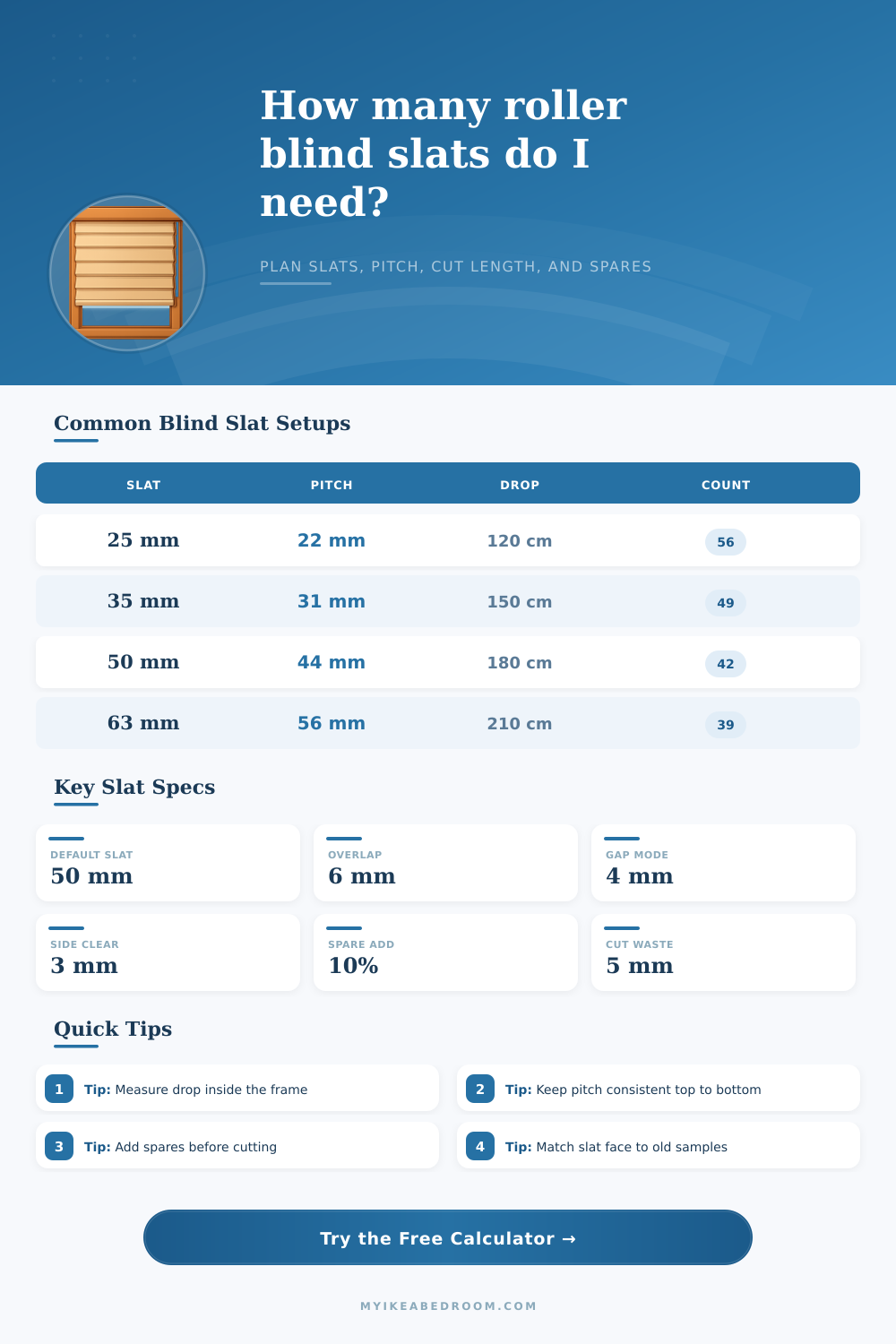
📊Slat Pitch Reference
| Slat face | Typical overlap | Effective pitch | Slats for 150 cm drop |
|---|---|---|---|
| 25 mm mini slat | 3 mm | 22 mm | 68 to 69 pieces |
| 35 mm medium slat | 4 mm | 31 mm | 48 to 49 pieces |
| 50 mm wide slat | 6 mm | 44 mm | 34 to 35 pieces |
| 63 mm timber slat | 7 mm | 56 mm | 27 to 28 pieces |
| 89 mm fabric vane | 10 mm | 79 mm | 19 to 20 pieces |
Pitch in overlap mode equals slat face minus overlap. A complete stack usually needs one starting slat plus enough pitch repeats to cover the remaining usable drop.
📐Cut Length and Deduction Table
| Blind width | Side clearance | Finished slat | Cut blank with 5 mm trim |
|---|---|---|---|
| 600 mm / 23.62 in | 3 mm each side | 594 mm / 23.39 in | 599 mm / 23.58 in |
| 800 mm / 31.50 in | 3 mm each side | 794 mm / 31.26 in | 799 mm / 31.46 in |
| 1000 mm / 39.37 in | 4 mm each side | 992 mm / 39.06 in | 997 mm / 39.25 in |
| 1200 mm / 47.24 in | 4 mm each side | 1192 mm / 46.93 in | 1197 mm / 47.13 in |
| 1500 mm / 59.06 in | 5 mm each side | 1490 mm / 58.66 in | 1495 mm / 58.86 in |
🪟Common Bedroom Window Examples
| Window setup | Measured size | Profile and pitch | Estimated slats |
|---|---|---|---|
| Narrow side window | 24 x 48 in | 25 mm slat, 22 mm pitch | 53 per blind |
| Standard bedroom | 36 x 60 in | 50 mm slat, 44 mm pitch | 32 per blind |
| Wide bedroom window | 60 x 64 in | 50 mm slat, 44 mm pitch | 34 per blind |
| Tall balcony door glass | 22 x 72 in | 35 mm slat, 31 mm pitch | 57 per blind |
| Metric tall window | 100 x 210 cm | 63 mm slat, 56 mm pitch | 37 per blind |
🧵Material Comparison Table
| Material profile | Typical face | Approx. weight | Best calculation note |
|---|---|---|---|
| PVC mini slat | 25 mm | 90 g/m | Add more spares for brittle older pieces |
| Aluminum mini slat | 25 mm | 70 g/m | Use tighter cut checks to avoid bent ends |
| Vinyl medium slat | 35 mm | 130 g/m | Keep overlap modest to prevent heavy stacks |
| Basswood slat | 50 mm | 160 g/m | Measure old slat crown before matching |
| Faux wood slat | 50 mm | 220 g/m | Check headrail lift rating on tall blinds |
| Wide timber slat | 63 mm | 260 g/m | Use fewer pitch repeats but heavier stacks |
| Fabric vane | 89 mm | 110 g/m | Use reveal gap mode for separated vanes |
💡Measurement Tips
The roller blind slat quantity calculator is used to determine the quantity of roller blind slats that is needed for a given window. This calculator is used in place of measuring the window themself, as purchasing too many slat will waste money, while purchasing too few will prevent the blind from completely cover the window. The height of the window that the blind will cover may include the headrail and bottom rail of the window.
These measurement are included in the height of the window, but the blind slats does not cover these measurements. By using the calculator to subtract these measurements from the total height of the window, the blind will accurately fit within the window. Two factor that will impact the number of slats that are required for the blind are the face height of each slat and the number of slat overlaps.
How Many Blind Slats Do I Need
The face height is the height of each slat of the blind, and the number of overlaps is the number of slats that the following slat will cover. Using different overlap settings will require a different number of slats to cover the same distance. The calculator will indicate the number of slats required with each type of overlap settings.
The material from which the slats is made will impact the total weight of the blind. Blinds made from heavier materials will exert more pressure upon the lift mechanism of the blind compared to blinds made from light materials. Each material will have a different impact upon the total weight of the blind.
The calculator will show how each material will impact the weight of the blind. It is also important to purchase some spare blind slats in case one of the slats break or becomes damaged in some fashion. Typically, individuals will purchase some percentage of spare slats when they calculate the number of slats required for the blind.
The spare slats may be required in case the individuals are purchasing a color for the blind that is not common (as common white PVC blind), but fewer spare slats may be purchased for a common color blind. The calculator will indicate the number of spare slats that will be provided with the blind according to the percentage of spare slats that are selected. In addition to the calculations of the length that is required for the blind, it is also important to factor in the amount of side clearance that the blind will require.
The side clearance is the amount of space that the blind will require on each side of the window to prevent the blind from hitting against the window brackets. In addition, the trim allowance is the amount of space that will be cut from the blind slats to allow for the slats to be squared after they are cut from the blind slat package. These measurements may seem small in the context of the total length of the blind, but they do have an impact upon the total length of the blind slats.
The blind slat quantity calculator individually calculate these measurements to ensure that each measurement is accounted for. The reference tables included on the page can be utilized to verify the calculations performed by the calculator. The reference tables include common pitches for blinds and the deductions in length that each type of blind require.
In the case that the calculations from the calculator indicate a number that is very different from the reference tables, it is recommended that an individual check their measurements with the window to be certain that the measurements are correct; incorrectly measuring the window will result in incorrectly cutting the slats. Beyond calculating the number of slats that are required for standard windows, the calculator can also be used for non-standard windows. For example, bay window or door windows will have different calculations performed for those windows than a standard window.
The calculator allows for each of these windows to have different setting for each window. It is also recommended that prior to using the calculator to determine the number of slats that are required for the blind, that an individual measures an existing slat of a blind. The measurements of an existing blind will be more accurate than the measurements that are provided in the blinds catalog.
Thus, by using the calculator with the accurate measurements of each slat, the individual will have a list of the number of slats that are required to purchase.