Roman Shade Cord Length Calculator
Estimate lift cord length for roman shades by finished size, lift columns, cord-lock side, headrail routing, pull tail, knots, and buffer.
📌Real Shade Presets
🧵Cord Routing Inputs
📏Cord Material Comparison
🗂Reference Tables
| Shade Width | Usual Columns | Outer Inset | Header Travel Check |
|---|---|---|---|
| 18-28 in | 2 lift cords | 2 in | Shortest cord crosses one side |
| 29-42 in | 3 lift cords | 2-2.5 in | Middle cord adds half-width travel |
| 43-60 in | 4 lift cords | 2.5-3 in | Outer cord has the longest header run |
| 61-78 in | 5 lift cords | 3 in | Add support before spans exceed 18 in |
| Cord Path Choice | Header Run Formula | Tail Count | Best Fit |
|---|---|---|---|
| Left side lock | Column position to left edge | One shared or all cords | Left-hand access or wall clearance |
| Right side lock | Right edge minus column position | One shared or all cords | Most common room layout |
| Center pull point | Distance to shade center | One shared tail | Narrow shades and balanced pulls |
| Split left and right | Distance to nearest side | Two short tails | Wide shades with lighter pulls |
| Common Shade | Finished Size | Columns | Typical Cord Needed |
|---|---|---|---|
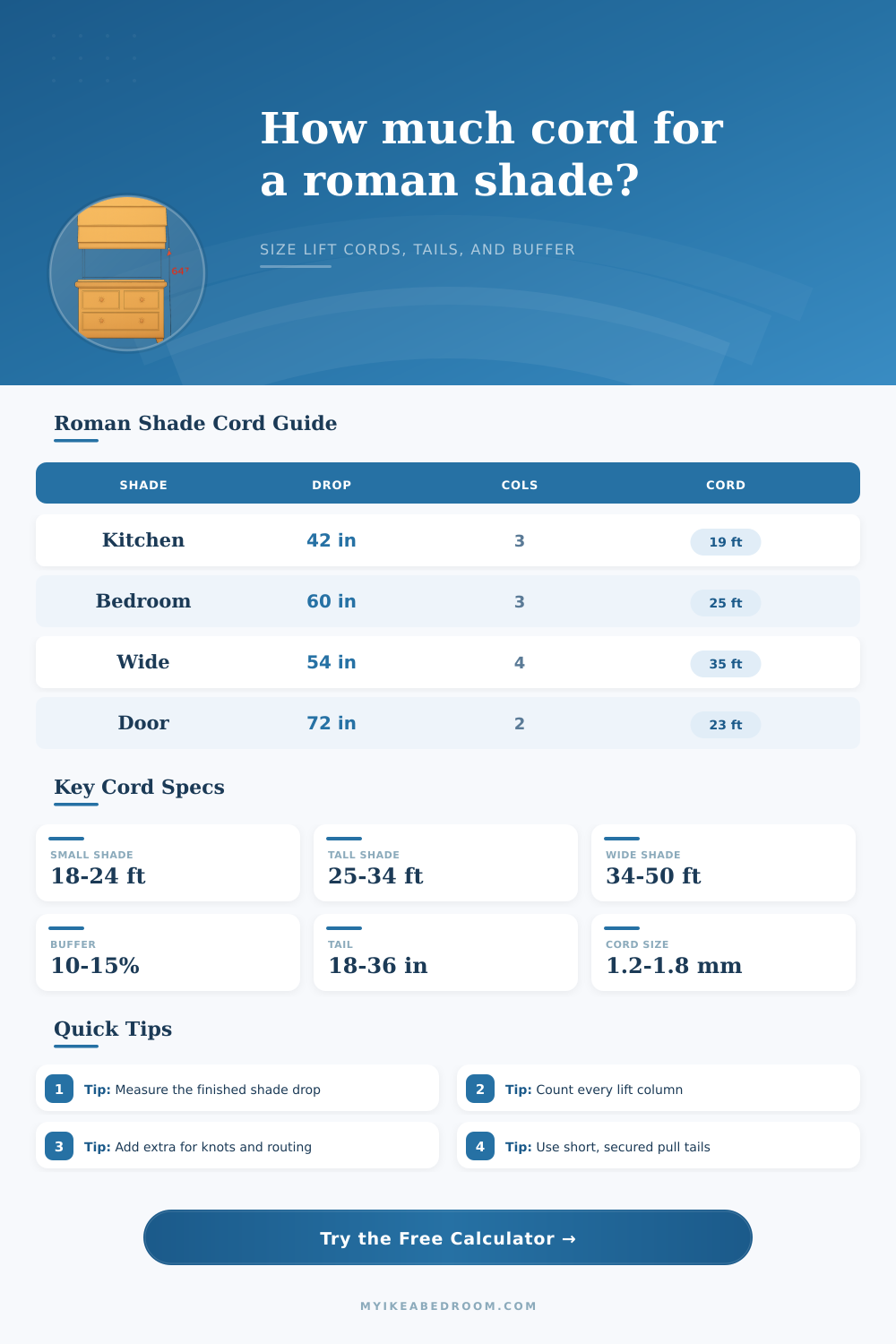
| Kitchen sash | 30 x 42 in | 3 | 18-22 ft with buffer |
| Bedroom single | 36 x 60 in | 3 | 24-29 ft with buffer |
| Wide living window | 58 x 54 in | 4 | 33-40 ft with buffer |
| Tall door shade | 25 x 72 in | 2 | 22-27 ft with buffer |
| Cord Diameter | Typical Use | Handling Note | Calculator Setting |
|---|---|---|---|
| 1.2 mm braided nylon | Small to medium shades | Low bulk through rings | Use normal buffer |
| 1.4 mm braided polyester | Most roman shades | Good abrasion resistance | Default selection |
| 1.8 mm polyester shade cord | Wide or lined panels | Easier grip, more ring friction | Add 10-15 percent |
| 2.0 mm cotton blend cord | Decorative soft pulls | May stretch slightly | Use careful final trimming |
⚖Routing Method Comparison
Side Lock
Each lift cord rises vertically, crosses the headrail toward one side, then gathers into a shared pull.
Center Pull
Header travel is measured toward the middle, which can reduce the longest single cord on narrow shades.
Split Pull
Left and right cords route to their nearest side, reducing friction on wide shades with several columns.
Condenser
Multiple lift cords merge into one short pull tail after the cord lock or guide point.
💡Cord Planning Tips
When you decide to make roman shade, you must determine the correct cord lengths for the roman shades. Many people dont consider the cord length of roman shades until after the fabric is cut and the rings is sewn onto the lift cords. However, the cord length need to be calculated before the fabric is cut.
People may use their best guess as to the length of the cord that is require. However, the best guess will likely be incorrect. The cord length calculations must include the length of the routing paths that the lift cord will take along the headrail to the cord lock, as well as the length of the pull tail of each lift cord.
How to Calculate Cord Length for Roman Shades
The drop of the roman shades is the vertical measurement from the headrail to the fabric. However, the drop isnt the only distance that the lift cords must travel. Each lift cord must also travel horizontal from one side of the headrail to the other to reach the cord locks.
The distance that the cords must travel horizontally will vary based on the location of the cord locks along the roman shades. For instance, if the cord lock are on the right side of the roman shades, then the cord on the leftmost lift column will have to travel the full width of the headrail. The distance that the cords will travel horizontally must be accounted for in the cord length calculations.
The distance between the lift columns impact the way that the roman shade will hang. If the distance between the columns is too great, the roman shade will sag in the middle of each distance. However, if there are too many columns, the cords will have to pass through too many ring.
A common recommended distance between the outermost lift columns is under eighteen inch. The calculator will use the finished width to calculate the correct number of columns for the roman shades. Additionally, using the outer inset setting will ensure that the lift columns are positioned away from the side hems of the roman shade.
This will prevent the cords from catching on the hems when the roman shades are lifted or lowered. Another measurement that must be accounted for in the cord length is the length of the pull tail. People can choose between a shared pull tail and individual pull tails on each of the lift cords.
A shared pull tail will require only one length of cord for the roman shade. However, individual pull tails will require an additional length of cord for each of the lift cords. The length of each pull tail will need to be long enough for individuals to pull the roman shades to the desired position.
However, the length must also be short enough to prevent the pull tails from dragging on the floor or creating reach opportunities for children or pets to pull the roman shades too far. The diameter of the cords for the roman shades can also impact the length of the cords that is required for the roman shades. Thin cords will easily pass through the rings.
Thin cords will take up less space when the roman shades are lifted. However, thick cord will have a better grip on the individuals hands. Thick cords will create more friction when lifting the roman shades.
The type of cord for the roman shades can be selected in the calculator so that the calculations will include the length of cord that may be require if thick cords are used. The length of the cords must also accounted for the amount of wrap that occur along the headrail along with the length of the knots along each lift cord. Each lift cord will have to wrap around the headrail hardware along with being secure along the bottom ring or bottom batten.
The length of the roman shades can be measured from the headrail to the fabric; however, this will not account for the length of wrap along the headrail and along the knots along each cord. Therefore, allowances for the amount of wrap along the headrail and along the knots along each lift cord must be accounted for. Finally, there will be a buffer percentage for the total length of the cords.
The dimensions of the roman shades will not match the dimensions that are calculate. As the fabric is hemmed, the rings may not be evenly spaced along the lift columns. Additionally, the cords may stretch when lifted.
A buffer percentage accounts for the potential stretching and uneven spacing of the lift. A ten or fifteen percent buffer is added to the total length of the cords for the roman shades. This total length will be displayed in the calculator so that individuals will not have to purchase additional cord for the roman shades.
The reference tables will provide information on the number of lift columns that is required for roman shades of specific widths. Additionally, there are tables that show the routing methods for the cords that can be used for roman shades. These tables can help prevent selecting a routing method that may make it difficult to operate the roman shades after they are installed.
Using these tables will ensure that the roman shades are even across the entire area. The consistency of the number of lift columns and the type of pull tails will ensure that when the roman shades are operate, each shade will feel the same. Additionally, the cord length calculations including the headrail travel, the tail configuration, and the buffer will ensure that the roman shades will function correctly from the first use.