Roman Shade Dowel Quantity Calculator
Estimate dowel rows, cut lengths, rod stock, spacing, and spare pieces for one shade or a matched room set.
✨Real shade presets
📏Shade and dowel inputs
🧵Dowel style reference
📊Reference tables
| Finished shade length | Typical row spacing | Usual dowel rows | Fold character |
|---|---|---|---|
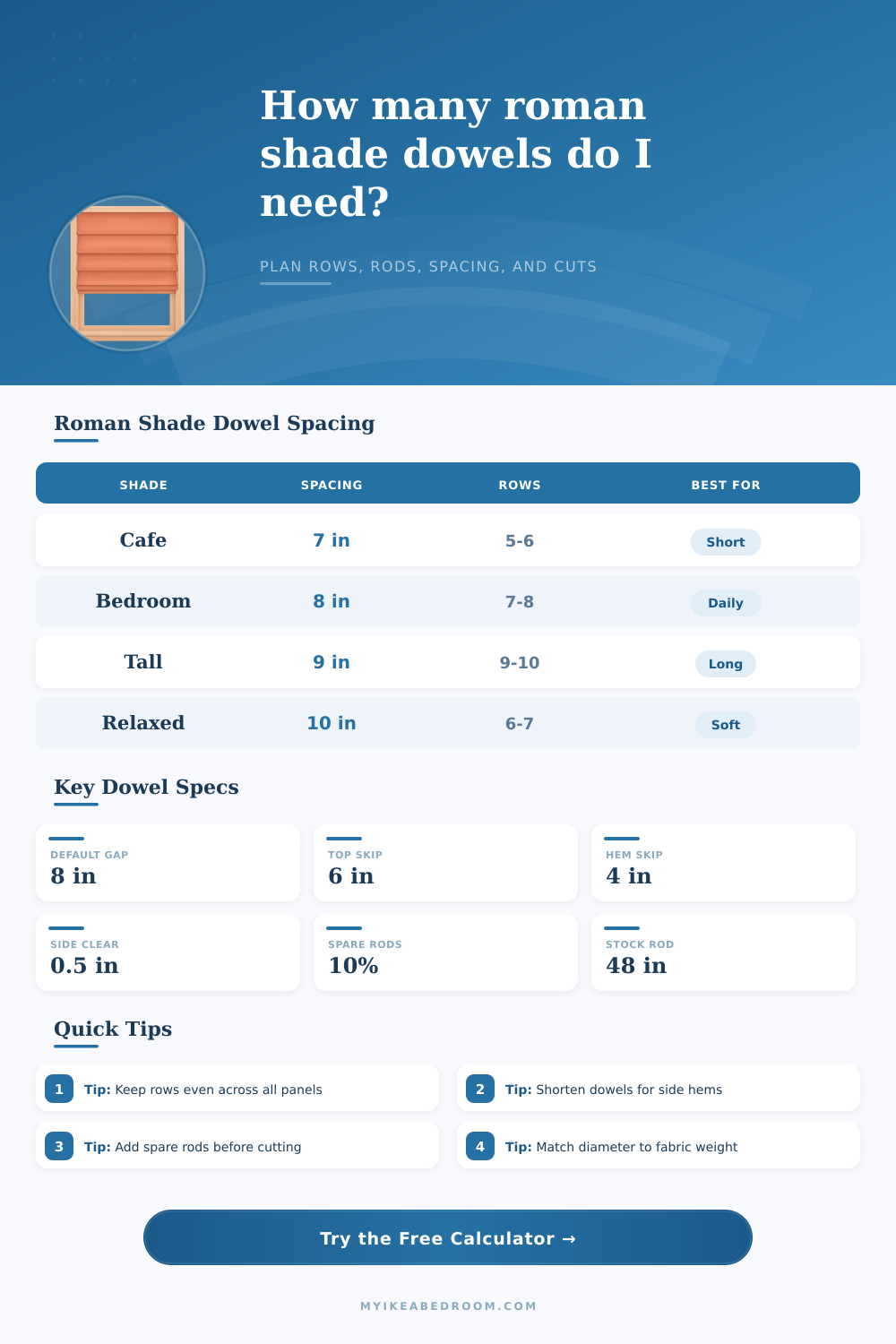
| 36 to 48 in | 6 to 7 in | 5 to 7 rows | Compact folds for cafe or small windows |
| 49 to 64 in | 7 to 8 in | 7 to 8 rows | Balanced bedroom window folds |
| 65 to 84 in | 8 to 9 in | 8 to 10 rows | Cleaner stack on taller shades |
| 85 to 96 in | 9 to 10 in | 9 to 11 rows | Longer folds with fewer horizontal seams |
| Dowel or batten type | Best fabric weight | Pocket allowance | Planning note |
|---|---|---|---|
| 1/4 in wood dowel | Sheer, voile, light cotton | About 3/4 in pocket depth | Use tighter spacing to prevent soft sagging |
| 5/16 in wood dowel | Linen blend, medium cotton | About 7/8 in pocket depth | Good everyday roman shade default |
| 3/8 in wood dowel | Blackout lined or heavier weave | About 1 in pocket depth | Keeps wider folds straighter |
| Flat batten | Crisp tailored shade panels | Match tape or sleeve depth | Useful when a flatter back stack matters |
| Stock length | Works well for | Cut strategy | Metric equivalent |
|---|---|---|---|
| 36 in rod | Narrow shades under 34 in | One finished dowel per rod | 91.4 cm stock |
| 48 in rod | Most bedroom shades | One medium dowel per rod | 121.9 cm stock |
| 60 in rod | Wide windows up to 58 in | One wide dowel per rod | 152.4 cm stock |
| 72 in rod | Small paired cuts | Two short dowels if widths fit | 182.9 cm stock |
| Common roman shade setup | Shade size | Suggested rows | Cut length per row |
|---|---|---|---|
| Small inside-mount bedroom window | 28 in wide by 48 in long | 6 rows | About 27 in |
| Standard bedroom window shade | 34 in wide by 64 in long | 8 rows | About 33 in |
| Wide linen roman shade | 54 in wide by 72 in long | 8 to 9 rows | About 53 in |
| Tall glazed door shade | 30 in wide by 84 in long | 10 rows | About 29 in |
⚖Spacing comparison grid
Closer rows
Balanced rows
Wider rows
💡Roman shade dowel tips
Roman shades require internal rods to allow the fabric panel to create the folds needed to evenly distribute the fabric throughout the shade. These internal rods allow the flat shade to become a series of panels with folds in the fabric. Additionally, if the internal rods has the wrong number or length, the shade will develop sagging fabric panels.
Therefore, a person must calculate the number of internal rods and the length of each internal rod prior to begin the construction of the shade. The width of a Roman shade will determine the length of each internal rod. Additionally, the length of the Roman shade will determine how many row of internal rods will fit within the shade.
How to Measure and Pick Rods for Roman Shades
When calculating the number of internal rods, a person must account for the space that the headrail will take at the top of the shade and the space that the hem will take at the bottom of the shade. The distance between each row of internal rods will determine the appearance of the folds within the shade. If there is a narrow distance between the internal rods, the folds will be more short and deeper within the shade.
If there is a wide distance between the internal rods, the folds will be more even within the shade. Many people select a middle range for the distance between each row of internal rods, as this will allow for even distribution of the weight of the fabric panels throughout the shade. Another consideration for the length of the internal rods is the width of the shades side clearances.
The person will place the internal rods within the shades sewn pockets, so there must be enough space along each side of the shade for the hems of the shade to not push outward. If the rods are too long for the sewn pockets, the fabric will begin to stretch over time. To avoid stretching of the shades fabric panels, a person must shorten the length of each internal rod by a small amount on each end of the rod.
Another consideration for the length of the internal rods is the diameter of each rod. The diameter of the internal rods must match the weight of the shades fabric panels. If the shades fabric panels are lightweight fabrics, such as cotton, thin internal rods will work best for the panels.
However, if the shade contains heavy fabrics, such as linen or blackout-lined fabric, thick internal rods will be required to evenly distribute the weight of the fabric panels. If too thin internal rods are used for the heavy fabric panels, the rods will bow out of alignment within the shade over time. When purchasing the internal rods, the length of the rods that are stocked in the retailer and the allowance for breakage will factor into the purchase order.
Each long internal rod may provide two shorter internal rods. However, the length of the two shorter rods must be within the length of the long internal rod. Additionally, some internal rods may break during the sewing process.
Therefore, an allowance for the breakage of some rods will ensure that a person does not purchase too few rods to complete the sewing process of each Roman shade. If a Roman shade contains many panels of fabric of the same weight, such as many Roman shades for a single room, the distance between the internal rods should be the same for each shade. Otherwise, each shade will not line up with each other when raised at the same time.
Common errors in the construction of Roman shades include measuring the wrong dimension for the shade. For instance, some individuals may use the width of the fabric that is cut to create the shade instead of the finished width of the shade. If the finished width of the shade is used, the length of the internal rods will be too long for the shade.
Another common error is for individuals to purchase the shade rods without leaving the necessary space at the top and bottom of the shade for the headrail and the hem. If the rods are purchased without leaving space for the top and bottom of the shade, the rods will be within the headrail or the hem of the shade. To avoid these measurement error, individuals must ensure that the measurements for the length of each shade take into account the space that the headrail and hem of the shade will take up.
The type of pocket that is created within the Roman shade will impact the function of the internal rods. If the shade uses sewn pockets, the internal rods will be within the pockets, and the sewing must be precise to allow the internal rods to slide into the pockets. If the shade uses tape pockets, a person can adjust the position of the internal rods after the shade is created, and cord operation can be utilized with these types of pockets.
However, the type of pocket will not impact the number of internal rods, but the type of pocket will impact the amount of extra length of the shade that must be allowed for the depth of the pocket. Once the Roman shade is hung within the room in which it will be used, the shade can be raised and lowered. If the fabric panels of the shade are not even with respect to the floor when the shade is raised, the distance between the internal rods was incorrectly measured for the weight of the shades fabric panels.
In this case, the distance between the internal rods can be adjusted on the next Roman shade that is to be constructed. The planning of the Roman shade with respect to the internal rods will ensure that the shade has the correct length for each row of internal rods, the rods are spaced correctly for the weight of the shades fabric panels, and that each rod has the correct diameter to allow it to function within the shade. Actually, you should of checked the diameter too.
Its important to make sure you’re measurements are correct so the shades looks profesionaly. This is different than just guessing. The furnitures in the room will look much better with a moddern shade.
You’ll recieve teh rods soon.