Curtain Panel Quantity Per Room Calculator
Estimate how many curtain panels, balanced pairs, rod width, fullness, and side-stack clearance a bedroom or multi-room window plan needs.
Curtain Quantity Breakdown
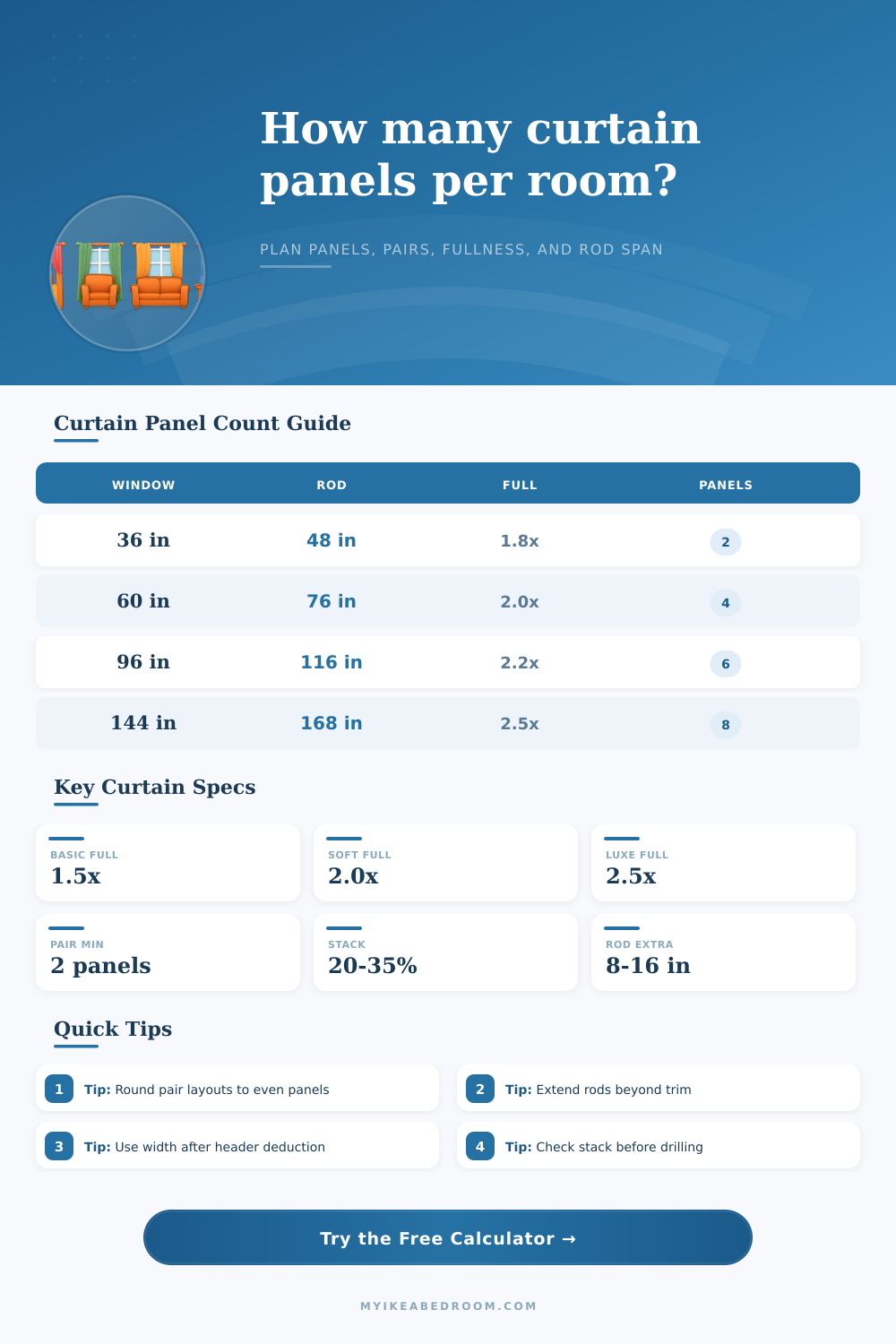
| Opening width | Rod span with returns | Fullness target | Common panel count |
|---|---|---|---|
| 30 to 42 in | 46 to 58 in | 1.8x to 2.0x | 2 panels at 50 in each |
| 48 to 60 in | 64 to 80 in | 2.0x to 2.25x | 3 to 4 panels, or 4 for balanced pairs |
| 72 to 96 in | 92 to 120 in | 2.0x to 2.5x | 4 to 6 panels depending on panel width |
| 108 to 144 in | 132 to 172 in | 2.25x to 3.0x | 6 to 10 panels for a full wall look |
| Sliding door | Door width plus 12 to 20 in | 1.5x to 2.0x | 2 to 4 panels with one-way stack |
Counts assume flat panel widths before hanging; fixed pleats may need a different usable face width than the package width.
| Header style | Good fullness range | Quantity effect | Bedroom note |
|---|---|---|---|
| Grommet or eyelet | 2.0x to 2.5x | Often rounds up one panel pair | Needs room for wave folds at each side |
| Rod pocket | 1.8x to 2.5x | High gather can reduce easy sliding | Works best on rarely opened panels |
| Back tab or hidden tab | 1.8x to 2.2x | Predictable pair planning | Neat folds for bedroom windows |
| Clip rings or hooks | 1.5x to 2.0x | Can use less fullness cleanly | Useful when rod width is tight |
| Sheer voile | 2.5x to 3.0x | Usually needs extra panels | Use more panels for privacy and soft folds |
| Fabric weight | Estimated stack share | Suggested side extension | Quantity planning caution |
|---|---|---|---|
| Light sheer | 18% to 22% | 6 to 8 in each side | High fullness raises panel count quickly |
| Medium curtain | 22% to 28% | 8 to 12 in each side | Most bedroom panels land here |
| Blackout lined | 28% to 34% | 10 to 14 in each side | May need wider rod returns than expected |
| Thermal layered | 32% to 40% | 12 to 18 in each side | Check wall space before adding panels |
| Room layout | Openings per room | Typical target | Likely panels per room |
|---|---|---|---|
| Small bedroom, one window | 1 | 48 in window, 2.0x fullness | 2 panels |
| Primary bedroom, two windows | 2 | 60 in windows, balanced pairs | 6 to 8 panels |
| Nursery blackout wall | 1 | 72 in window, 2.25x fullness | 4 panels |
| Studio patio door | 1 | 96 in door, one-way stack | 4 panels |
| Full wall curtain run | 1 | 144 in wall, rich folds | 8 to 10 panels |
To determine an number of curtain panels needed for a window, many different measurement for the window must be considered. The number of panels will drasticly affects the visual appearance of the curtain when hung from the rods. For example, if the number of panels are too few, the curtains will look thinly and skimpy when hung from the curtain rods.
In contrast, if the number of panels is too high, the panels will be thick and will pile up on the sides of the window. Therefore, an understanding of each of the different measurements of the window is required to determine the correct number of panel. The width of the window is the first measurement that must be considered.
How Many Curtain Panels Do You Need
However, the width of the window isnt the only measurement that is required. In addition to the width of the window, you must measure the clear opening of the window to determine the amount of fabric that is required to cover the window. Furthermore, you must also measure the width of the curtain rod.
The curtain rod will have to extend past the window on both sides to provide a place for the curtain panels to rest when the curtains are open to cover the window. If the length of the rod is not sufficient for the curtain panels to rest on the sides of the window, the curtains will cover the glass when the curtains are opened. Another measurement that impacts the number of panels is the fullness of the curtains.
Fullness is a measurement of the ratio of the width of the curtain panels to the width of the rod. For example, a fullness of 1.5 is used for curtains that will have a more relaxed drape. A fullness of 2.0 is used for curtains that will create soft folds, typically for bedroom.
A fullness of 2.5 is used for heavy curtains, typically for blackout or lined curtain panels. The more high the fullness of the curtains, the more panels will be required for the same size of window. Therefore, the same sized window may require two panels of fabric in one room that has a ratio of 1.5 fullness, but it may require four panels in another room that has a fullness of 2.5.
The width of an individual panel is not a fixed measurement. The style of the header of the panel will change the usable width of the curtain panel. For example, the usable width of a grommet panel will differ from the usable width of a back-tab panel.
In addition, the panels may be compress when they are hung on the rods. To account for the different types of panels, a calculator is used to determine the usable width of each panel. This calculator will account for the different type of headers for the panels.
Another measurement for curtains is the clearance of the panels. The clearance of the panels refers to the space that each panel will occupy when the panels are pushed against the sides of the window. Each panel has a certain thickness when it is gathered into panels.
The thicker the fabric, the more space the panels will occupy. For example, blackout curtains will have more clearance than curtains that are made of light fabrics such as cotton. This measurement is important to account for to ensure that the curtain rod will extend enough on each side to provide clearance for the panels to the glass.
If there is not enough clearance, the panels will cover the glass when they are open. In this situation you can move the curtain rod brackets out more further from the glass to account for the clearance of the panels. In addition to these measurements, the length of the curtains will not change the number of panels for the curtains.
However, the length of the curtains will impact the visual design of the curtains. For example, floor length curtains will cover the floor more than café length curtains, which only cover the lower portion of the windows. Therefore, the length of the curtains is a consideration in the design of the room.
Some of the most common mistake in determining the number of panels of curtains that are needed for windows include using only the width of the window as a measurement. Curtains have to be purchased with extension rods to provide enough space for the panels to rest on the sides of the window. Another mistake people often make is choosing a high fullness for the curtains without consider the clearance.
This will result in the curtains covering the glass when they are opened. You can avoid these mistakes by using a calculation tool to determine the number of panels prior to installing the curtain rods. The reference tables found on this page are a quick check for the number of panels needed for windows of different sizes.
These tables are not meant to replace the calculations that you perform for your windows. These tables are a helpful tool when determining which width of panels to purchase for the curtains. Finally, it should be stated that the color and hardware of the curtains will affect the appearance of the windows.
However, the width, fullness, and clearance of the panels will change the number of panels needed for the curtains to cover the windows of a room.