Chair Seat Webbing Length Calculator
Estimate strap cut lengths, total webbing, spacing, wrap allowance, and material stretch for woven chair seat repairs.
📌Chair webbing presets
📏Seat and webbing inputs
Webbing length results
🧵Webbing material comparison
📊Reference tables
| Material | Typical width | Pretension guide | Best chair use |
|---|---|---|---|
| Jute upholstery webbing | 2 in to 3.5 in | 0% to 2% | Traditional dining and rocker seats |
| Cotton herringbone webbing | 1.5 in to 2 in | 0% to 3% | Light chair seats and decorative restorations |
| Pirelli rubber webbing | 1.5 in to 2 in | 8% to 12% | Mid-century lounge and molded frame seats |
| Elastic furniture webbing | 2 in to 3 in | 5% to 10% | Springy modern dining or accent chairs |
| Polypropylene webbing | 1 in to 2 in | 0% to 2% | Outdoor and patio chair frames |
| Nylon seat webbing | 1 in to 2 in | 1% to 4% | Small chairs, stools, and utility seats |
| Rubberized support webbing | 2 in to 2.5 in | 6% to 10% | Wide seats needing firm rebound |
| Strap width | Common clear gap | Coverage per pitch | Notes |
|---|---|---|---|
| 1 in | 0.25 in to 0.5 in | 67% to 80% | Useful on narrow stools or curved rails |
| 1.5 in | 0.375 in to 0.625 in | 71% to 80% | Good balance for compact cafe chairs |
| 2 in | 0.5 in to 0.75 in | 73% to 80% | Most common dining chair layout |
| 3 in | 0.75 in to 1 in | 75% to 80% | Fewer wide strips on large seats |
| Wrap method | Allowance per end | Fastener area | Use when |
|---|---|---|---|
| Fold and staple | 1.5 in to 2 in | Two staple rows | Wood rails with underside access |
| Double fold staple | 2 in to 2.5 in | Three staple rows | Jute or cotton needs a clean folded end |
| Slot or groove insert | 1 in to 1.5 in | Hidden spline channel | Rubber webbing slides into a frame groove |
| Clip or metal tab | 1 in to 2 in | Clip bite length | Modern elastic strips use end clips |
| Chair type | Inside opening | Typical strap count | Approx. total |
|---|---|---|---|
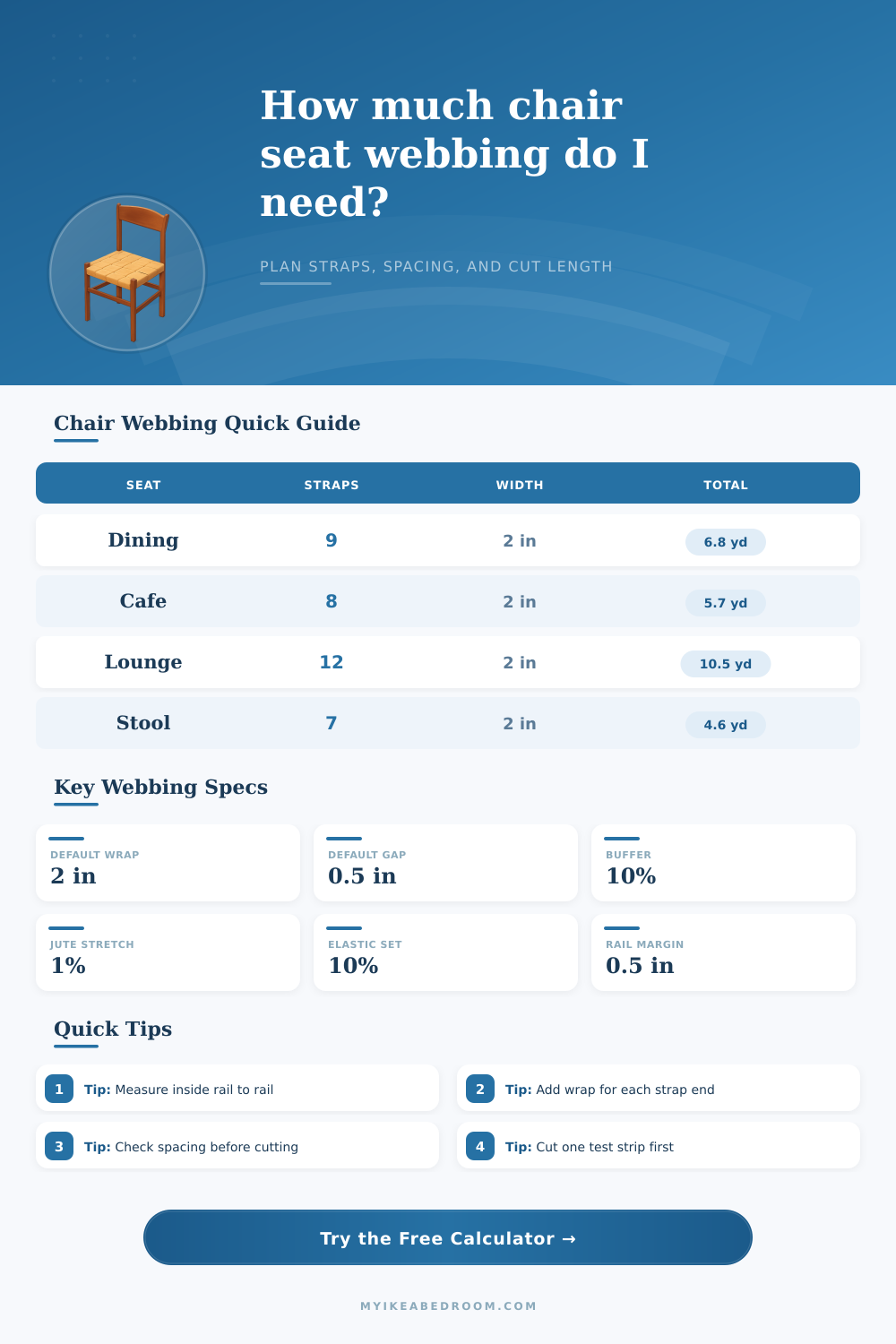
| Dining chair | 17 in by 16 in | 5 plus 5 | 6 yd to 8 yd |
| Cafe chair | 15 in by 14 in | 4 plus 4 | 5 yd to 6.5 yd |
| Lounge chair | 22 in by 20 in | 6 plus 6 | 9 yd to 12 yd |
| Ottoman frame | 20 in by 20 in | 6 plus 6 | 9 yd to 11 yd |
| Small stool | 13 in by 13 in | 4 plus 3 | 4 yd to 5.5 yd |
💡Practical measuring notes
When you replace the seat supports on a dining chair, you have to determine the amount of webbing that you need to purchase and the length of each strip of webbing. If you calculate the amount of webbing incorrect, you could end up either out of webbing before you finish installing it on the chair, or you could end up purchasing too much webbing, leaving you with costly scrap of webbing. The amount of webbing necessary for each chair frames can be difficult to calculate due to the variety in chair frames.
Some chairs has rails that taper in certain directions, and the corners of those chairs dont have perfectly square corners. The webbing calculator ask for several different measurement of the chair to design a plan for how to cut the webbing. The measurements that are necessary include the inside rail-to-rail spans of the chair, the number of straps of webbing that will be installed in each direction, the width of the webbing, the gap between the straps of webbing, and the wrap allowance for each of the rails of the chair.
How to Measure and Buy Webbing for a Chair
The rail-to-rail spans is the distance that the webbing will need to span. The wrap allowance is the amount of webbing that will be folded under each rail of the chair to staple the webbing to the frame. The webbing calculator also uses a pretension percentage to shorten the amount of webbing that need to be purchased.
This percentage account for the elastic or rubber nature of the webbing to stretch it into place. If any of the measurements is altered in the webbing calculator, the cut list will update to reflect those alterations. The type of webbing that you choose will affect the amount that you stretch.
Natural materials like jute and cotton will not require much stretching of the webbing. However, types of rubber elastic webbing will require the webbing to be stretched eight to twelve percent beyond its original length when cut. These percentages is set into the calculator as the typical measurements for each type of webbing material, but you can alter them according to the specifications of the chair.
The spacing of the webbing is another factor that many people do not consider when purchasing webbing. Although the webbing may appear to fill in the gaps on the chair according to the webbing grid that is created, the webbing may not fill those gaps due to the tapered nature of the chair. The webbing calculator will give you an estimate of the actual gap between the straps of webbing based on the width and number of the straps.
The webbing calculator can also provide you with the percentage of the opening of the seat that the webbing will cover. This number can help you to decide if you need to add more webbing strips to your chair to cover the gaps. Because chair frames are rarely perfect rectangle, you should use the smallest clear span in each direction as the starting point for your measurements.
The webbing calculator will calculate the amount of webbing necessary for the smallest span and then add the wrap allowance and buffer to that original measurement. If your chair contain a taper in one of its rails, you can make the first few strips of webbing longer than necessary in order to trim them after establishing the weave of the webbing. This would allow you to avoid purchasing extra webbing then is necessary.
The weave pattern for the webbing will also alter the math for how much webbing is needed. For a plain over-under weave pattern, the crossing allowance will be small since the webbing will cross and pass under the other straps of webbing. For weaves like baskets and diagonal layers, the crossing allowance will be greater.
The webbing calculator incorporate these alterations in the calculations. You will have to decide whether the benefit of using a complex weave design is worth the extra complexity for the pattern. For chairs that use cushions, the weave pattern is not as important as for lounge chairs where the webbing design is visible.
The fastening method that is used will alter the calculations for how much webbing is needed. Folding and stapling the webbing from below is used for the most common type of chair rail material. Other methods of fastening the webbing may include metal clips or grooves in the chair rails.
For grooves, the wrap allowance can be lessened. For metal clips, the tail end of the webbing will need to be longer for the clip to be able to secure the webbing. The webbing calculator provides you with an estimate for how much webbing to purchase, but you will have to make a final decision regarding how much webbing to cut for each strip once you are working with the hardware.
In order to ensure that you do not make any mistakes when installing the webbing, install the first direction of webbing strips completely before you cut the crossing strips of webbing. By installing the first set of webbing strips, you will be able to see where the second set of webbing will land. Additionally, by installing the first set, you will ensure that the folded ends of the webbing are on the underside of the rail.
By using this webbing calculator you will have a reliable starting point in installing webbing on your chair, but you will still have to read your chair and select the appropriate webbing material for your chair.