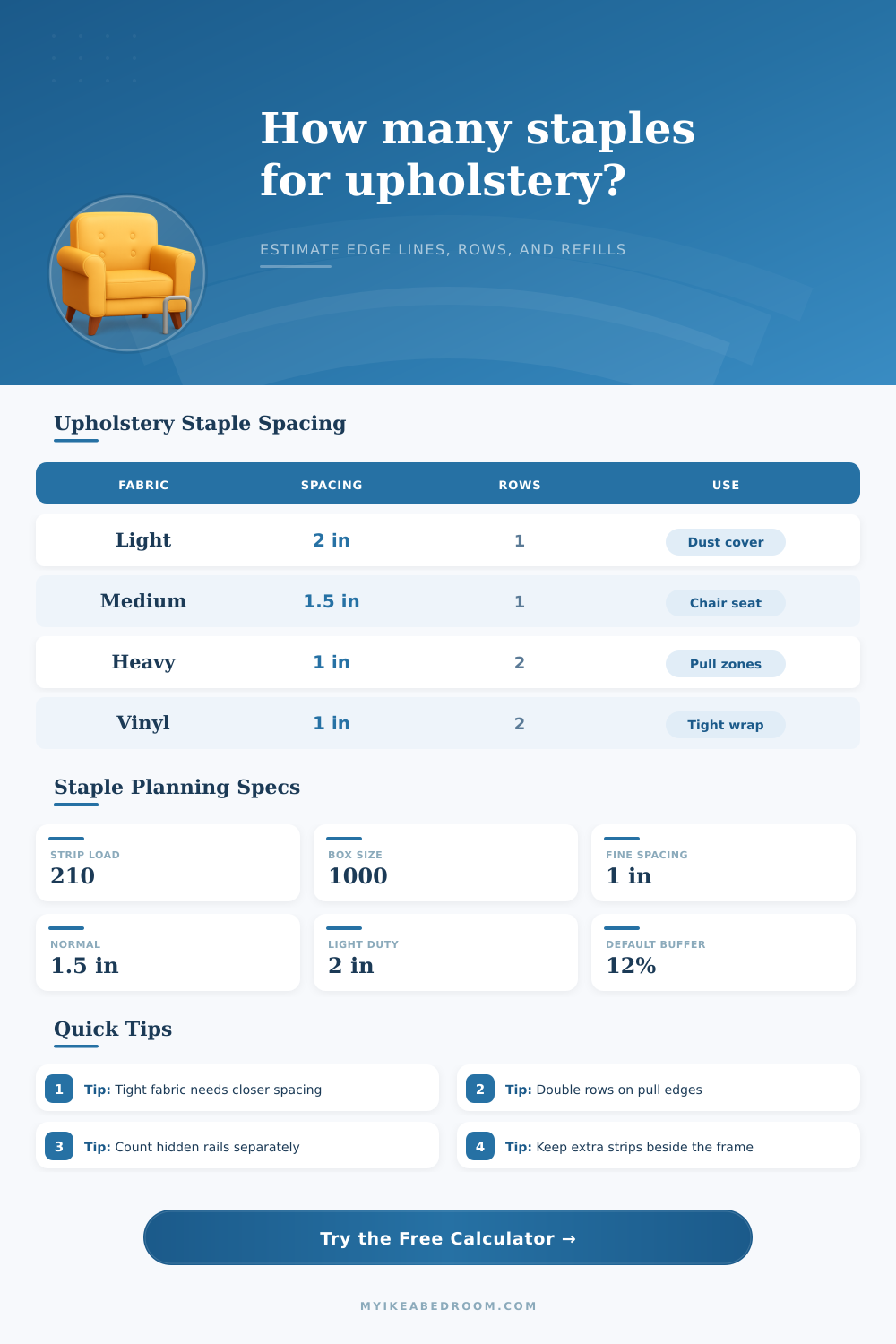
Upholstery Staple Quantity Calculator
Estimate furniture staple counts from edge length, spacing, fabric stack, reinforcement rows, corner clusters, and refill capacity.
🛋Project presets
📏Staple line inputs
Full staple count breakdown
🧵Fabric stack comparison grid
📌Staple spacing reference
| Upholstery situation | Typical spacing | Rows | Planning note |
|---|---|---|---|
| Cambric dust cover or light liner | 2 in / 5.1 cm | 1 row | Used where fabric carries little pull. |
| Standard chair seat fabric over batting | 1.5 in / 3.8 cm | 1 row | Good baseline for square or mildly rounded seats. |
| Curved cushion front or shaped corner | 1.25 in / 3.2 cm | 1 to 2 rows | Use extra clusters where folds stack up. |
| Heavy upholstery, vinyl, or tight pull rail | 1 in / 2.5 cm | 2 rows | Useful where the fabric wants to creep or relax. |
| Leather, welt cord, or deep pleated corner | 0.75 in / 1.9 cm | 2 to 3 rows | Prevents gaps around bulky folded edges. |
📐Edge pattern formulas
| Selector | Formula per panel | Best for | Watch point |
|---|---|---|---|
| All 4 edges | 2 x width + 2 x height | Seat pads, ottoman lids, wall panels | Add separate dust cover line if used. |
| 3 edges | 2 x width + height | Hinged lids and open-back panels | Confirm which side is not stapled. |
| 2 opposite long edges | 2 x longest side | Bed rails and long fabric wraps | Ends may still need cluster staples. |
| 1 long pull edge | Longest side only | Partial repairs and single rail pulls | Use double rows for tensioned fabric. |
| Custom staple line | Entered length x panel count | Curved frames and irregular furniture | Measure along the actual staple path. |
🔧Refill and conversion table
| Refill reference | Count basis | Equivalent line at 1.5 in | Equivalent line at 1 in |
|---|---|---|---|
| 100-staple short strip | 100 staples | 150 in / 12.5 ft | 100 in / 8.3 ft |
| 125-staple compact strip | 125 staples | 188 in / 15.6 ft | 125 in / 10.4 ft |
| 210-staple common strip | 210 staples | 315 in / 26.3 ft | 210 in / 17.5 ft |
| 1,000-staple sleeve | 1,000 staples | 1,500 in / 125 ft | 1,000 in / 83.3 ft |
| 5,000-staple shop box | 5,000 staples | 7,500 in / 625 ft | 5,000 in / 416.7 ft |
📋Common furniture estimates
| Furniture project | Typical staple line | Suggested spacing | Staples before buffer |
|---|---|---|---|
| 18 x 19 in dining chair seat | 74 in / 188 cm | 1.5 in | About 50 plus corners |
| 60 x 36 in padded headboard panel | 192 in / 488 cm | 1.25 in | About 154 plus folds |
| 48 x 18 in bench top | 132 in / 335 cm | 1.5 in | About 88 plus corners |
| 76 x 12 in bed rail, two long edges | 152 in / 386 cm | 1.25 in | About 122 per rail |
| 24 x 24 in ottoman lid | 96 in / 244 cm | 1 in | About 96 plus pleats |
💡Upholstery counting tips
When you are fabricating a chair frame or a bench top with vinyl, you will need to determine how many staples you will need to complete the job. The number of staples that are necessary for each piece of furnitures is not based off the length of the piece of furniture divided by the distance between staples. Instead, there are a variety of factors that influence the number of staples that are necessary.
These factors includes the number of staples that is required for the fabric stack, the number of staples required for the pull zones, the number of staples required for the corner clusters, and the number of staples that may be misfire during the upholstery process. Calculating the number of staples necessary will ensure that you dont run out of staples during the upholstery process, nor will it require you to purchase extra boxes of staples that you will not utilize. The spacing of the staples to be used during upholstery is one of the first decisions that must be made.
How Many Staples You Need for Upholstery
For projects that utilize light dust covers, for instance, the spacing between staples may be two inches. Standard chair seats, however, may have a staple spacing of one and a half inches in order to provide even tension to the batting and the fabric. For vinyl or leather products, the spacing may be one inch or three-quarters of an inch in length, as vinyl and leather products have the tendency to creep back when the upholstery tension is released.
The staple spacing calculator will calculate the math for you once you have selected your staple spacing based upon the type of fabric that will be utilized and the amount of tension that will be placed upon the product. Another factor to consider is the row count. For flat surfaces and products that have relatively low tensions upon the fabric, a single row of staples will be sufficient.
However, if the piece of furniture is long and has many edges that the fabric is pulling, the user will use a double row of staples. For instance, cushions may have a second row of staples along the front rail only. The sides of those cushions may only require a single row of staples, though.
While a row of staples may seem like a relatively small factor to consider, it will impact the number of staples required for four chair seats or a long headboard. A multiplier can be used for the row count to factor this into the total staple calculation. Another factor that will alter the total number of staples to be used is the type of fabric that will be used.
For example, a light cotton liner will require few staples to be placed. Medium upholstery fabric placed upon batting will require a small percentage of additional staples to be placed. However, if leather or thick hide is used, there will be an increased number of staples required to adhere to the leather due to the resistance of the leather to the staple.
The calculator automatically calculates these factors so that you dont have to remember the various types of fabric combinations. Another factor that will impact the number of staples necessary for upholstering is the number of clusters that will be incorporated into the piece of furniture. For instance, the corners of products will require clusters of staples.
Furthermore, if the furniture will include tucks or pleats, there will be clusters of staples required at those corners. The number and size of each cluster will be asked of you prior to calculating the total number of staples that will be required. These staples will be hidden from view once the fabric is complete and taut, but they will be necessary for the furniture to remain in place.
It is important to account for the number of staples that might be misfired during the upholstery process. When first beginning to upholstery furniture, an eight percent allowance for misfired staples will usually be sufficient. For normal furniture that includes curves or corners, though, a twelve percent allowance for misfired staples may be better.
If you are still learning the upholstery trade, or if you are completing upholstery jobs for products that use high tension vinyl, an eighteen percent or twenty-five percent buffer for misfired staples may be better. This percentage will be calculated at the end of the staple count to ensure that you have enough staples to complete the job. Once you know the total number of staples that will be required for the project, the strip size is another calculation that will factor into the upholstery process.
Most pneumatic staple guns come with strips that contain two hundred ten staples. However, there are also boxes that contain one thousand staples or more. You will be notified of the number of strips and boxes of staples that will be required for your upholstery project.
Furniture pieces are rarely textbook rectangles. For instance, headboards will have rounded tops. Window seats may be more irregular in their returns.
Bed rails may have additional lines of staples for additional dust covers. The tool allows you to account for these differences in the calculation of the total number of staples. You can select how many lines of staples will be used for the furniture.
Full perimeter, three edges, two opposite sides, or only one long pull edge. Additionally, if your furniture does not match any of the options, you can enter the length of the additional line of staples directly into the calculator. If you are upholstery multiple pieces of furniture that are of the same dimensions and type, the count will also be multiplied as necessary.
For instance, four dining chairs will have four times the total staple count. Two bed rails will have twice the line length with the same staple spacing, rows, and factors. A field for the total panel count will allow you to account for this in the calculator.
By planning for the number of staples that will be necessary to complete your upholstery project, you will be able to focus upon the quality of your work. Rather than having to continually count the number of staples that remain in your staple gun, you can focus upon creating the best possible outcome for your project. The true skill in upholstery is not in the ability to memorize the formula for calculating the number of staples.
Instead, it is in the understanding of which factors will require an increase in the number of staples to be used, and which factors will not. By understanding these factors, you can have confidence that the number displayed on the calculator will accurately reflect the amount of work that will be required to complete your upholstery project.