Ottoman Reupholstery Fabric Calculator
Estimate upholstery yardage for smooth, skirted, storage, round, channel, and tufted ottomans with repeat matching and fabric behavior included.
| Usable width | Square feet per yard | Metric area per meter | Best ottoman use |
|---|---|---|---|
| 45 in | 11.25 sq ft | 1.14 sq m per m | Small stools, narrow benches, contrast panels |
| 54 in | 13.50 sq ft | 1.37 sq m per m | Most upholstery fabric and standard ottoman tops |
| 60 in | 15.00 sq ft | 1.52 sq m per m | Wide bench ottomans and fewer side seams |
| Railroaded 54 in | 13.50 sq ft | 1.37 sq m per m | Long side bands when the pattern can run sideways |
| Ottoman style | Top allowance | Side allowance | Pieces typically cut |
|---|---|---|---|
| Smooth top, tailored sides | 3% shaping | 4% pull and stapling | Top, side band or four panels, bottom return |
| Boxed cushion top | 8% boxing ease | 8% seam depth | Top, boxing strip, side panels, welt strips |
| Storage lid wrap | 12% hinge-side ease | 14% underside return | Lid top, wrapped sides, inside return strips |
| Tailored skirt or kick pleats | 5% smoothing | 35% skirt fullness | Top, deck, skirt drops, pleat returns |
| Deep diamond tufted | 28% pull-down | 10% side shaping | Oversized top, side panels, button covers |
| Channel stitched bench | 18% channel loft | 18% alignment | Long top, channel allowances, side panels |
| Gathered round pouf | 16% crown ease | 25% gathered side ease | Round top, round base, continuous side band |
| Repeat size | Added roll length per major panel | Best use | Calculator handling |
|---|---|---|---|
| 0 in solid | 0 in | Boucle, tweed, plain canvas, random texture | No repeat length added |
| Up to 4 in | 4 in | Tiny geometrics and subtle stripes | Adds one small repeat to visible panels |
| Up to 8 in | 8 in | Medium floral, check, or medallion layout | Adds repeat length for top and side alignment |
| Up to 12 in | 12 in | Large centered motifs or bold plaid | Adds large repeat allowance before overage |
| Project scenario | Measured size | Assumed fabric | Typical cut yardage |
|---|---|---|---|
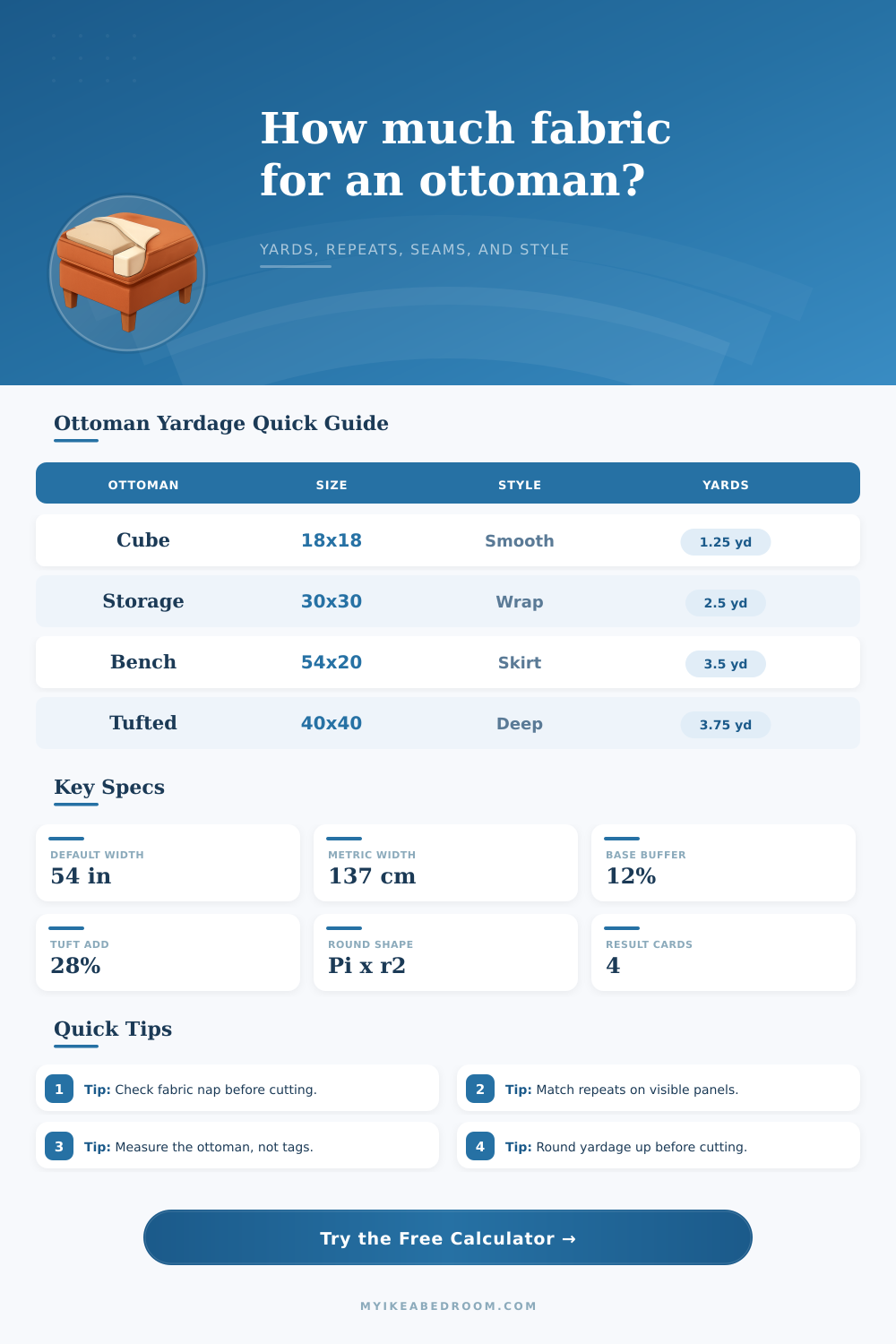
| Small cube footstool | 18 x 18 x 16 in | 54 in plain weave, 12% buffer | About 1.25 yd |
| Square storage ottoman | 30 x 30 x 18 in | 54 in fabric, lid return included | About 2.5 yd |
| Cocktail table ottoman | 42 x 28 x 17 in | 54 in boxed top upholstery | About 2.75 yd |
| End-of-bed skirted bench | 54 x 20 x 18 in | 54 in fabric with pleated skirt | About 3.5 yd |
| Deep tufted square ottoman | 40 x 40 x 16 in | 54 in velvet with 8 in repeat | About 3.75 yd |
When you decide to reupholster an ottoman, you must calculate the correct amount of fabric that you will need to purchase for the project. Calculating the correct amount of fabric prevent you from running out of fabric while you are performing the ottoman reupholstery project. Many people find that choosing fabric for their ottoman can be dificult due to the fact that the amount of fabric that they will need to purchase will depend upon the width of the fabric, the style of the ottoman, the pattern of the fabric, and the amount of overage that they choose to include in the calculation.
In order to calculate the correct amount of fabric, you must consider each of the details regarding the construction of the ottoman because each of these details will impact the total amount of yardage of fabric that are required for the project. One of the first factors to consider is the width of the fabric. Fabric comes in different widths in different bolts, such as forty-five inches, fifty-four inches, or sixty inches.
How Much Fabric Do You Need for an Ottoman
The usable width of the fabric is the distance between the selvages of the fabric. If you choose a fabric with a narrow usable width, you will need to include more seam in your ottoman to accomplish the same coverage as an ottoman that utilizes a fabric with a wide usable width. Because each seam requires some amount of fabric for the seam allowance, using a fabric with a narrow usable width will require more fabric than using a fabric with a wide usable width.
The construction style of the ottoman will also impact the amount of fabric required for the ottoman. For instance, ottomans that have a smooth top and the tailored sides of the ottoman will require less fabric than ottomans that have deep diamond tufting. For ottomans with deep diamond tufting, the tufting will pull at the fabric at the buttons of the ottoman, and you will need to cut the top of the ottoman larger than the area of the ottomans actual top.
Additionally, ottomans that have skirts will require more fabric than ottomans that does not have skirts due to the drop and pleats in the skirt. Similarly, ottomans that have storage lids will require more fabric than ottomans that do not have storage lids because the storage lid will require fabric for the return that is included in the underside of the storage lid. The third of the factors that you should consider in the calculation of the amount of fabric that is required for upholstering an ottoman is the pattern repeat of the fabric.
The pattern repeat will impact the amount of fabric that is required by the ottoman because if the ottoman features a large pattern repeat, you will lose some of the fabric to cutting the fabric to even out the pattern on the top of the ottoman and its sides. For ottomans with small pattern repeats, the pattern will even out on the ottoman without losing much fabric to even out the pattern. The yardage calculator accounts for the pattern repeat of the chosen fabric by adding a certain amount of yardage for the repeat to the amount of yardage calculated for the major panels of the ottoman.
The fourth of the factors to consider is the amount of overage of the fabric that you plan to purchase. This extra amount of fabric is added to the total amount of fabric that will be calculated for the ottoman in order to account for the fabric that may be lost due to mistakes or shaping of the fabric. For example, if you are cutting fabric to create an ottoman with a smooth top and smoothly-tailed sides, some of the fabric will need to be shaped into curves.
The amount of fabric that is lost due to shaping the material will need to be accounted for in the purchase of the fabric. Similarly, if you make a mistake in the cutting of the fabric, some of the yardage will be lost to that mistake. An eight percent overage may be sufficient for plain fabric that is professionally laid out, but if the fabric has a large pattern repeat or if the ottoman has pleats in its skirt, a twenty or twenty-five percent overage will be required.
Using a higher percentage for overage accounts for potential errors in the amount of fabric that will be required for the ottoman reupholstery project. Another decision that you must make prior to beginning to measure the ottoman for fabric requirements is the measurement of the ottomans actual dimensions. You will measure the dimensions of the ottoman once you remove the old fabric from the ottoman, as those dimensions may be different than the dimensions that are published for the ottoman in fabric catalogs.
The actual dimensions of the ottoman will provide the most accurately calculation of the fabric that is required for the ottoman. Additionally, the environment where the ottoman will be placed should be considered. For example, if the ottoman will be used by young children or pets, the fabric may need to be chosen with certain properties, such as being easy to clean.
However, each of the fabrics that may be purchased have different properties regarding the stretch of the fabric. The reference tables that are provided with the yardage calculator will display ottoman styles and fabric widths and the amount of yardage in each unit. These tables are not rules that must be followed for each project, but these tables will help individuals to understand the proportions of fabric required for ottoman styles and sizes prior to entering their measurements.
Once the individual enters their measurements for the ottoman, the breakdown panel will display in what amounts each portion of the ottoman will require fabric: the amount of yardage for the top area of the ottoman, the yardage for the side area of the ottoman, the yardage for the seam allowances, the yardage for the returns on the underside of the ottomans storage lid, and the yardage for the pattern repeat. This breakdown allows individuals to understand how altering the width of the fabric or the construction of the ottoman will impact the total amount of fabric that will be required to complete their ottoman upholstery project. Finally, you should round up the total amount of yardage that is calculated for the ottoman to the nearest eighth of a yard.
Rounded up amounts of yardage will ensure that you will have enough fabric for your ottoman. While it is better to have a small amount of extra fabric than to run out of fabric entirely for your ottoman reupholstery project, it is difficult to find additional fabric that is of the same dye lot as the fabric that has already been purchased for your ottoman.