Chair Seat Reupholstery Fabric Calculator
Estimate fabric yardage, cut blank size, repeat matching, layout rows, and staple spacing for removable chair seats.
| Seat build | Thickness | Underside pull | Add to each edge |
|---|---|---|---|
| Thin plywood slip seat | 0.5-1 in | 1-1.5 in | 1.75-3 in |
| Foam dining seat | 1-2 in | 1.5-2 in | 3-4.5 in |
| Thick stool pad | 2-3 in | 2-2.5 in | 4.5-6 in |
| Boxed or sewn cover edge | Measured boxing | Seam plan | Pattern piece based |
| Bolt width | Usable after selvage | Common chair capacity | Best for |
|---|---|---|---|
| 45 in | 43 in | 1 large or 2 small blanks | Vanity stools, small dining seats |
| 54 in | 52 in | 2 typical dining blanks | Most chair reupholstery fabric |
| 60 in | 58 in | 2 roomy or 3 narrow blanks | Wide office seats, solid fabrics |
| Leather hide | Irregular | Template placement needed | Single seats and small batches |
| Fabric behavior | Rotation allowed | Extra planning | Calculator effect |
|---|---|---|---|
| Plain or small allover | Usually yes | Small buffer only | Chooses shorter layout |
| Directional print | No | Keep fronts aligned | Locks length direction |
| Velvet or chenille nap | No | Cut every seat same nap | Adds nap handling buffer |
| Stripe, plaid, large motif | Usually no | Round up to repeat | Uses repeat dimensions |
| Project | Top size | Typical blank | Fabric note |
|---|---|---|---|
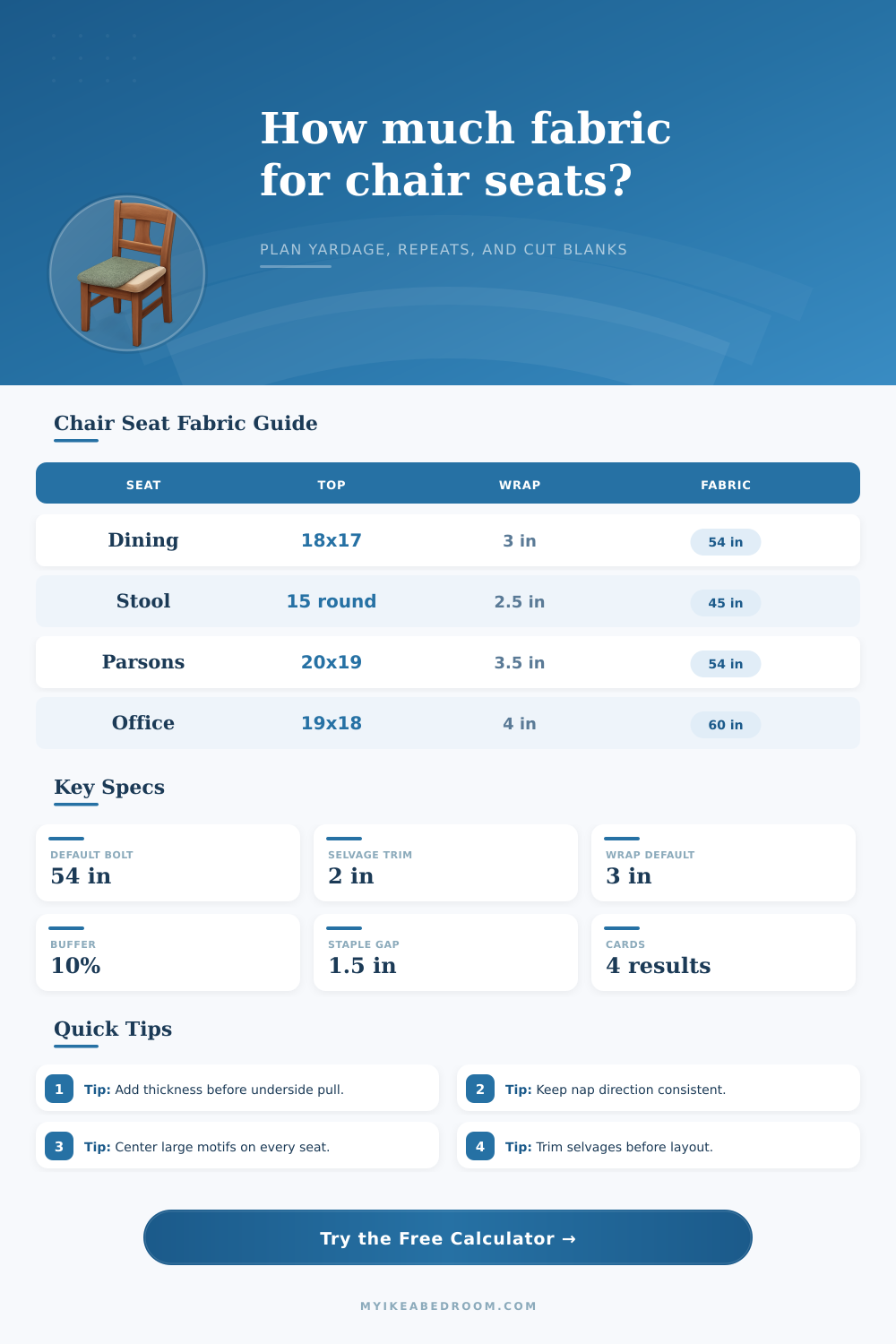
| Dining slip seat | 18 x 17 in | 25 x 24 in | Two across on 54 in fabric |
| Round stool top | 15 in diameter | 21-22 in circle | Check nap before rotating |
| Parsons chair seat | 20 x 19 in | 28 x 27 in | One across on 54 in fabric |
| Tapered kitchen chair | 18 front, 15.5 back | 25 x 24 in | Mark the front edge on each blank |
Reupholstering chair seat require accurately calculating the measurements of the fabric that will cover the chair seats. The amount of fabric necessary to reupholster the chair seat is dependent on more than the area that must be covered by the fabric by the chair seat’s dimensions. The thickness of the foam beneath the fabric must also be consider.
Additionally, other measurements that must be considered include the amount of fabric that must pulling underneath the seat board, the thickness of the fabric patterns, and the width of the fabric bolt. Incorrect calculations of these measurements will result in either purchasing too much fabric or not having enough fabric to complete the reupholstering chair seat project. The fabric calculator require people to input several measurement for the reupholstering project.
How to Measure Fabric to Reupholster a Chair Seat
The person must enter the width and depth of the chair seat’s top surface into the fabric calculator. Additionally, other measurements that the fabric calculator will require are the thickness of the foam that will be covered by the fabric and the amount of fabric that will pull underneath the chair seat’s board. The allowance for the turn-under allowance requires that the person input the amount of fabric required to create the fold that will cover the raw edges of the seat fabric.
For example, if the top surface of the chair seat measure 18 inches in width and 17 inches in depth, the seat may require a fabric dimension of 25 inches in width and 24 inches in depth. This additional fabric will ensure that the chair seat cover will remain taut and not loosen at the corners of the seat. The behavior of the fabric will also impact the amount of fabric that a person will have to purchase for the project.
For example, if the fabric contain a small allover print, then the print can be rotated to allow the fabric to line each chair seat evenly. However, if the fabric is velvet with a one-way nap, then the person cannot rotate the velvet in position. Other patterns, such as stripes or large motifs in the fabric design will also impact the amount of fabric necessary to purchase because the person may have to decide whether the print should be centered on each chair seat.
The calculator will calculate the length of the fabric required according to the type of fabric that will be used for the project. A number of allowances for the fabric will have to be made for each individual chair seat that will be reupholstered. For instance, a half-inch allowance will be required for each of the four edge of each chair seat.
Additionally, a number of staples will be required to secure the fabric to the chair seat. If the staples are to be placed every one and a half inches, for example, the person will have to purchase a number of hundred of staples to complete the entire project. The calculator will calculate the number of staples that will be necessary so that the person can decide whether a manual or electric staple gun will be used to staple the fabric to the chair seat.
The width of the bolt of fabric that will be purchased will also determine how many chair seat blank will be cut from the fabric. Fifty-four inch fabric bolts are common in most fabric stores. With a fifty-four inch fabric bolt, two dining chair seat blanks can typically be cut side by side from the fabric.
Fabric bolts that are narrower than fifty-four inches will require the person to cut the blanks in a single file. Additionally, the narrower the fabric bolt, the more seam will have to be created in the fabric to complete the project. The fabric calculator will calculate how many blanks can fit across the fabric bolt’s width so that the individual is aware of the length of the fabric required for the project.
The measurements and calculations may not always be made according to ideal conditions. The wood frames from which the old chair seats were constructed may not be made to be square and the foam may not lie evenly on the wooden frame. Therefore, the person will have to use a buffer percentage to account for these potential measurements and calculations.
A percentage of ten percent is typically used as the buffer for chair seat reupholstering projects. This percentage provides for potential mistake in cutting the fabric for the project. However, if the fabric that will be used in the project is especially valuable or contains a large motif that should be facing the same direction on every chair seat, a higher percentage of buffer will be used.
The process of measuring the dimensions of the chair seat requires that the person first removes the seat board from the chair. The dimensions of the top of the removed seat board will be measured. Additionally, the thickness of the foam, the pull allowance, and the turn-under allowance will be added to the measurements of the chair seat.
If the dimensions of the seat are in the shape of a trapezoid, the measurements of both the front and back edges will have to be obtained. For round chair seats, the diameter of the chair will be measured along with the allowance for the full edge of the fabric that will cover the seat. These measurements will allow the fabric calculator to determine the size of the blank of fabric that will have to be cut from the bolt of fabric.
Calculators allow the person to determine the direction in which the fabric should be oriented before purchasing the fabric from the fabric store. For example, if the chair seats should all face the same direction, then cutting random scraps of fabric will result in the fabric not aligning with the other fabric for the other chair seats. The calculator will display for the person the number of rows and the number of columns of the fabric that will be used to reupholster the chairs so that the person can determine whether the fabric will result in any waste when purchased for the project.
This information will be of use to the person if they are considering purchasing two different type of fabric for the project. Many people tend to make mistakes when calculating the fabric measurements for a chair seat reupholstering project. One of the most common mistakes is to skip the allowances for the edges when measuring the dimensions of the chair seat.
The person will have to account for the fabric that will travel down the side of the foam beneath the chair seat to the area where it will be stapled to the wooden chair seat board. Additionally, another mistake that people make is to ignore the direction in which the velvet or chenille fabric will nap. If the velvet fabric naps in different directions, for instance, the color of the fabric will look differently on each of the chair seats in the project.
A number of reference tables can be used to determine the allowances for different types of chair seat builds. For instance, if the person is fabricating a thin plywood slip seat, the allowances will be less than if the person is fabricating a thick stool pad. This is due to the thickness of the thin plywood slip seat.
These reference tables can be used to help the person decide the values that should be entered in the appropriate fields in the fabric calculator. The calculator will apply the number to each of the fields to determine the amount of each fabric that will be required for the project. Additionally, other considerations include the spacing at which the staples will be placed in the fabric.
For instance, if the individual decides that the staples will be placed every inch and a half, the individual will have to purchase a number of hundreds of staples for the entire project. If the person decides on a different spacing for the staples, such as closer together or further from one another, the number of staples required will change. The fabric calculator will indicate the count of the number of staples that will be required to assist the individual in determining the type of staple gun that will be used for the project.
Other considerations for the fabric include the allowance for the pattern repeat of the fabric. For example, if the fabric contains twelve-inch vertical stripes, the individual may have to shift each row of the chair seats to allow for the fabric to continue the stripes for each of the chairs. The calculator will round the dimensions of the fabric to the nearest measure of the pattern repeat so that the individual knows the length of the fabric that will be required to include these allowances for the pattern shift.
Finally, other allowances will be made for types of fabrics like leather and vinyl. Unlike cotton or velvet fabrics, hides of leather will not be even in size and shape, and they cannot simply be purchased in large even rectangles. Vinyl typically comes in very wide bolts.
Additionally, vinyl typically shows the staple holes in the fabric if they are to be adjusted in relation to the wooden chair seat boards. Because of these differences in vinyl and leather, the calculator will increase the buffer that is calculated for these types of fabrics so that the individual can account for these considerations. The value of fabric calculators is that they allow people to compare the different types of fabric and determine the amount of each type that will be required.
The requirements of the project may require that one fabric has more fabric than the other due to the width of the fabric bolts or the size of the patterns in the fabric. Knowing the amount of fabric that will be required for the project will allow the individual to make decisions regarding the budget to purchase the fabric and the timeline necessary to purchase the fabric for the project. Additionally, knowing the measurements will allow the individual to order the amount of fabric that will be required for the project so that they will not run out of the fabric prior to completing the project.