Slipcover Skirt Yardage Calculator
Estimate fabric for bed, sofa, chair, bench, and ottoman skirts using finished run, drop height, pleat fullness, fabric width, pattern repeat, seams, hems, and cutting layout.
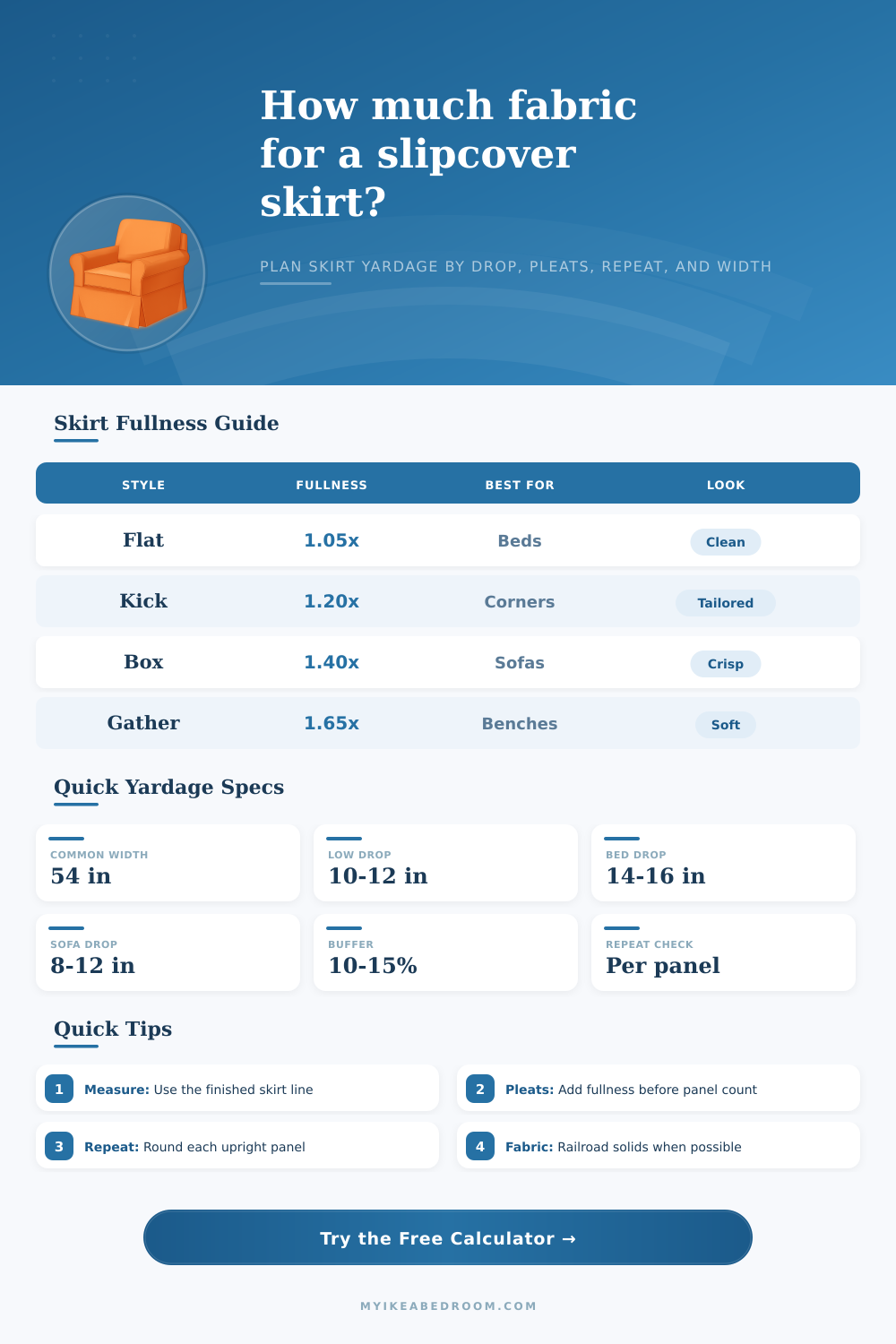
| Skirt Style | Multiplier | How It Changes Yardage | Good Slipcover Use |
|---|---|---|---|
| Flat tailored skirt | 1.05x | Adds slight ease so the skirt is not strained. | Modern beds, benches, window seats |
| Tailored corner ease | 1.15x | Allows subtle turn allowance at corners and side returns. | Platform beds, armchairs, fitted sofas |
| Corner kick pleats | 1.20x | Adds extra fabric at corners without a gathered look. | Loveseats, chair bases, straight sofas |
| Box pleated skirt | 1.40x | Builds repeated fold depth across the skirt run. | Ottomans, daybeds, formal sofa skirts |
| Soft gathered skirt | 1.65x | Uses extra run length for visible soft gathers. | Storage benches, cottage bed bases |
| Full ruched skirt | 2.00x | Doubles the finished path for dense texture. | Decorative benches and accent pieces |
| Fabric Width | Railroaded Drop Range | Upright Panel Span | Best Use |
|---|---|---|---|
| 45 in decorator cotton | Up to about 40 in after hems | About 44 in before seam loss | Short bed skirts, small ottomans |
| 54 in home decor fabric | Up to about 49 in after hems | About 53 in before seam loss | Most sofas, chairs, and bed bases |
| 58 in linen or canvas | Up to about 53 in after hems | About 57 in before seam loss | Long bench skirts and full wraps |
| 60 in wide upholstery fabric | Up to about 55 in after hems | About 59 in before seam loss | Fewer panels on wide sofas |
| Layout | Yardage Formula | Pattern Direction | When to Choose It |
|---|---|---|---|
| Railroaded long strip | Adjusted run divided by 36 | Pattern runs along the skirt path | Solids, small texture, stripes that work sideways |
| Upright vertical panels | Panel count times cut drop divided by 36 | Motif stays upright on every panel | Florals, directional prints, velvet nap |
| Repeat matched upright | Each panel rounded to the next repeat | Seams align at visible joins | Plaids, checks, large repeats |
| Auto efficient layout | Compares both possible layouts | Uses the lower yardage valid option | Early planning before final fabric choice |
| Furniture Scenario | Typical Finished Run | Common Drop | Planning Note |
|---|---|---|---|
| Queen bed front + sides | 200-220 in | 14-16 in | Tailored skirts often fit railroaded on 54 in fabric. |
| King bed full wrap | 300-320 in | 14-18 in | Gathered skirts grow quickly because fullness is applied to the full path. |
| Three seat sofa front + returns | 145-170 in | 8-12 in | Patterned fabrics usually need upright panels at visible corners. |
| Armchair skirt | 85-115 in | 7-10 in | Corner pleats add polish without heavy fullness. |
| Square ottoman wrap | 100-130 in | 8-14 in | Box pleats can require more fabric than the small footprint suggests. |
When you are purchasing fabrics for a slipcover skirt, you must determine if you will have enough fabric to reach the floor. The slipcover skirt sit on the furnitures at eye level so the fabric should not be too short; otherwise, the shortfall will be visible. There are several measurement and factors that you must consider when purchasing fabric for a slipcover skirt.
The first measurement you must take is the finished path of the skirt. For a queen bed skirt, the finished path is the front edge and the two side returns. For a sofa skirt, the finished path is the front edge and the two short returns that end before the back leg of the sofa.
How to Measure Fabric for a Slipcover Skirt
Measure the finished path of the skirt, not the widest portion of the cushion. The second measurement you must take is the drop height of the skirt. The finished drop is the length of the skirt from where it will attach to the furniture to the floor.
The drop measurement must include the top seam allowance and the bottom hem allowance. The finished drop measurement plus the top seam allowance plus the bottom hem allowance will equal the total drop that must be cut from the fabric. The third factor to consider is the fullness style of the skirt.
For example, a flat, tailored skirt require less fabric than a skirt with box pleats or soft gathers. The gathers will require more fabric than a flat, tailored skirt because the fabric will bunch at the gathered areas. The fourth factor to consider is the width of the fabric and the pattern repeat.
If you select a fabric with a wide width, you can railroad the skirt which means the fabric can be long strips. However, if the fabric has a narrow width or features a directional print, you will require upright panels of fabric. Additionally, if the fabric features a stripe or plaid print, the print will have to match at every seam which will require more fabric.
The fifth factor to consider is the buffer percentage. You add a buffer to the total yardage of fabric to account for the fact that the fabric may shift when cutting the fabric. Additionally, the seams of the skirt may require more fabric than originally calculated.
A ten or fifteen percent buffer in yardage will protect against these issues. The sixth and final factor to consider is the cutting layout. For instance, a skirt for a sofa may require three upright panels of fabric if using a large floral print.
However, the same skirt may only require two panels of fabric if the fabric has a wide width. Try to determine different possible cutting layouts to find the one that will require the least amount of yardage. Using these various measurements and factors, you can determine the amount of fabric that will be required for different type of furniture.
For instance, a queen bed skirt with a tailored design will require a moderate amount of fabric. However, a king bed with a gathered skirt will require a large amount of fabric. Additionally, an ottoman with box pleats will also require a significant amount of fabric for the skirt.
By taking the time to calculate the finished path of the skirt, the fullness style of the skirt, the cut drop and the cutting layout of the skirt, youll be certain that the fabric you purchase will reach the floor correctly.