Welt Cord Length Calculator
Calculate upholstery piping length for cushions, pillows, bolsters, headboards, ottomans, slip seats, and double welt trim.
Full breakdown
| Cord style | Typical diameter | Cut strip width | Best use |
|---|---|---|---|
| Micro covered cord | 1/8 in / 3 mm | 1 1/2 in / 38 mm | Small pillows, light upholstery, tight curves |
| Standard cotton welt | 5/32 in / 4 mm | 1 3/4 in / 44 mm | Seat cushions, back cushions, dining chairs |
| Medium welt | 3/16 in / 5 mm | 2 in / 51 mm | Box cushions, benches, heavier fabric |
| Large upholstery cord | 1/4 in / 6 mm | 2 1/4 in / 57 mm | Ottomans, large sofa cushions, visible edge detail |
| Soft foam welt | 3/8 in / 10 mm | 2 3/4 in / 70 mm | Rounded decorative edges and soft profile seams |
| Double welt trim | Two 5/32 in cords | 2 1/2 in / 64 mm | Staple-cover trim on chair backs and panels |
| Pre-made lip cord | Varies by trim | No cover strip | Decorative seam insertion with a sewn lip |
| Seam plan | Base formula | What it counts | When to use it |
|---|---|---|---|
| Single perimeter | 2L + 2W | One outline | Knife-edge pillow, flat panel, headboard outline |
| Top and bottom perimeter | 2 x (2L + 2W) | Two matching rims | Box cushion with welt on both faces |
| Top, bottom, corners | 2 rims + 4H | Two rims and four vertical seams | Box cushions with welt down each boxing corner |
| Round cushion | 2 x πD | Top and bottom circular rims | Round ottoman or round seat cushion |
| Bolster with end caps | 2 x πD + L | Two circular ends plus one long seam | Cylindrical pillow or bolster cover |
| Double welt | 2 x selected seam | Two cord lines | Decorative staple cover and chair back trim |
| Join situation | Overlap per join | Buffer range | Reason |
|---|---|---|---|
| Straight pillow perimeter | 1 1/2 in | 5% to 8% | Easy seam path with one start and stop point |
| Standard box cushion | 2 in | 8% to 10% | Accounts for corners, trimming, and boxing alignment |
| Large cord or thick fabric | 2 1/2 in | 10% to 15% | Bulky joins need a longer tapered overlap |
| Round cushion or bolster | 2 in | 12% to 15% | Curves and bias handling consume more usable length |
| Pattern-matched welt cover | 2 in | 15% to 20% | Extra lets you align stripes or motifs at visible joins |
| Common upholstery piece | Example dimensions | Typical welt plan | Approx. cord before buffer |
|---|---|---|---|
| Dining chair slip seat | 18 x 17 in | Single perimeter | 1.94 yd / 1.78 m |
| Knife-edge pillow | 20 x 20 in | Single perimeter | 2.22 yd / 2.03 m |
| Box sofa cushion | 26 x 24 in | Top and bottom | 5.56 yd / 5.08 m |
| Bench cushion | 48 x 18 in | Top and bottom | 7.33 yd / 6.71 m |
| Round ottoman cushion | 30 in diameter | Two circular rims | 5.24 yd / 4.79 m |
| Headboard outline | 60 x 36 in | Single perimeter | 5.33 yd / 4.88 m |
Planning the welt cord lengths is a process that require precise measurements. If the welt cord length are not measured correctly, then there is a chance that you might not have enough welt cord to complete your upholstery projects. For instance, you might find yourself out of welt cord if you havent accounted for the length of seam runs, joins, and curve in your project.
The welt cord length calculator take into account these factors when calculating the total amount of welt cord that will be needed for your project. The shape of the item will determine the amount of welt cord that are required. For instance, a box cushion will require welt cord along the top and bottom of the box cushion as well as along the vertical corners of the box cushion.
Plan and Calculate Welt Cord Lengths
In contrast, a knife edge pillow will only require welt cord along one continuous perimeter of the knife-edge pillow. For items like ottomans or bolsters, the welt cord will have to create a circular seam around the object. Circular seams requires more welt cord then straight edges.
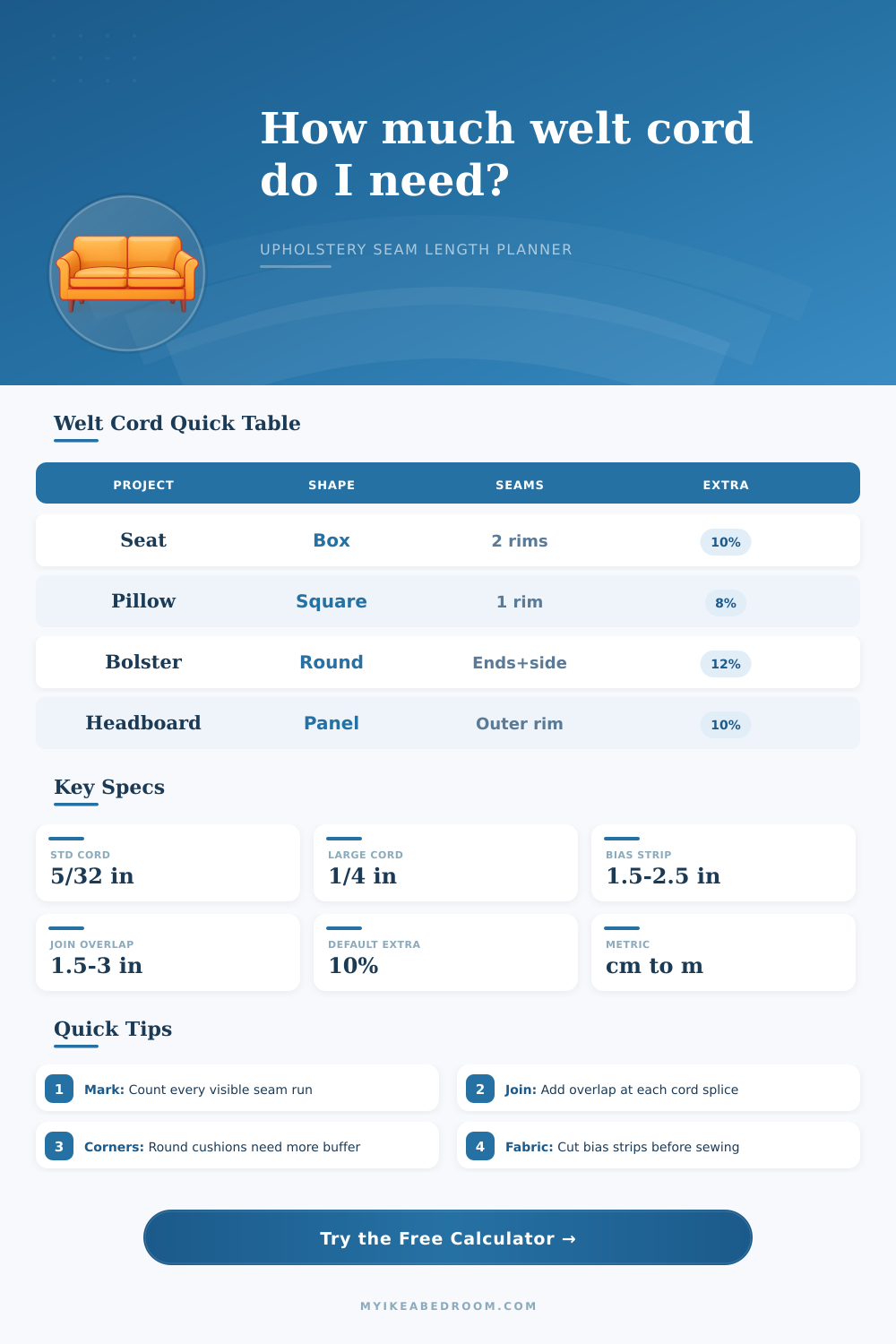
The calculator helps by allowing you to select the shape of the item and the plan for the welt cord seam to ensure that the base length number reflect the total amount of welt cord that will be required for the project. The diameter of the welt cord will play a significant role in the final appearance of the welt cord seam. A 5/32-inch diameter is the standard for welt cord and will sit within most seams.
For more visual weight to the seam, you may use a 1/4-inch welt cord. However, for items such as dining chair, a 1/4-inch welt cord may appear too heavy. For items like sofas, a 1/4-inch welt cord may be appropriate.
The table in the calculator will show the width of the strip of fabric that must be cut on the bias of the fabric to allow the welt cord seam to wrap around the welt cord. If you are to use lip cord in place of welt cord, the strip width does not have to be calculated because the lip cord is manufactured with the fabric attached to the welt cord. The joins in the welt cord are the points at which one piece of welt cord end and another welt cord begins.
A join requires an overlap in the welt cord so that the welt cord can be tapered at the ends of the welt cord. The calculator use two inches as the default value for the length of joins. In cases in which the cord or the fabric is especially thick, two and a half inch may be required for each join.
You must enter the total number of joins into the welt cord calculator because the number of joins will likely inform the total length of welt cord that will be required. For items like large headboards, at least one join will be required. The join can be placed on the underside of the headboard so that it wont be visible.
The calculator will incorporate a buffer percentage into the total length of welt cord to ensure that you will not run out of welt cord during the project. A straight knife-edge pillow will only require a small buffer in the welt cord length. For items like box cushions with rounded corners and bolsters, a larger buffer will be required.
The calculator will add the buffer percentage to the total length of welt cord after the base length and the length of the joins have been accounted for in the welt cord length calculator. This buffer allowance will allow for the welt cord to stretch and accommodate for the welt cord being doubled to allow for a second layer of welt cord. By comparing welt cord length for two different plans for the welt cord seam, it is possible to determine which welt cord plan will require more welt cord.
For example, adding vertical corner welt to a box cushion will require more welt cord than a box cushion that does not have vertical corner welt. The person can see the difference in welt cord length between the two options in the welt cord length calculator to allow the person to decide on the best welt cord plan. The type of fabric that you are to use in the welt cord seam will also affect the amount of welt cord that is required.
Tightly woven fabrics like cotton and linen will hold their shape to the welt cord. In contrast, loosely woven fabrics may require more attention to the welt cord seam. The welt cord length calculator does not have a setting to account for the type of fabric that will be used.
This means that the buffer percentage will have to be used to accommodate for the type of fabric that is selected. There are a few common mistakes made by individuals who are planning the length of their welt cord. One of the most common is only measuring the cut edge of the welt cord rather than the welt cords finished seam line.
Welt cord follows the seam line, so the length of the welt cord should reflect the width of the seam allowance. Another common mistake is forgetting that double welt requires two cord. If you are to use double welt, the welt cord length calculator will double the length of the welt cord by selecting the double welt option in the welt cord seam plan.
Four specific numbers will be provided as the welt cord length calculator is completed. The first number will be the total length of the welt cord that will be required for the project. The base length of the welt cord seam will be the second number.
The length of the fabric strip will be the third number. The fourth number will be the allowance of welt cord that is provided for the joins in the welt cord seam. This fourth number will help to determine whether the buffer percentage that was chosen for the welt cord is appropriate or if a larger buffer percentage has to be used.
This welt cord length calculator will eliminate the need to perform the arithmetic calculations for the welt cord length required. The calculator will assist in the planning of the placement of the joins in the welt cord and the cord weight that is to be used for the welt cord seam.