Calculating the correct button count for a tufted headboard is a necessary task because the button count will determine whether the headboard look balanced or incorrect. A person must decide how many tufting points to use and where to place those tufting points so that the headboard doesnt look too crowded or too sparse. If a person use too few buttons for the headboard, the tufts will look stretched.
Conversely, if a person uses too many buttons, the square will look too cramped for the headboard. Furthermore, using a button tufting calculator will help a person to avoid mathematical error when determining the width of the headboard, the height of the headboard, and the edge insets for the headboard. The edge insets for a headboard are important because they will prevent the outer tuft of the headboard from becoming too close to the frame of the headboard.
How to Count Buttons for a Tufted Headboard
If the buttons are too close to the frame of the headboard, they will interfere with the stitching of that headboards frame. Using the same size for the left-right and the top-bottom edge insets for a headboard will provide a headboard that is visually even and balance. The button count calculator requires these inset measurements so that the calculator can determine if the design will still be symmetrical when the edge insets are applied.
The choice of pattern for a tufted headboard will change the total button count for that headboard. Grid patterns requires the multiplication of the number of rows of tufts by the number of columns of tufting points. A diamond layout use a different formula from the grid pattern for calculating the total button count.
An offset diamond layout removes one button from every other row of the headboard design. A bordered diamond pattern will add buttons to the border that sit along the edges of the headboard. Recognizing these different button counts allows the calculator to account for each of these design choices so that the person does not have to redraw the headboards tufting points.
The type of button that a person will use will change the number of spare buttons that a person will need for the project. Fabric-covered buttons will require more spare buttons than metal shank buttons. This is because the fabric will fail during the pulling of the thread through the fabric cover.
Metal shank buttons will be more durable than fabric-covered buttons but can bend if the thread tension is too high when inserting the button into the foam. Plastic snap-back buttons will be useful for projects that require light tufting points but will crack more easy than either fabric-covered or metal shank buttons. Using the spare buttons field on the calculator will allow a person to ensure they have enough spare buttons for the headboard project.
The depth of the foam that will be used in the headboard will impact the length of the thread that will be used and the size of the buttons. Using deeper foam will require longer length of thread to fully saturate the foam. If the foam is deep enough that the fabric circles will cover the shank of the buttons, those fabric circles will need to be large enough to allow the fabric to cover the button shank so that no raw edge are created.
The button count calculator will convert the size of the buttons to the diameter of the fabric circles so that a person knows how many fabric circles to cut from the fabric. The spacing between the buttons is where most people will make mistakes with a tufted headboard. The spacing between the buttons should be determined from the center of one button to the center of the next button.
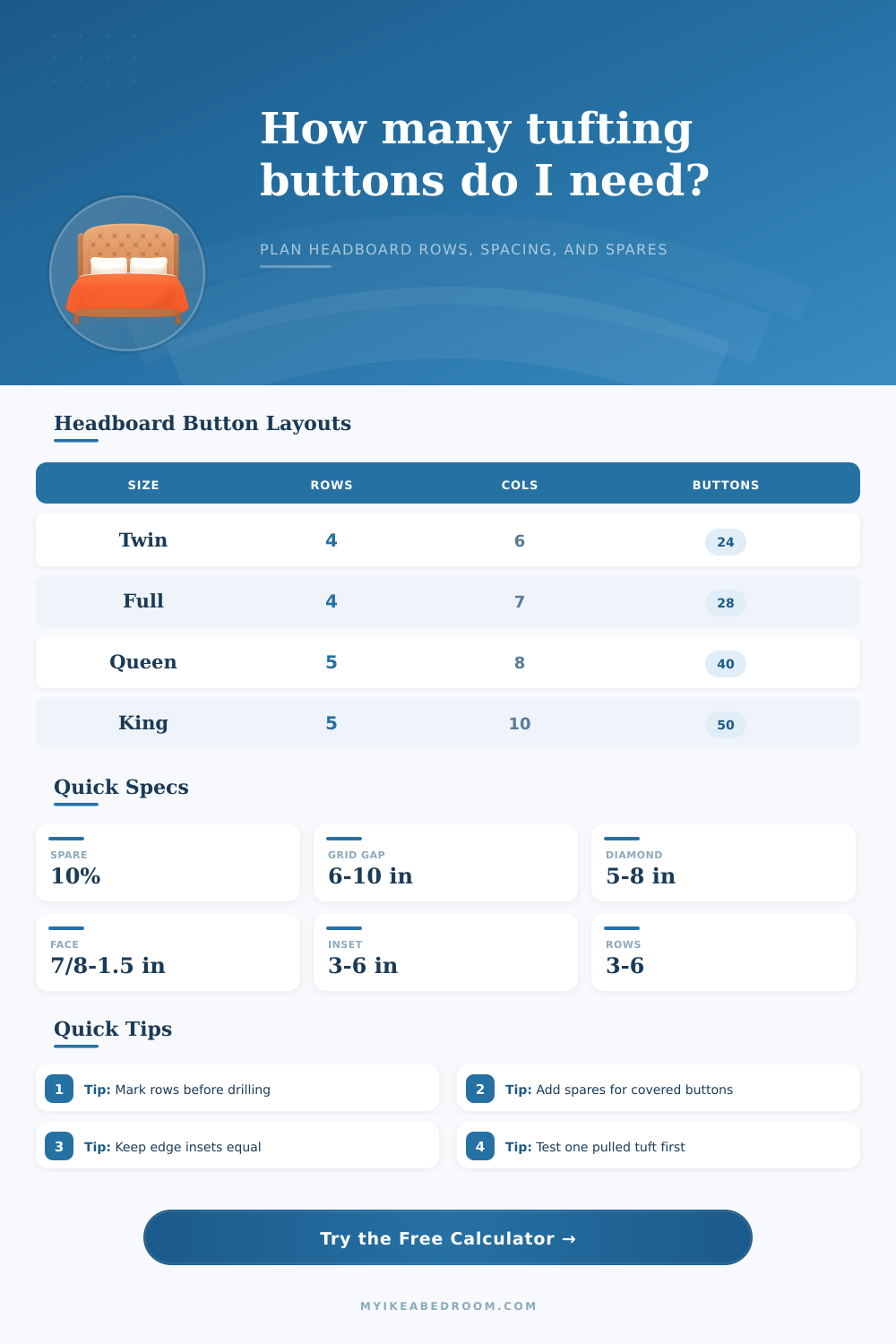
Using the button count calculator will determine the true center to center distance so that a person knows whether the number of rows and the number of columns for the headboard will lead to balanced squares or long rectangle. The table of common row and column counts for common bed size is provided so that a person has a starting point for their project. While these numbers are not rules for a headboard project, they will assist a person in determining how many rows of buttons to use for a queen bed or king bed.
By changing the numbers in the headboard project input fields, the calculator will show the immediate change in the other field of the headboard button count calculator. The length of the thread that will be used should be calculated careful. The thread must go through the foam and the button so that the button is secured to the headboard.
Furthermore, there must be enough thread left over for the creation of knot. The button count calculator will provide an estimation of the length of thread that will be required for the project. The button count for a headboard is an adjustable number.
A person may want to use a specific grid count for a different headboard design. However, the spacing between the buttons may end up being too tight once the thickness of the foam and the thickness of the fabric are added to the calculation. Using the button count calculator allows a person to adjust for these material to ensure that there will be no mismatch between the design elements and the headboard materials.
A person should also provide spare buttons for the headboard project. Using a percentage for the spare buttons allows for easier calculations of how many spare buttons will be needed. Using a percentage of 10% of the total button count is generally sufficient for most headboard projects that use covered buttons.
If a person is using thick fabric or is a first-time tufting headboard builder, percentages as high as 20% may be better. The button count calculator allows for quick changes to this percentage so that a person can fine-tune the number of spare buttons that will be purchase for the project. Ensuring that a person has the appropriate number of buttons, thread lengths, and proper spacing between the buttons prior to the start of a headboard project is essential to the success of that project.