Diamond Tufting Spacing Calculator
Lay out staggered button rows, even diamond pitch, inset margins, pull depth, and fabric cut allowance for upholstered headboards, benches, ottomans, and padded panels.
✦Tufting Presets
⚙Panel And Pattern Inputs
Layout Breakdown
◇Fabric Behavior Comparison
📊Reference Tables
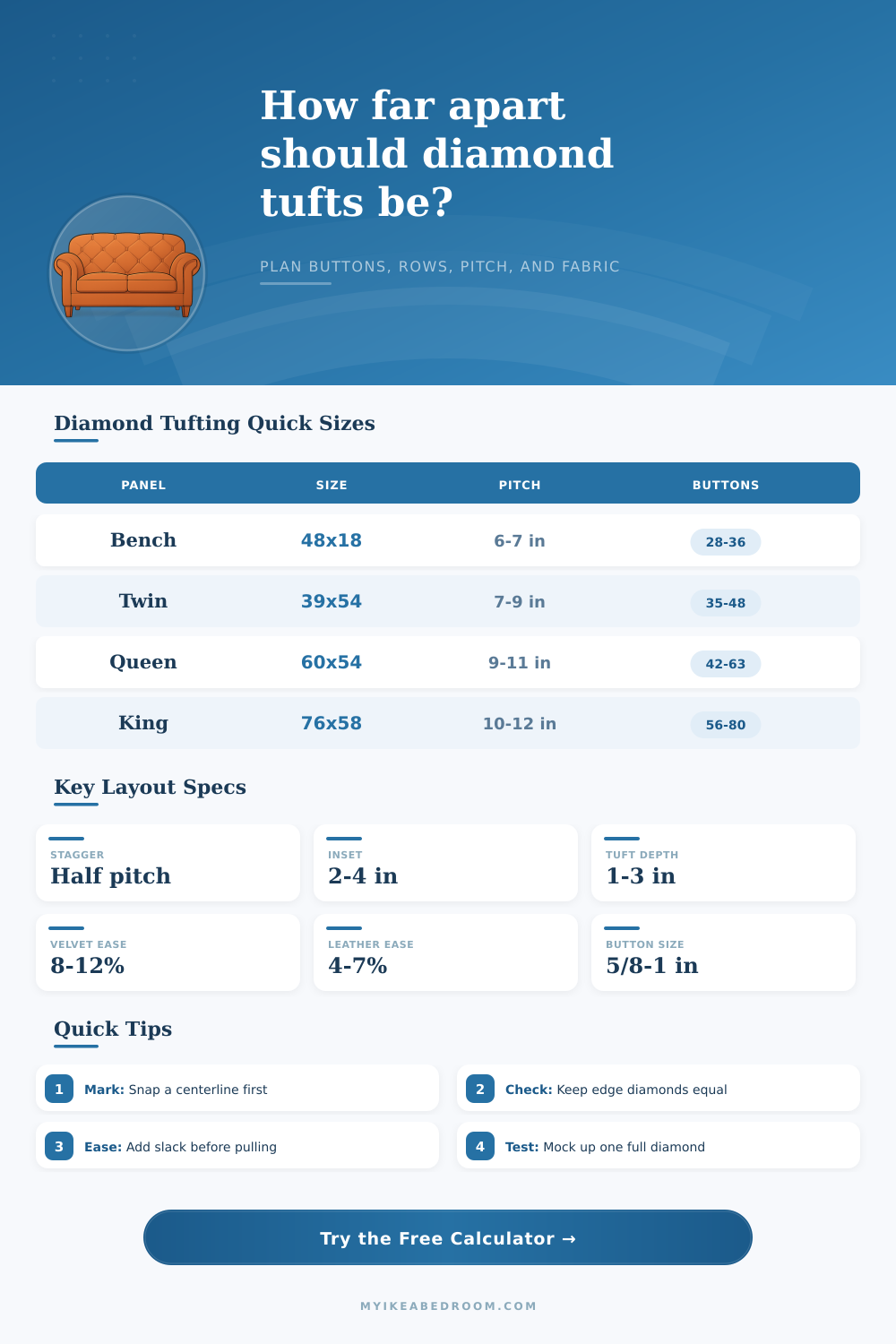
Common Tufted Panel Sizes
| Piece | Typical Panel | Good Pitch | Button Range |
|---|---|---|---|
| Twin headboard | 39 × 48 to 54 in | 7 to 9 in | 35 to 48 |
| Full headboard | 54 × 48 to 56 in | 8 to 10 in | 42 to 56 |
| Queen headboard | 60 × 50 to 60 in | 9 to 11 in | 42 to 63 |
| King headboard | 76 × 54 to 64 in | 10 to 12 in | 56 to 80 |
| End bench | 42 × 16 to 22 in | 5.5 to 7 in | 20 to 36 |
Diamond Scale Guide
| Visual Scale | Width Pitch | Row Pitch | Best Use |
|---|---|---|---|
| Tight cushion | 5 to 7 in | 4.5 to 6.5 in | Stools, benches |
| Classic bedroom | 8 to 10 in | 7 to 9 in | Twin, full, queen |
| Broad luxury | 10 to 12 in | 8.5 to 11 in | King panels |
| Large wall panel | 12 to 15 in | 10 to 13 in | Feature panels |
Fabric And Button Pairing
| Fabric | Ease | Button | Pull Depth |
|---|---|---|---|
| Velvet or velour | 8 to 12% | 5/8 to 7/8 in | 1 to 2.5 in |
| Linen blend | 6 to 10% | 3/4 to 1 in | 1 to 2 in |
| Microsuede | 7 to 11% | 5/8 to 1 in | 1 to 2.5 in |
| Faux leather | 4 to 7% | 7/8 to 1 in | 0.75 to 1.75 in |
| Boucle weave | 8 to 13% | 7/8 to 1.125 in | 1 to 2 in |
Marking And Offset Rules
| Layout Item | Rule | Why It Matters | Check |
|---|---|---|---|
| Side inset | 2 to 4 in | Leaves wrap room | Equal both sides |
| Row offset | Half pitch | Forms diamonds | Alternate rows |
| First row | On centerline | Keeps pattern square | Level across |
| Outer diamonds | Same width | Prevents lopsided edges | Mirror left/right |
| Pull test | One diamond | Confirms folds | Before drilling |
ℹTufting Notes
Diamond tufting is a method in which the buttons on an panel of fabric pull that fabric into the center, forming a pattern of diamond. The diamond pattern is formed as each button pull the fabric toward the center of the panel. The diamonds form a grid pattern with the diamonds composed of shapes that appear crisp when viewed from a distance and soft when viewed up close.
The diamonds will only be correctly formed if the spacing of the buttons is correct; if the buttons are spaced too far from each other, the diamonds will appear loose on the panel, but if the buttons are too close to each other, the fabric may puckor the buttons may crowd each other. The correct spacing of the buttons are based off the size of the panel, the depth of the buttons, and the way that the fabric will behave when it is folded or stretched. The calculator included in this article will calculate for you the number of rows of buttons and the size of the fabric cuts necessary to create the diamond tufting pattern once you enter the size of the panel that you will be using and the desired width of the diamond.
Diamond Tufting: Button Spacing and Fabric Size
The calculator will ensure that the diamonds at the edges of the panel are even by calculating the size of the edge diamonds prior to the cutting of the fabric. The inset fields on the calculator are used to ensure that the diamonds do not extend into the frame or the staple line of the tufted panel; if the buttons are placed too close to the edges of the panel, the fabric will not be able to wrap around the panel’s edges. An inset of two to four inches of the edges of the panel is recommended to allow for the fabric to fold at the edges of the panel and to allow it to be staple to the panel.
The type of fabric that you use will impact the amount of “ease” that the fabric need. For instance, velvet and other fabrics that have a nap to the fabric will require more ease since the button will flatten that nap of the fabric. In contrast, leather and vinyl will require less ease since those materials will not flatten in the same way as velvet.
You can adjust the ease percentage on the calculator to include the amount of fabric that will dissapear into the folds of the fabric. Without including the proper amount of ease in the fabric, the diamonds may appear shallow or the fabric may tear at the buttons when attempting to reach the desired tuft depth. Diamond tufting requires that the row spacing between the rows of buttons is in balance with the width of the diamonds.
If the row spacing and the width of the diamonds are not in balance with each other, the diamonds may appear as long and skinny diamonds or short and wide diamonds. The stagger offset is always half of the width of the diamonds, and this amount of offset to each row of buttons creates the diamonds. If the width of the diamonds is changed without changing the row spacing, the entire layout of the row will shift relative to each other; the diamonds at the top and bottom edges may not match with the diamonds on each side of the panel.
The calculator ensures that both the row spacing and the width of the diamonds are balanced with each other so that the diamonds remains even throughout the panel. The tables located on this page show typical size for tufting panels and the pitch that should be used with those sized panels. These tables are a starting point for most tufters; they are not strict rules.
For instance, both a queen sized headboard and a reading nook may be sixty inches wide, yet the headboard may have a larger diamond size than the reading nook if the reading nook can be viewed from a closer distance. These tables provide a sense of scale for most sized panels and tufting depth, but the calculator will provide a better idea of the depth that will work with the size of the panel after the insets are removed from the size of the panel. Tuft depth is a measurement that many people tend to ignore when tufting fabric, but it is a very important measurement.
For instance, a depth of three quarters of an inch will create a very flatly looking tufted panel, but a depth of two inches or more will create shadow and folds in the fabric. However, deep tuft depths will require more ease in the fabric. Additionally, the fabric that is used will need to be able to handle such a depth; deeper tuft depths will put strain on the fabric that could otherwise cause it to tear.
The fabric profiles will alert the user to any too deep tuft depth that are selected so that the user can avoid potential tears in the fabric. Creating the layout of the buttons on the fabric panel can be tricky. The best way to start is with the placement of the centerline of the panel.
The placement of the diamonds in relation to the centerline will ensure that the pattern is square with the panel. The first row of buttons will be placed along the centerline, and the remaining rows will be offset from the centerline. The diamonds on each side of the panel should be of the same size to ensure that it is centered on the panel; otherwise the pattern may shift towards one side of the panel.
If the division of the panel into rows results in an odd number of inches for the width of the panel, the depth of the buttons will have to be adjust slightly before dividing the panel into rows. Most people make one or more mistakes when tufting a panel of fabric. For example, some may choose the depth of the buttons without first ensuring that the fabric is deep enough to reach the buttons to the chosen depth; if it is not deep enough, the folds may pull on the fabric in the wrong direction.
Additionally, most people do not take into account the way that the depth of the buttons will impact the size of the fabric. For depths of two inches or more, you must cut the size of the fabric to account for both the depth of the buttons, the travel of the fabric between each button, and the ease in the fabric that disappears into the folds. The calculator includes these measurements in the size of the fabric cut so that the fabric will be the correct size once the tufting process begins.
The best way to test your layout of buttons is to pull the first diamond in the fabric panel. If the folds of the fabric are even and the button is located at the desired depth of the button, the remainder of the panel will be even and the buttons will be located at the appropriate depths. If the folds of the button are not even with each other, the layout can still be adjusted before drilling the holes in the foam.
The test of the first diamond will reveal to the tufturer whether the depth of the buttons, the size of the diamonds, and the ease of the fabric are correctly chosen. While it may be frustrating to lay out the buttons for the fabric panel, it is important to take the time to ensure that the diamonds and the size of the buttons will be even throughout the panel. By using this calculator, you remove the need for any arithmatic calculation from the process of creating a diamond tufting panel.