
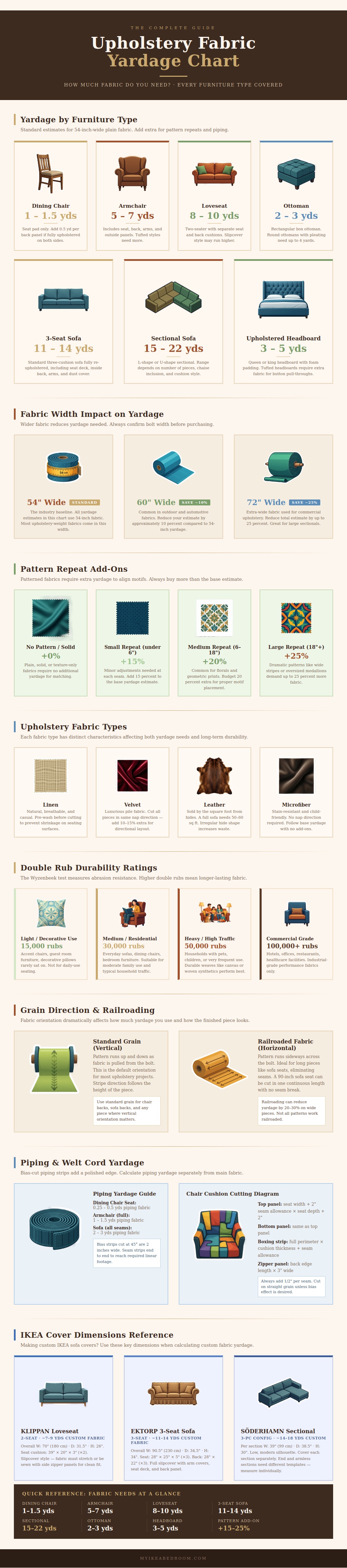
Fabric yardage are the measurement of the amount of fabric that an individual must purchase to complete there upholstery projects. It is essential to calculate the fabric yardage that will be necessary for an upholstery project in order to ensure that the individual has enough fabric to cover the piece of furniture that they intend to upholster. If an individual dont calculate the yardage of the fabric that they will use for their project, the individual may not have enough fabric to complete the project, or they may have to spend too much money on the project due to purchasing too much fabric.
One of the main factor to consider when calculating the yardage of the fabric that will be used for a project is the width of the fabric. Most upholstery fabric comes in a standard width; however, fabrics that is wider than the standard width will provide more surface area for the upholstery project. By utilizing one of these wider fabric, an individual can cover the large areas of a project without having to create any additional seams; additionally, the individual can avoid having to cut the fabric to allow for a pattern motif.
How Much Fabric to Buy for Upholstery
Thus, an individual must know the width of the fabric that will be utilized in the project prior to calculating the yardages of that fabric. The second main factor to consider when calculating the yardage that will be required for the upholstery project is the pattern repeat for the fabric. An individual must purchase additional fabric to account for the pattern if the pattern will be continued at the seams of the piece of furniture.
Fabrics that are solid in color does not have any pattern repeats, and thus each piece of solid fabric can be placed wherever the individual desires. However, fabrics that have a pattern and motif will require the individual to match that pattern at the seams of the furniture; this requires the individual to purchase additional fabric in order to allow for the pattern to be matched. Thus, an individual must purchase additional yardage for the upholstery project if the fabric contain any pattern repeats.
The type of fabric that will be utilized in the upholstery project will also impact the yardage of the fabric that is necessary to complete the project. For instance, linen is a fabric that will shrink when it is wet. Thus, an individual will have to wash the linen prior to beginning the upholstery project.
Velvet is a fabric that has a nap; the nap is the direction of the fibers in the fabric. An individual must cut each piece of velvet in the same direction in order to ensure that the color is evenly distribute throughout each piece of the upholstered furniture. Thus, an individual will have to purchase additional yardage of velvet to allow for each piece to be cut in the same direction.
Lastly, microfiber is a fabric that does not have a nap. Thus, no additional fabric yardage will be required for an upholstery project that utilize microfiber. Finally, leather is a material that is sold by the hide instead of by the yard; thus, it has a different calculation for yardage then the other types of upholstery fabric.
In addition to the type of fabric that will be utilized in the upholstery project, there are also considerations of the durability of that fabric. Durability is an important factor to consider when purchasing upholstery fabric; however, it does not directly impact the yardage calculation. A double rub test represents the durability of the fabric.
The double rub test measures how many times that the fabric should be rubbed prior to the fabric beginning to wear. An individual who is purchasing a fabric for a sofa will want to select a fabric with a more high level of durability than they would for a chair. However, the yardage of each of those fabrics does not differ.
In addition to the type of fabric that will be used for the project, there are also considerations of the grain direction for that fabric. The grain of the fabric can be laid out in a standard fashion, or it can be railroaded. If the project is to be “railroaded,” the width of the fabric will cover the length of the piece of furniture.
Additionally, by railing the fabric, an individual may avoid the need for a center seam for the furniture; however, the way the pattern will appear on the furniture will be alter. In addition to the type of fabric that will be used for a project, there are also fabric details to consider. For instance, piping and welt cord will require additional yardage of the upholstery fabric.
The piping and welt cord will be used to frame the cushions and the arms on the upholstered furniture. The individual can obtain the strips of fabric for the piping and welt cord on the bias of the upholstery fabric; thus, they can be prepared in a separate yardage calculation. However, the individual will have to purchase additional yardage for piping if the project is to be performed for a large sofa rather than a small dining chair.
The type of fabric that will be used in a modular furniture project will require each section of the furniture to be measured individually. Additionally, each individual will have to account for zippers and allowances for the seams to be incorporate into the furniture. If the yardage calculation for the fabric does not include these allowances, the fabric may not be enough for each section of the furniture.
Finally, if an individual considers each of these factor (fabric width, pattern, nap, durability, grain, railroading, piping, welt cord, and custom covers), the individual will be able to accurately calculate the yardage of the fabric that will be required for each project.
