Blanket Yarn Calculator
Estimate blanket yarn yardage, skeins, meters, grams, stitch counts, row counts, border yarn, texture allowance, overage, and color split from finished blanket size and gauge.
Choose a common blanket size, then adjust yarn weight, stitch texture, gauge, border, skein length, color split, and overage.
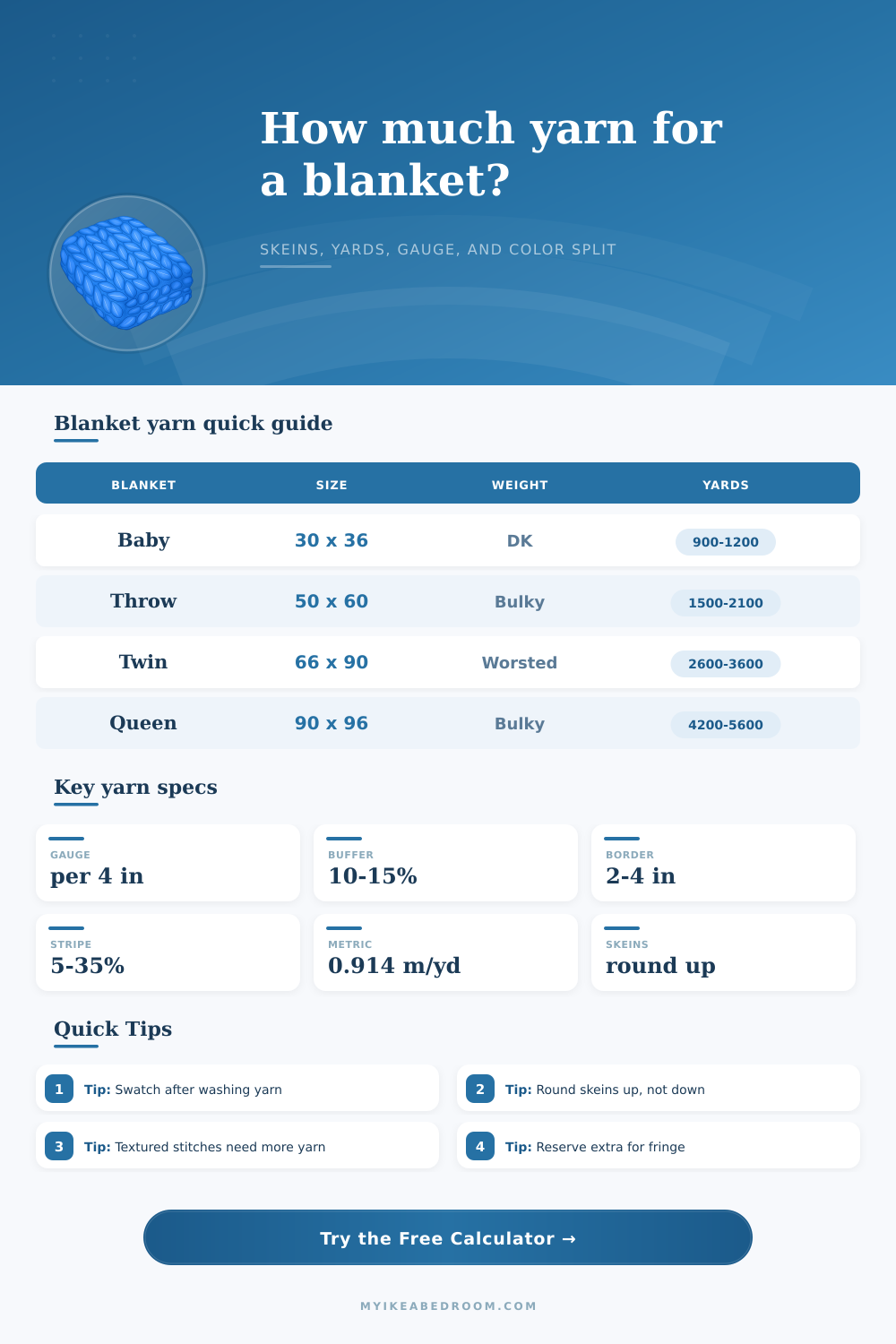
| Blanket type | Finished size | Typical weight | Planning range |
|---|---|---|---|
| Security or stroller | 24 x 30 in | DK or worsted | 450 to 850 yd |
| Baby crib blanket | 30 x 36 in | DK or worsted | 750 to 1300 yd |
| Lap blanket | 36 x 48 in | Worsted | 1000 to 1700 yd |
| Throw blanket | 50 x 60 in | Worsted or bulky | 1600 to 2800 yd |
| Twin bed blanket | 66 x 90 in | Worsted or bulky | 3000 to 5200 yd |
| Queen bed blanket | 90 x 96 in | Bulky or worsted | 4300 to 7600 yd |
| Texture choice | Multiplier | Best for | Yarn behavior |
|---|---|---|---|
| Stockinette or single crochet | 1.00 | Plain fabric baseline | Neutral estimate |
| Garter, moss, or half double crochet | 1.12 | Reversible blankets | More rows and texture |
| Ribbed or waffle texture | 1.22 | Squishy sofa throws | Dense fabric pull-in |
| Cables, bobbles, or basket weave | 1.35 | Decorative bed blankets | High yarn demand |
| Open lace or granny clusters | 0.78 | Airy coverlets | Lower yardage |
| Skein label | Yards each | Meters each | How calculator rounds |
|---|---|---|---|
| Small cotton ball | 120 yd | 110 m | Round up to full balls |
| Standard worsted skein | 220 yd | 201 m | Round up to full skeins |
| Large acrylic skein | 364 yd | 333 m | Round up after buffer |
| Bulky wool hank | 109 yd | 100 m | Round up by dye lot |
| Jumbo chenille ball | 32 yd | 29 m | Round up heavily |
Use when: you want the cleanest yardage estimate.
Best for stockinette, single crochet, linen stitch, or simple panels.
Use when: both blanket faces need to look finished.
Garter, moss, seed, and half double crochet often use extra yarn.
Use when: cables, bobbles, ribs, or waffles dominate.
Dense textures need a larger multiplier and a stronger buffer.
Use when: the design has visible holes or clusters.
Lace and granny-style blankets usually need fewer yards per area.
Gauge tip: Measure stitches and rows from a washed swatch. Blanket fabric can grow, relax, or tighten after laundering, especially cotton, wool, and chenille.
Color tip: For stripes or contrast borders, keep the accent percentage separate from the total buffer so each color still rounds up to complete skeins.
When you plan a blanket, you must determine how much yarn you will need to complete the blanket. You need to ensure that you have enough yarn to complete the blanket without running out of yarn during the process. Additionally, you need to ensure that you have enough yarn so that you dont find out that your chosen dye lot for the yarn are unavailable after you have started your blanket.
The amount of yarn that will be needed for your blanket will depend upon the measurements that you would like your blanket to make when complete, as well as upon the way in which the yarn and fabric are build. One of the main factor that will impact the amount of yarn that is needed for your blanket is the weight of the yarn. Lace weight yarn and fingering weight yarn will cover a large area in your blanket with fewer yards of yarn than super bulky yarn will cover due to the fact that each stitch in lace weight and fingering weight yarn will cover less ground than each stitch in super bulky yarn.
How Much Yarn Do You Need for a Blanket
While the calculator utilizes these baseline rates for yarn coverage to determine an estimated amount of yarn that will be needed, that estimate is also adjusted according to the stitch pattern that you plan to use. Plain stitch patterns, like stockinette or single crochet, will use a neutral amount of yarn indicated by the calculator, while texture patterns, like cables or bobbles, will require more yarn to create the texture in the blanket. Lastly, open lace pattern will require less yarn than the plain blankets due to the fact that the holes within the lace design replace some of the yarn that would normally be used to create the blankets fabric.
Another of the factors that will impact the amount of yarn that is needed for your blanket is the gauge of the blanket. Blankets can have the same size yet require different amounts of yarn according to their gauge. Blankets with a tighter gauge will require more yarn than blankets with a looser gauge.
The gauge for your blanket should be determined using a swatch of yarn that has been washed, as blankets are too often be washed and blocked in their creation. Using a washed swatch will provide you with the most realistic gauge measurement for your completed blanket. Blankets that have borders will require more yarn than blankets without borders of the same size.
Blankets often require an additional calculation of the yarn needed to create borders of the blanket because borders often use a different yarn, stitch, or color to those used in the main blanket. If your blanket design incorporate stripes or color blocking, you can use the accent percentage field to split the total yardage of yarn needed for the blanket. By splitting the yardage required for blankets with accent colors, you can determine how many skein of each color of yarn will be needed for the blanket, avoiding the scenario of running out of one of the accent colors.
Another consideration for yarn for blankets is the need to include an overage for the yarn. Typically, you include an overage of ten percent for yarn to account for the yarn that is wasted when new skeins of yarn are join together during the crafting of the blanket, as well as for accounting for any gauge difference among yarn skeins. An overage of fifteen or twenty percent may be desired for blankets that contain fringe elements or for blankets that use hand dyed yarn.
This overage will ensure that your project will not stall due to running out of yarn. Blankets of different sizes will have different amount of yarn required to complete the blankets of that size. For example, a throw blanket that measures fifty inches in length by sixty inches in width will require between sixteen hundred and twenty-eight hundred yards of yarn to complete the blanket.
Blankets of the twin size will require more yarn than throw blankets of the same yarn weight and gauge due to the larger area that needs to be cover by the blanket. Some blankets may contain dense textures in their fabric that will add to the weight of the blanket and the amount of yarn that is required to create those textures. Blankets with textures like waffle or cable blankets will be heavier than blankets with textures as simple as stockinette blankets.
Additionally, blankets that use heavy textures will drape differently from blankets that are comprised of lighter yarns and fabrics. The blanket yarn calculator will allow you to see how different textures will impact the total yardage of yarn that is required for your blanket. These calculations should of been performed before you begin to create your blanket.
While you may change the colors for your blanket after the calculator has calculated the yarn requirements, it is not possible to purchase additional yarn while the blanket is being create. Thus, the yarn yardage calculated for your blanket will allow you to complete your blanket without running out of yarn.