Quilt Batting Calculator
Plan batting cut size, prewash shrink allowance, quilting draw-up, package count, roll yardage, seams, and leftover area for baby quilts, throws, bed quilts, wall hangings, and runners.
Start with a common quilt size, then adjust overhang, shrinkage, batting type, package format, join overlap, and quilting density.
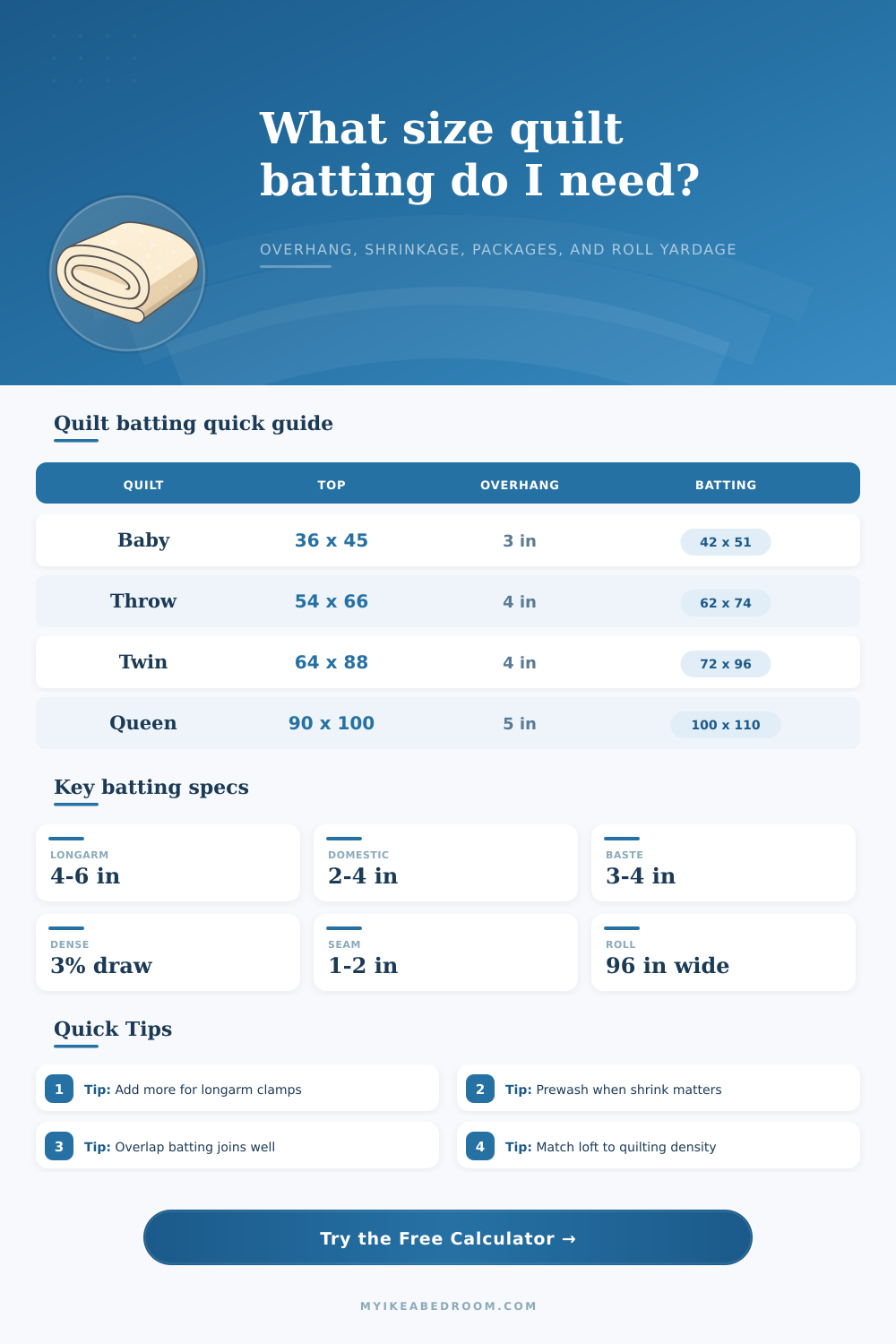
| Project | Typical quilt top | Domestic batting cut | Longarm batting cut |
|---|---|---|---|
| Wall hanging | 24 x 36 in | 30 x 42 in with 3 in overhang | 34 x 46 in with 5 in overhang |
| Baby quilt | 36 x 45 in | 42 x 51 in with 3 in overhang | 46 x 55 in with 5 in overhang |
| Throw quilt | 54 x 66 in | 62 x 74 in with 4 in overhang | 64 x 76 in with 5 in overhang |
| Twin quilt | 64 x 88 in | 72 x 96 in with 4 in overhang | 74 x 98 in with 5 in overhang |
| Queen quilt | 90 x 100 in | 100 x 110 in with 5 in overhang | 102 x 112 in with 6 in overhang |
| King quilt | 108 x 108 in | 118 x 118 in with 5 in overhang | 120 x 120 in with 6 in overhang |
| Format | Nominal size | Best fit range | Calculator treatment |
|---|---|---|---|
| Crib package | 45 x 60 in | Baby quilts, small throws | Counts sheets and joined panels when needed. |
| Throw package | 60 x 60 in | Square throws and lap quilts | Checks whether one piece covers the cut size. |
| Twin package | 72 x 90 in | Twin bed quilts and large throws | Uses sheet area and join overlap for multiples. |
| Queen package | 90 x 108 in | Full and queen quilt tops | Compares package area against planned cut area. |
| King package | 120 x 120 in | Queen with longarm overhang, king tops | Shows trim area available after cutting. |
| Roll batting | 96 to 120 in wide | Bed quilts, repeated projects, exact lengths | Calculates linear yards from the required cut length. |
| Quilting style | Draw-up allowance | Typical spacing | Batting note |
|---|---|---|---|
| Loose utility quilting | 1% | 4 to 8 in apart | Works best with batting approved for wider quilting distance. |
| Moderate allover quilting | 2% | 2 to 4 in apart | A safe planning default for many throw and bed quilts. |
| Dense texture quilting | 3% | 1 to 2 in apart | Adds more draw-up before the quilt is washed. |
| Heirloom or matchstick work | 4% | Under 1 in apart | Use extra batting and backing before trimming. |
After calculating, these cards compare the overhang plan, package fit, leftover area, and fiber behavior for the current batting choice.
Awaiting input
Calculate to compare quilting setup clearance.
Awaiting input
Calculate to see package or roll usage.
Awaiting input
Calculate to separate draw-up from wash shrink.
Awaiting input
Calculate to check seam overlap and panels.
Tip 1: Measure the quilt top after borders are attached and squared. Batting planned from an early block layout can come up short after border changes.
Tip 2: When joining batting scraps, keep seams away from very dark solids and high-contrast quilting paths if the batting thickness changes at the join.
When you prepare to quilt a quilt top, you must first select the batting that will cover the quilt top. The batting you select must provide enough material to allow for extra material at the edges of the quilt top for basting and quilting the quilt top, and the batting must not result in a quilt that is to small once it is washed. The batting is the single layer of fiber that is placed between the quilt top and the quilt backing.
The batting will determine how the quilt layers will drape from the quilt, how much the quilt will shrink when it is washed, and how the quilting lines will appear on the quilt. The calculator will mathematically calculate the amount of batting you need once you enter the measurements for your quilt and the allowances you will use for quilting the quilt. The calculator will remove the guesswork in determining the amount of batting that you need to purchase for your project.
Choose Batting and Use the Calculator
You have the ability to adjust the batting overhang in the batting calculator. Two inches of batting overhang on each end of the quilt top will allow you to use many domestic sewing machines for quilting. Four inches of batting overhang will provide more room for longarm quilting clamps and the movement of the quilt layers when you perform quilting with density.
The calculator incorporates the batting overhang into each of the calculations after you enter the batting overhang in the batting calculator. If you will be using a longarm quilting machine instead of a domestic sewing machine, you can adjust the batting overhang in the calculator to determine the size of the batting pieces that you will have to cut from your batting roll. The shrinkage and draw-up of cotton batting can be surprising to many quilters.
Cotton batting can shrink three percent or more when the quilt is washed. Additionally, quilting that is performed with density can create another small percentage in the draw-up of cotton batting. The batting calculator separates the shrinkage and draw-up functions so that you can determine the batting that you will need if you plan on quilting with dense quilting lines.
The shrinkage and draw-up calculations will help you to decide between a polyester batting that will not shrink and a cotton batting that will shrink when the quilt is washed and used. This separation will allow you to determine the size of the batting that you will cut when you prepare the quilt. The batting sheets come in different sizes and the batting can be sold in rolls.
A sheet of batting that covers a queen-sized bed will work for a throw quilt that may allow extra material for overhang, but it may leave scraps of batting if you use it to quilt a king-size quilt top. Rolls of batting will allow you to avoid scraps of batting when you create the same quilt top repeatedly. However, if your batting roll is narrower than the size of the quilt that you will make, you will have to join the batting pieces together with stitches.
The batting calculator will allow you to determine if a single piece of batting will allow the quilt to be completed or if you will have to purchase two or more pieces of batting. Additionally, the calculator will show you the leftover area of the batting piece to allow you to decide if the scraps can be of any use to you. This will help you to decide on the format of the batting that you purchase.
The fiber that you use for batting will affect the quilt in more ways than just the shrinkage of the batting. If you use high-loft polyester batting, the quilting stitches will tend to pull away from each other due to the elastic nature of the batting. Wool batting will drape well on the quilt top but requires more effort in basting the quilt layers due to the nap of the wool batting.
Bamboo batting will be soft to the touch when you handle the quilt while it is being made and will drape well on the sleeping person but can compress more than cotton batting if you use dense quilting designs. The batting calculator allows you to choose the fiber that will be used in your batting; this will automatically update the shrinkage value for the batting that you choose. However, the choice of fiber for your batting will depend on the use of the finished quilt.
For example, if you are making a quilt top for a baby, it would of been best to use cotton or cotton-polyester batting for the babys comfort and because the babys quilt will need to be washed often. However, if you are making a wall hanging with the quilt top, you can use batting with a lower loft. If you have to join two or more pieces of batting together, the batting calculator allows you to account for this with the overlap input for batting.
If you use one-and-a-half inches of batting overlap and stitch it with a wide zigzag stitch, the batting pieces will hold but will provide you with a firm line in your quilt. Try to avoid sewing batting together along high-contrast colors or dark solid colors. The percentage of batting that you will overlap when you join batting pieces together is used as an allowance for directional cutting of batting and to account for the uneven compression of lofty batting when you place it on the quilting frame.
Many mistakes can occur when purchasing batting when you measure the quilt top too early in the process. Once you add the borders and square the quilt, the size of the quilt will change by one inch or more. This small inch can be magnified if you purchase batting with an overhang that allows for quilting machines with limited movement.
People often do not account for the draw-up that will occur with quilting that is denser than average. The batting calculator will show you the size of the quilt after draw-up and shrinkage of batting has occurred. This will allow you to determine if the quilt will still fit on the bed that you plan to use the quilt on or if you will have to alter your quilting plans.
The reference tables on this page list the sizes of the quilt tops and batting that has been determined for those sizes. These measurements are merely the starting point for batting selection for your quilting project; what you use on your sewing machine will change the final batting outcome. By entering your measurements and the fiber that will be used in the batting in the batting calculator, you can have a better idea of the size and yardage of batting that you will need for your project.
Batting planning is the process of understanding the different choices you can make in the batting purchase. The batting calculator allows you to create a cut size and yardage figure that is specific to your quilting project. This will allow you to focus on the quilting of the project and the way that the quilt will feel when it is in use.