Irish Chain Quilt Calculator
Estimate finished block counts, chain patch pieces, strip widths, top fabric, backing, batting, and binding for single, double, and triple Irish chain quilt layouts.
Choose a starting layout, then adjust quilt size, block size, chain style, seam allowance, fabric width, and finishing allowances.
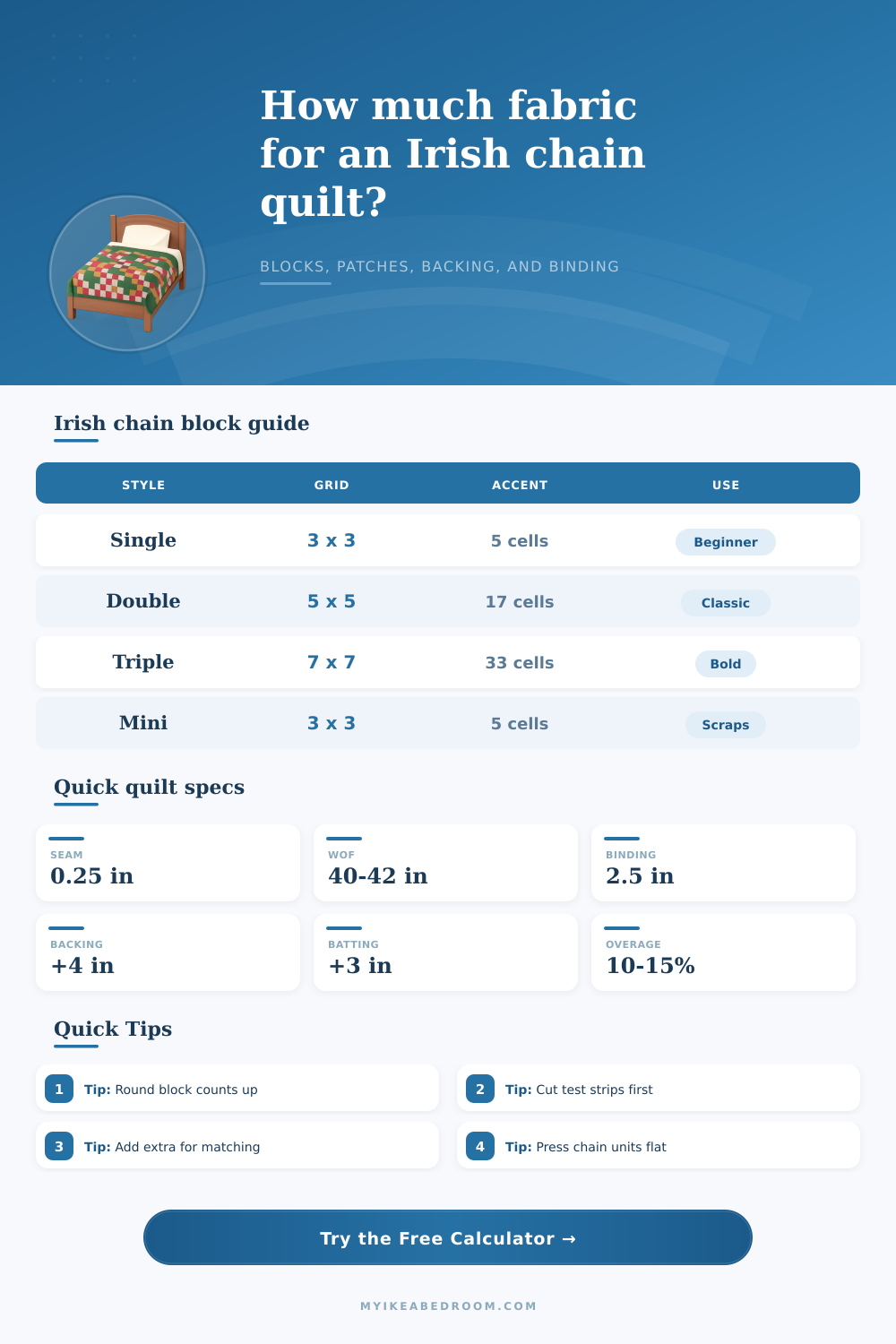
Best for: baby quilts, fast throws, scraps.
Block model: 3 x 3 chain block alternates with plain blocks.
Best for: bed quilts and two-color chains.
Block model: 5 x 5 chain blocks with two accent paths.
Best for: bold grid movement and larger blocks.
Block model: 7 x 7 chain blocks with dense patch counts.
Best for: planned quilting space.
Block model: checkerboard layout is rounded from your target size.
| Style | Patch grid | Accent 1 cells | Accent 2 cells | Background cells |
|---|---|---|---|---|
| Single Irish chain | 3 x 3 | 5 per chain block | 0 per chain block | 4 per chain block plus plain blocks |
| Double Irish chain | 5 x 5 | 9 per chain block | 8 per chain block | 8 per chain block plus plain blocks |
| Triple Irish chain | 7 x 7 | 13 per chain block | 20 per chain block | 16 per chain block plus plain blocks |
| Mini single chain | 3 x 3 | 5 per chain block | 0 per chain block | Use smaller blocks and the same model |
| Quilt type | Target size | Good block size | Common chain style | Backing note |
|---|---|---|---|---|
| Baby quilt | 42 x 54 in | 6 in | Single chain | Usually one wide backing panel |
| Lap quilt | 54 x 66 in | 6 in | Double chain | May need two standard-width panels |
| Twin quilt | 66 x 90 in | 6 in | Double chain | Plan backing seam direction early |
| Queen quilt | 90 x 96 in | 6 or 9 in | Double chain | Often easier with wide backing fabric |
| King quilt | 108 x 108 in | 9 in | Triple chain | Allow generous batting and backing |
| Finished block | Single patch cut | Double patch cut | Triple patch cut | Use case |
|---|---|---|---|---|
| 6 in block | 2.5 in squares | 1.7 in squares | 1.36 in squares | Single or double layouts |
| 7.5 in block | 3 in squares | 2 in squares | 1.57 in squares | Scrap-friendly throws |
| 9 in block | 3.5 in squares | 2.3 in squares | 1.79 in squares | Bed quilts and triple chains |
| 12 in block | 4.5 in squares | 2.9 in squares | 2.21 in squares | Fast large-scale chain quilts |
| Component | Formula | Typical allowance | Calculator output | Planning note |
|---|---|---|---|---|
| Backing width | Top width plus side overhangs | 3 to 5 in per side | Panels and yards | Panels are based on usable WOF |
| Batting size | Top size plus batting overhangs | 2 to 4 in per side | Cut rectangle | Use your quilter's requested margin |
| Binding length | Perimeter plus corner margin | 20 in extra | Strips and yards | Diagonal joins use a little extra |
| Top fabric | Patch, block, and border area | 10 to 15% overage | Yards by fabric role | Directional prints may need more |
Chain continuity: If the rounded block grid gives you an odd count in both directions, a chain-start corner usually keeps the diagonal movement balanced across the quilt top.
Strip cutting: Cut one test strip set before committing yardage, especially when double or triple chain patch units become smaller than two inches.
Plain blocks: The plain alternating blocks are counted as background yardage because most Irish chain layouts leave those spaces open for quilting motifs.
Finishing margin: Backing and batting allowances are separate from top overage so longarm, domestic quilting, and hand quilting plans can use different margins.
Planning a quilt requires you to answer several questions before you begin constructing the quilt. Questions includes: what size will the quilt be when it is finished? What pattern will I use for the quilt?
The answer to these questions will allow me to make an esential decision about the quilt design. The answer to these questions is important because the fabric for the quilt are costly and the time to complete the quilt is limited; mistakes made during the planning stage may cause difficulties in the quilting process. The Irish chain pattern comes in several versions.
Planning an Irish Chain Quilt
Each version have a different number of patches that must be cut for the quilt. The single Irish chain pattern uses a three by three grid with five accent squares in each block. The double Irish chain pattern uses a five by five grid but includes two separate paths for the accent squares.
The triple Irish chain pattern uses a seven by seven grid and contains even more accent squares in each block. The single Irish chain pattern will produce a quilt that appear to use light Irish chains; however, the triple Irish chain will create a boldly, pronounced Irish chain pattern. The version of the Irish chain pattern to be used will determine the amount of background space that is used in the quilt and the amount of movement of the Irish chain.
The calculator is used to mathematically calculate how many patches of each type of fabric are required for the quilt. The finished size of the quilt, the size of each block of the quilt, and the Irish chain design are all entered into the calculator. The calculator accounts for the borders that will be placed on the quilt outside of the block grid; it also accounts for the seam allowances that will be added to each patch of the quilt.
Furthermore, the calculator accounts for the difference between the number of chain blocks (made from accent fabrics) and plain blocks (made from background fabric). Plain blocks includes open areas for quilting; chain blocks create the lines that form the Irish chain pattern. A seam allowance of a quarter inch must be added to each patch of fabric that is included in the quilt.
Each patch requires a seam allowance to be added on each side of the patch. If the size of the seam allowance is changed, the size of the patches that is cut from the fabric will change. The usable width field calculates the width of the fabric that will be used after removing the selvage from each end of the strip of fabric.
An overage percentage can also be selected; this percentage allows for potential mistake in the quilting process. In addition to the patch and accent fabrics, the quilt also requires batting and backing and binding to finish the quilt. Backing requires extra fabric to be added to each side of the quilt so that the backing can be loaded onto the frame of the quilting machine.
Batting also requires a margin of extra fabric to be added to the quilt; however, the amount of batting required may be more different than the amount of backing required. The binding is the strip of fabric used to finish the edges of the quilt; the length of the binding requires extra length to allow for joining the strips of binding fabric and to allow the corner of the quilt to be turned. The backing, batting, and binding must be planned for the quilt so that the quilt doesnt have to be taken to the store a second time.
The Irish chain pattern allows for the use of several accent colors for the quilt. The calculator that is used to determine how much of each fabric is required will calculate how many yards of accent one fabric, accent two fabric, and background (plain) fabric is required for the quilt. The calculator can determine if one fabric of a certain yardage will be enough to complete the accent patches; otherwise, it can calculate the yardage required for a second accent fabric.
Furthermore, if the scraps of fabric are to be used for the quilt, the calculator can determine if the scraps will be enough to cover each of the accent cells for the Irish chain pattern. The size of each block of the quilt will determine the way in which the blocks will be assembled into the quilt; larger blocks will have fewer seams to be stitched together to assemble the quilt. Furthermore, the size of each patch will determine the intricacy of the Irish chain pattern; small patches will create an intricate quilt pattern of Irish chains.
The calculator allows the quilter to determine the size of each finished patch; dividing the size of the block by the grid number for the Irish chain design calculates the finished patch size. If the size of each finished patch is smaller than two inches, accuracy are required when cutting the patches to the size of each patch. It is common for many quilters to change the design of the quilt after using the calculator to determine the amount of fabric that is required to create the quilt.
The size of each block within the quilt can be changed, as well as the Irish chain design. For instance, a six-inch block may contain too many patches if using a triple Irish chain quilt design; however, a nine inch block may make the quilt too large for the backing fabric. Thus, the calculator allows the quilter to easily change the size of the blocks and the Irish chain design to view the yardage estimates for each change.
Once the quilter has determined the amount of fabric and the number of patches, the quilter can focus on the color of each patch and on quilting the patch design into the fabric.