Golden Ratio Drawer Calculator
Size a bedroom drawer stack with phi-based front heights, reveal spacing, rounding increments, pull-center positions, and equal-height comparison before cutting drawer faces.
Golden ratio drawer layout results
| Drawer | Raw height | Rounded height | Pull center from top | Face area | Fit note |
|---|---|---|---|---|---|
| Run the calculator to generate the drawer front cut list. | |||||
| Drawers | Bottom-heavy spread | Common use | Watch point |
|---|---|---|---|
| 2 | 1 : 1.62 | Nightstand | Large jump |
| 3 | 1 : 2.62 | Small chest | Top height |
| 4 | 1 : 4.24 | Vanity stack | Bottom depth |
| 5+ | Wide spread | Tall dresser | Use balanced |
| Detail | Fine | Standard | Loose |
|---|---|---|---|
| Reveal gap | 1/16 in | 1/8 in | 1/4 in |
| Metric gap | 2 mm | 3 mm | 6 mm |
| Rounding | 1/16 in | 1/8 in | 1/4 in |
| Best fit | Built-in | Dresser | Utility |
| Layout | Visual effect | Storage behavior | Best drawer count |
|---|---|---|---|
| Smallest on top | Grounded base | Bulkier items low | 3 to 5 |
| Largest on top | Top-heavy accent | Quick-access top storage | 2 to 4 |
| Largest near center | Softer symmetry | Balanced daily use | 5 to 8 |
| Equal fronts | Calm grid | Predictable boxes | Any count |
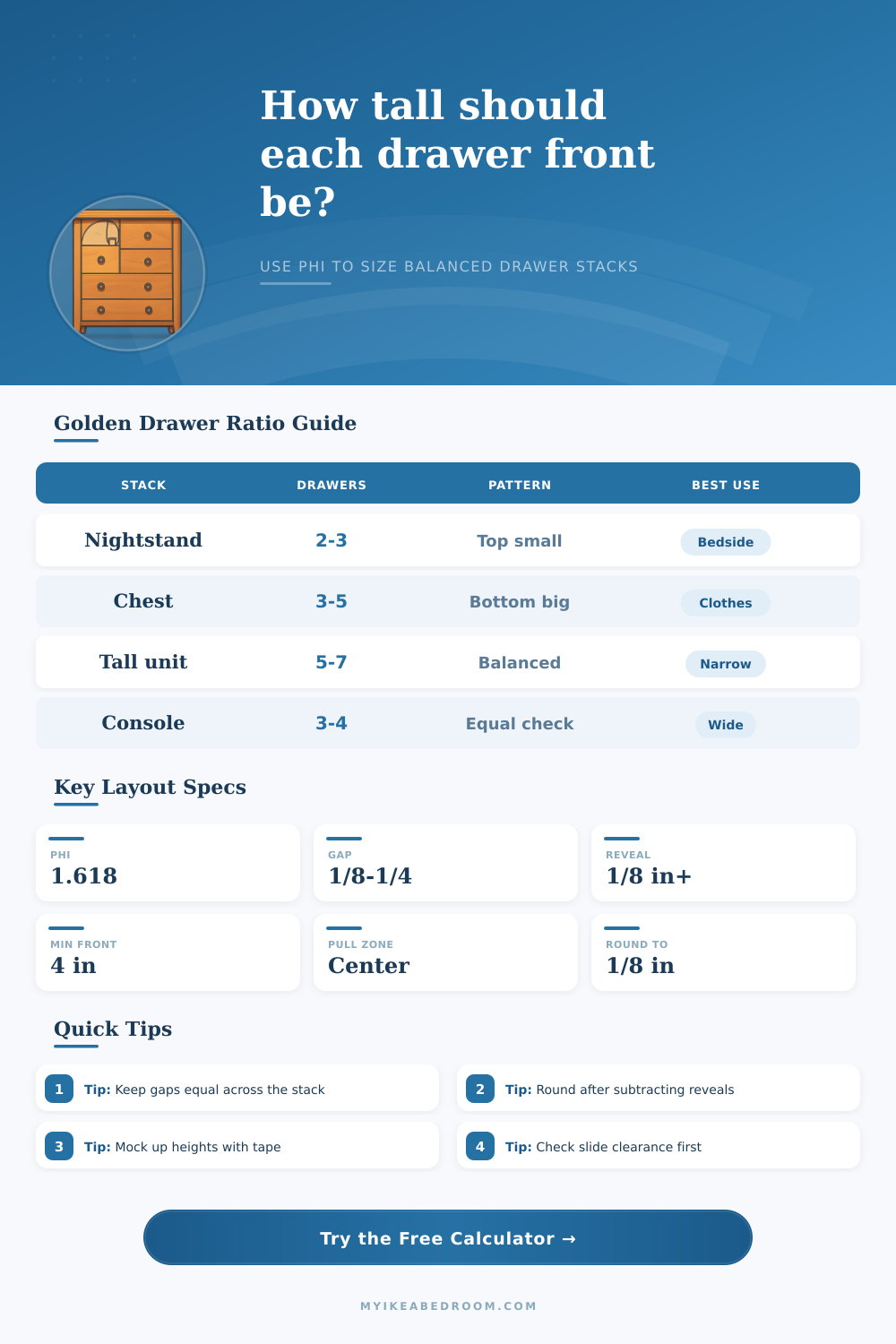
Many people find themselves creating drawer stacks that has an uneven appearance once the drawer fronts are cut and the hardware is mounted to the drawer. The unevenness of the drawer fronts can occur due to inconsistencies in the proportion of the drawer fronts and the positioning of the pull on the drawers because the furniture maker didnt plan the height of the drawers. The heights of the drawer fronts can be divided in the incorrect way, but using the golden ratio to calculate the heights of the drawer fronts will make it so that the proportion of the sizes of the drawer fronts will remain consistent throughout the entire piece of bedroom furnitures.
To determine the heights of the drawer fronts using the golden ratio, you need to measure the total height of the furniture between the top and bottom reveals. The gaps between the drawer fronts will be subtracted from this total height, and the resulting number can be used to calculate the sizes of the drawer fronts using a ratio of 1.618. A calculator will help with these calculations.
Make Drawer Fronts Even Using the Golden Ratio
The top and bottom reveals will protect the cabinets, and the gaps between the drawer fronts will affect the visual appearance of the dresser. Changing these measurements will change the heights of the drawer fronts. Depending on the type of bedroom furniture that is to be created, the heights of the drawer fronts can have different pattern.
For example, a nightstand that includes three drawers will have the smallest drawer front for the top drawer, while a nightstand will have a larger drawer front on the bottom to allow for bulky item to be stored within the nightstand. A tall, narrow dresser will have the largest drawer front in the center of the dresser to balance it out. A calculator allows people to switch between these different patterns.
The pattern of the dresser will affect the way in which the dresser is to be used, as well as how it is to look once completed. The placement of the drawer pulls will depend upon the height of the drawer fronts. The furniture maker will place the center of each drawer pull at the visual middle of each of the drawer fronts.
A calculator can help with this calculation, as well, eliminating the need for the furniture maker to re-measure each drawer front. The location of the pulls on the dresser will make an uneven appearance of the furniture if they are not even. Using consistent locations for the drawer pulls will ensure that the resulting dresser will have a professional appearance.
The number calculated through the golden ratio will not always be even numbers of fractions. These numbers will have to be rounded to the nearest eighth of an inch or the nearest sixteenth of an inch. A calculator will calculate these numbers after the furniture maker has calculated the proportion of each drawer front.
Additionally, any leftover height will be redistributed to the largest drawer front to ensure that the total height of the dresser remains the same as the height of the opening in the bedroom furniture. Additional rounding of the heights of the drawer fronts can be performed if the dresser is a built-in unit to the bedroom, but this rounding is optional for freestanding dressers. Some factors that cannot be accounted for with the golden ratio are the actual factors of the dresser that is to be made.
The height of the drawer slides will require for them to have clearance behind the dresser. Using the calculator will account for this. If the depth of the drawer is too shallow for the height of the drawer, it can lead to the drawers tipping when opened.
Using the minimum height and maximum height for the drawer fronts will prevent the furniture maker from creating a dresser with potential issue with the depth of the drawers. This calculator will help to provide a list of measurements that the furniture maker can use to create their bedroom furniture, but they will have to perform a tape test on the dresser themselfs. Some of the most common mistakes that furniture makers can make with drawer fronts is treating each drawer as the same height.
Treating each drawer as the same height can lead to drawers that dont make use of the available space within the bedroom furniture. Another of the most common mistakes is applying the golden ratio to the height of the opening in the bedroom furniture without first subtracting the height of the reveals and gaps between the drawers. If the height of the opening is used as the starting number for the calculation, the resulting height of the drawer fronts will be too tall for the opening.
To avoid these mistake, the furniture maker can calculate the height of the drawer fronts using the actual measurements of the bedroom furniture. The golden ratio can be used for bedroom furniture of any size. Whether the bedroom furniture will be a small jewelry chest or a large linen tower, the golden ratio will ensure the furniture look intentional.
When the furniture maker cuts the drawer fronts and places the pulls, the dresser will look as though it was created as a single object with a single purpose. The calculations can be used as a starting point for the furniture maker; however, they will have to ensure that the proportions of each drawer front are carried through each decision that is made to create the furniture.