Cabinet Knob Placement Calculator
Calculate knob center from the door or drawer edge, center height, mirrored pair layout, and a reveal clearance score before drilling cabinet fronts.
Cabinet knob placement results
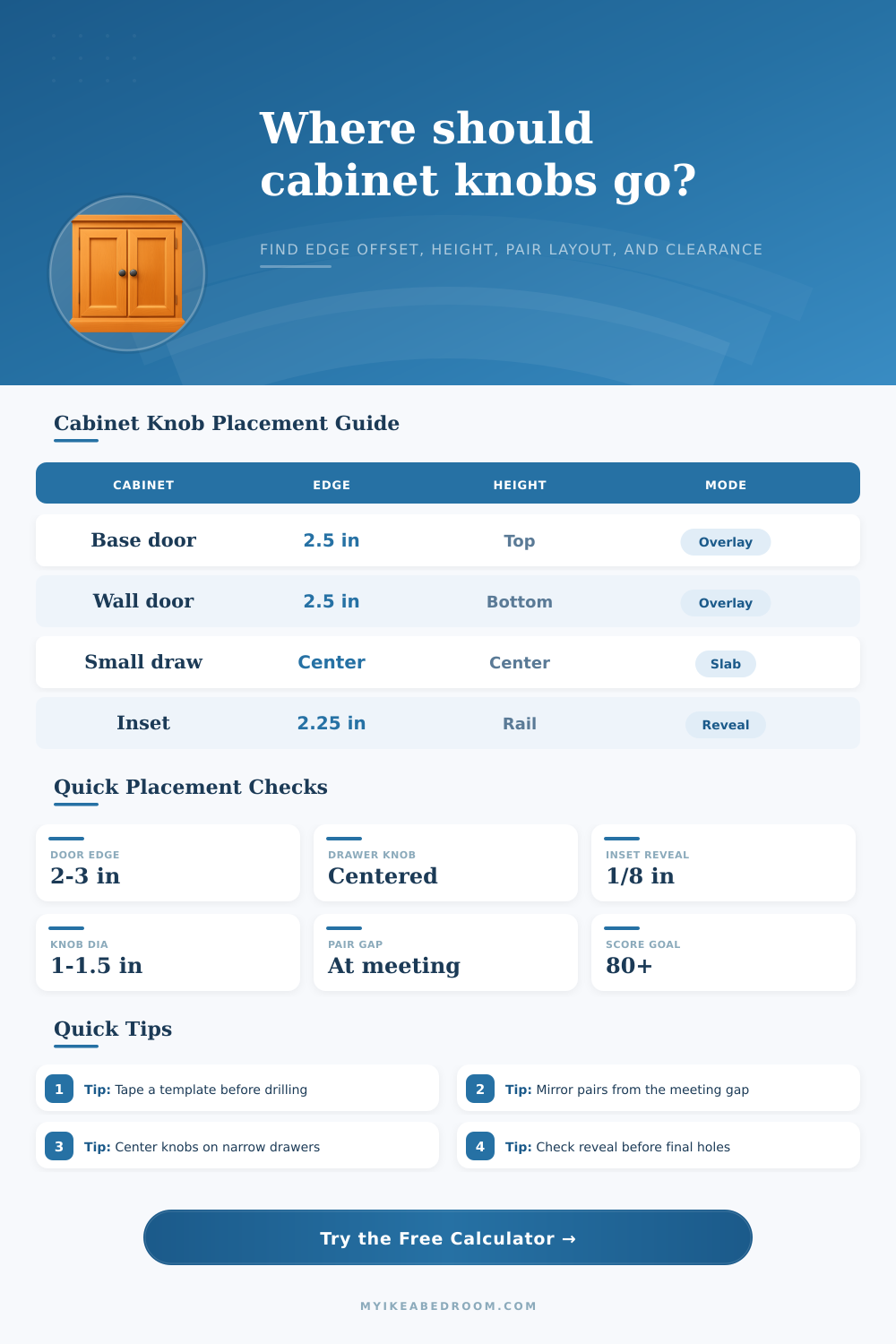
Common knob center offsets used by the calculator
| Cabinet front | Horizontal center | Vertical center | Best use |
|---|---|---|---|
| Base door | 2 to 3 in from opening edge | 2 to 3 in down from top | Lower cabinets |
| Wall door | 2 to 3 in from opening edge | 2 to 3 in up from bottom | Upper cabinets |
| Tall pantry | 2.5 to 3.5 in from edge | Comfort band near hand height | Full-height doors |
| Glass frame | Center in stile width | Center in rail zone | Narrow wood frame |
| Slab door | 2 to 2.5 in from edge | Type-based offset | Modern flat fronts |
| Drawer height | Knob approach | Two-knob rule | Visual note |
|---|---|---|---|
| 3 to 5 in | Single centered knob | Usually skip pair | Keep it simple |
| 6 to 9 in | Centered or top third | Quarter points | Common vanity drawer |
| 10 to 14 in | Center height | One third from each side | Works with wide drawers |
| 15 in plus | Upper third | One third from each side | Looks less bottom-heavy |
| Mount mode | Reveal check | Offset effect | Score cue |
|---|---|---|---|
| Overlay | Gap is usually forgiving | Use visual edge | 80 plus is strong |
| Full overlay pair | Watch meeting gap | Mirror from center gap | Keep knob edges clear |
| Inset | Reveal matters most | Use inside frame line | Score drops near gap |
| Frameless slab | Check adjacent front swing | Cleaner small offset | Template before drilling |
| Knob diameter | Minimum edge center | Comfort range | Drilling note |
|---|---|---|---|
| 0.75 in | 1.5 in | 2 to 2.5 in | Small doors |
| 1.0 in | 1.75 in | 2.25 to 2.75 in | General use |
| 1.25 in | 2.0 in | 2.5 to 3 in | Most common |
| 1.5 in plus | 2.25 in | 2.75 to 3.5 in | Large fronts |
Placing knobs on cabinet doors and drawers require precise measurement because the placement of the knobs will determine not just how the cabinets look, but also how the cabinets function and how they will work for the peoples in the kitchen. If a person places the knobs too close to the edge of the cabinet doors, a person’s hand may bump into the cabinet frame when they attempt to turn the knobs. Conversely, if the knobs are placed too far from the edge of the cabinet doors, the knobs may look off-balance on the doors.
These small changes in knob placement can make a big difference in the way that the cabinets may functions or may be visually balanced. To place knobs correctly on cabinet doors and drawers, an individual must understand several specific measurement. For example, the door width will provide information regarding in what way the knobs can be placed to the left or right side of the door.
How to Place Knobs on Cabinets and Drawers
The height of the door will provide information regarding in what height the knobs should be placed on those cabinet doors. The width of the rail or stile will determine in what portion of the door the knob should sit upon solid wood. The height of the drawer will determine the placement of the knob on tall drawer or narrow drawers.
Finally, the diameter of the knob will make it so that the knob will have enough breathing room from the cabinet edge. Depending upon the type of cabinet in which the knobs are to be placed, there are different rules for the placement of knobs. For example, base cabinet doors will require that the knobs are placed near the top corner of the cabinet doors.
Wall cabinets will have their knobs placed toward the bottom of the cabinet doors to allow for the hand of an individual to reach the knobs without strain. Pantries that contain tall cabinet doors will have their knobs placed into what is considered the comfort band of the cabinet doors, as those cabinets will be opened frequently by an individual. Drawers will have different rules then cabinet doors regarding knob placement.
Drawers do not have a hinge side to one of their sides. Therefore, placement of knobs on drawers will be based off how visually balance the drawers will appear. The calculator included on this website will assist in calculating the placement of knobs on cabinet doors and drawers.
The calculator will remove the guesswork involved in the placement of knobs on cabinet doors and drawers. For instance, the calculator will let an individual know if an offset will clear the cabinet door reveal or if the offset will leave the cabinet door with enough margin on the other mirrored drawer. The knob placement calculator will account for the mode in which the knobs are to be placed.
For instance, the calculator considers whether the knobs are to be placed in an overlay or inset placement to the cabinet doors. The gap between the cabinet doors will change based upon this selection. Finally, the knob placement calculator also considers which knobs will be used.
For instance, the individual can select whether knobs are to be in a traditional corner placement, a moddern minimal offset knob placement, or whether reach comfort is the priority in the kitchen. The knobs will be calculated accordingly. Even though the calculator includes all of the measurements regarding placement of knobs, it is still impossible for the calculator to take into account in what way the individuals in the household will use the kitchen.
For instance, if the kitchen is to contain a vanity in the bathroom, the knobs will need to be lower on the cabinet doors to account for the various heights of those who will use the vanity. Conversely, if the kitchen is to contain young children, the knobs may be higher on the cabinet doors to make it more difficult for the young children to continually turn the knobs to open the cabinet doors. Additionally, the knobs must be placed within the stile of glass frame cabinet doors to avoid any interference with the glass.
Most individuals make mistakes when placing knobs on cabinet doors and drawers. For example, most individuals will measure the placement of knobs on a base cabinet door and then use the same offset on all of there wall cabinets. The vertical placement for wall cabinet doors is not the same as that of base cabinet doors.
Additionally, most individuals will place knobs in the center of all of their drawer doors. This is true even for wide drawers since it may be possible to place knobs on each side of these wide drawers. Furthermore, most individuals will forget to account for the diameter of the knobs when they measure for placement on the drawers.
The knob may extend into the reveal of the cabinet doors even if the knob is in the correct position. These types of mistakes will make the cabinets feel incorrectly to the individual when they open the cabinet doors. A template can assist the individual in the physical act of drilling the knobs into the cabinet doors.
A template can be made out of scrap wood or cardboard. For mirrored drawers, if the same template is used to drill the knobs, the knobs will match on each side of each cabinet door. For inset cabinet doors, the edge of the knobs will be more important than the placement of the holes in the cabinet doors.
This is because an excessively wide knob may extend into the reveal of the cabinet doors. The reference tables on this page provide information as to the ranges of placement of knobs on cabinet doors. These reference tables are useful in that these ranges of placement have been tested on thousands of cabinet door installations.
These placement ranges indicate the various knobs that will visually balance with the remainder of the cabinet doors. While not rules that must be followed, these reference tables provide an individual with a place to start in placing knobs on their cabinet doors. The knob placement calculator will provide an individual with a starting point for placing the knobs on their cabinets.
From this starting point provided by the calculator, an individual can make a final adjustment to the knobs placement by a quarter inch. This last adjustment will allow for the knobs to be placed in the correct spot. Youll find that the calculator works better then you might expect.
It is a very useful tool for anyone working on a renovasion project. One should of checked the measurements twice before drilling. Don’t forget to check the knobs size too.
The process is much easier when you use a template. If you dont use one, you might recieve errors in the alignment. If you are working on a luxurios kitchen, you want everything to look perfect.
It is actualy quite simple if you take your time. Its a great way to ensure everything looks good. You should follows the guide to avoid making mistakes.
The placement of the knobs affects how the cabinets looks. If you want a clean look, the knobs should be placed carefully. The drawer handles will be chosen by the homeowner.
The kitchen area should be kept clean during the process. You should of measured the distance between the drawers as well. If you use too many knobs, it might look crowded.
Using a template makes the job much more comfortabley. The cabinets will look great when you are done. Most people find that the calculator helps alot.
Just be sure to check your work. Good luck with your project!