Cabinet Pull Size Calculator
Estimate cabinet pull length, center-to-center hole spacing, placement zone, double-pull layout, stile limits, rail limits, and hand clearance for doors and drawers.
Cabinet pull sizing results
Common hardware sizing cues used by the calculator
| Drawer front width | Classic pull | Modern pull | Layout note |
|---|---|---|---|
| 9 to 12 in | 3 in CTC | 3 to 5 in | Use one centered pull |
| 12 to 18 in | 3 to 5 in | 5 in CTC | Center on drawer front |
| 18 to 24 in | 5 to 6 in | 6 to 8 in | Match other drawer banks |
| 24 to 30 in | 6 to 8 in | 8 to 10 in | Longer pulls feel balanced |
| 30 to 36 in | 8 to 10 in | 10 to 12 in | Check double threshold |
| 36 in and wider | 10 to 12 in | 12 to 18 in | Often better with two pulls |
| Cabinet door | Pull direction | Placement zone | Constraint check |
|---|---|---|---|
| Upper cabinet | Vertical | Lower corner stile | Keep holes on flat stile |
| Base cabinet | Vertical | Upper corner stile | Clear adjacent pulls |
| Tall pantry | Vertical | Near hand height | Use enough projection |
| Shaker door | Vertical | Center of stile | Do not cross panel bevel |
| Slab door | Vertical or edge | 2 to 3 in from edge | Check hinge side clearance |
| CTC family | Common sizes | Best use | Replacement note |
|---|---|---|---|
| Compact inch | 3, 3.75, 5 in | Small drawers and doors | Good for existing holes |
| Mid inch | 6.25, 7.56, 8 in | Medium drawers | Balanced on 24 to 30 in fronts |
| Long inch | 10, 12, 15 in | Wide drawers and slab doors | Works with modern ratios |
| Metric | 96, 128, 160 mm | European cabinet hardware | Check spec sheet before drilling |
| Long metric | 192, 224, 256 mm | Large fronts | Often matches 8 to 10 in pulls |
| Appliance | 12, 18, 24 in | Heavy fronts and panels | Use stronger mounting screws |
| Pull style | Typical length | Hand clearance | Best cabinet type |
|---|---|---|---|
| Bar pull | 3 to 18 in | Good | Doors, drawers, slab fronts |
| Arch pull | 3 to 8 in | Good | Traditional doors and drawers |
| Cup pull | 3 to 5 in | Moderate | Small and medium drawers |
| Edge pull | 4 to 14 in | Low profile | Slab doors and minimal fronts |
| Appliance pull | 12 to 24 in | High | Large pantry or panel fronts |
| Knob | Single point | Varies | Small doors and narrow drawers |
| Scenario | Front size | Suggested pull | Placement cue |
|---|---|---|---|
| Small drawer | 15 x 6 in | 3 in CTC | Centered on face |
| Wide drawer | 33 x 10 in | 8 in CTC | Centered or paired |
| Tall pantry door | 24 x 72 in | 12 in CTC | Vertical on stile |
| Shaker drawer | 24 x 8 in | 5 to 6 in CTC | Stay on rail center |
| Appliance drawer | 30 x 14 in | 12 to 18 in | Check hand clearance |
| Edge pull door | 18 x 30 in | 6 to 8 in | Top or side edge |
Choosing the correct cabinet pull size is a necessary step in the kitchen design processes. The size of the cabinet pull affects not only how the kitchen look but also how the cabinet pull will function. The distance between the screw hole, the length of the cabinet pull, and where the cabinet pull will be located on the door or drawer all must be considered when choosing the size of the cabinet pull.
If the proportions of the cabinet pull are not correctly choose, the cabinet pull may look too small or too large for the cabinet. However, if the proportions of the cabinet pull are correctly chosen, the cabinet pull will look balanced within the kitchen design. Sizing the correct cabinet pull can be difficult due to the various widths of cabinet fronts and styles.
How to Pick the Right Cabinet Pull Size
The upper door may be narrower then the base drawer, and the wide base drawer may be used to hold heavy items. Fronts can have a one or two cabinet pull depending on the width of the cabinet front. The width of the Shaker rail and stiles can affect the size of the cabinet pull, and the amount of finger clearance that is desire behind the cabinet pull.
People may attempt to guess the size of the cabinet pull that will best fit behind the cabinet front. However, guessing the size of the cabinet pull will likely result in an incorrect size of the cabinet pull. The cabinet pull calculator will assist with the mathematics behind sizing the pull correct.
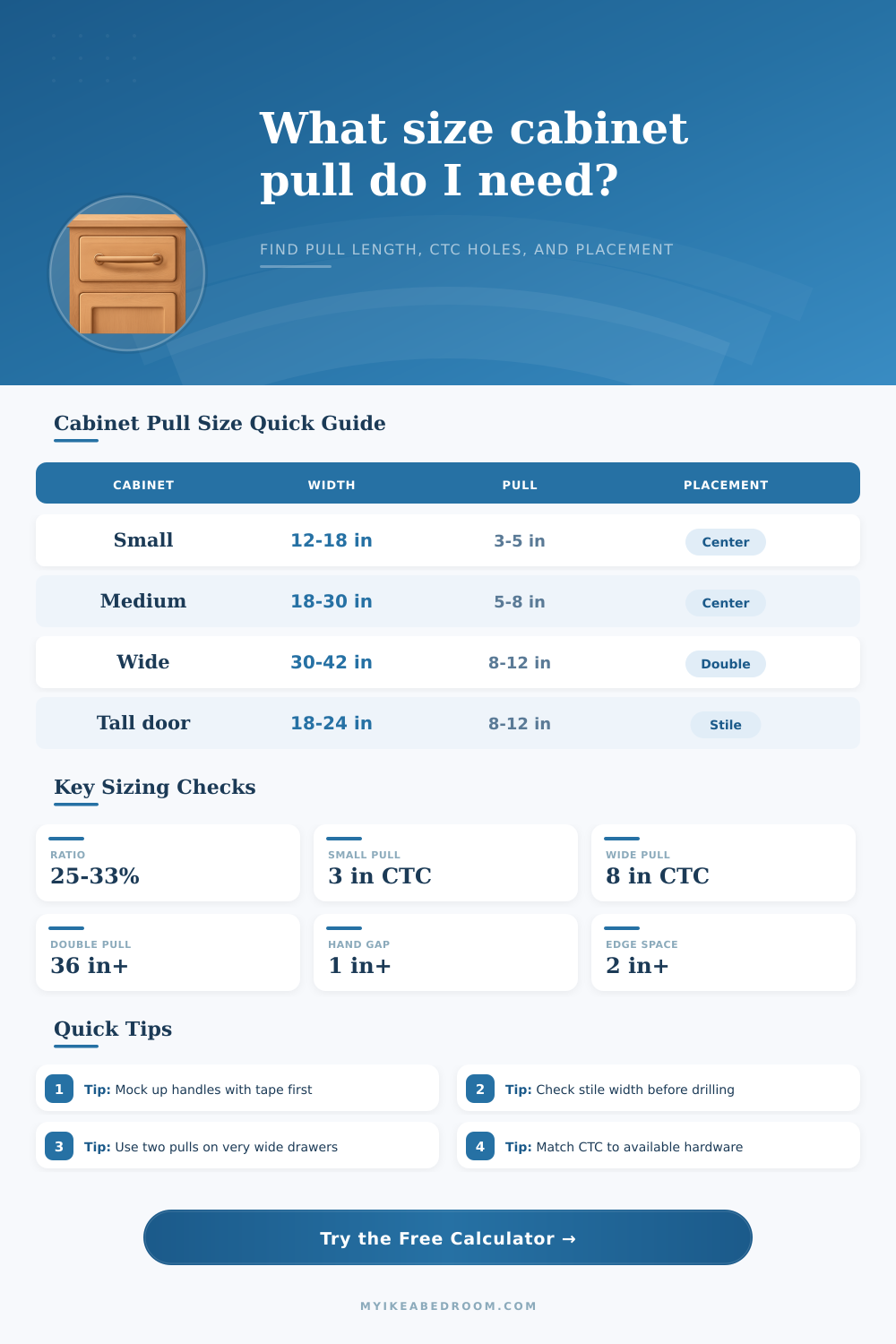
Once the user enters the dimensions of the cabinet front and the type of cabinet into the calculator, the program will calculate the length of the cabinet pull that will look balanced against the cabinet. Additionally, the calculator will ensure that the center-to-center distance for the cabinet pull will use available cabinet hardware sizes so that the pull will not be unavailable. The result from the calculator will indicate if one or two cabinet pulls will be needed for the drawer.
The results of the calculator will contain specific information that must be understood to purchase the correct cabinet pull. The percentage of the ratio will ensure that the cabinet pull will not be too short for cabinets with wide cabinet fronts and will not be too long for cabinets with narrow cabinet fronts. The center-to-center distance will allow the installers to drill the cabinet front appropriately for the placement of the cabinet pull.
Additionally, the placement zone can determine the placement of the cabinet pull; if the pull is to be used on a drawer, it will be horizontal, and if its for a cabinet door, it will be vertical. A long cabinet pull on a wide drawer can be awkward to use and may place strain on the screws that hold the pull to the cabinet. Therefore, the calculator will also show if two cabinet pulls will be required for the drawer.
Another measurement that the calculator will provide in the results is the amount of hand clearance that will be provided behind the cabinet pull. If the pull is too close to the cabinet, it may be difficult to place the fingers behind the cabinet pull, especially when pulling deep drawer. The calculator will alert the users if the clearance for the pull is too small for the cabinet.
Most kitchens contain several complications to the calculations that may need to be factored into the pull size. For instance, if the cabinet contains existing screw hole, these can be entered into the calculator to determine if the new cabinet pull will align with the existing holes. Additionally, if the cabinet contains inset doors, the stiles can be narrow.
In this case, the cabinet pull should not land on the beveled edge of the door but on the flat portion of the door itself. This will be specified in the constraint check on the results screen of the calculator. It is also important that all cabinet pulls in the kitchen are of the same hardware.
Upper cabinets and drawers may have a different type of cabinet pull than the base cabinets. The user can enter the same dimension into the cabinet pull calculator for different cabinet types to ensure that the lengths of the pulls will be appropriate for each cabinet. The style of the cabinet pull can affect the measurement of the cabinet pull.
For instance, the distance between the center points of a cup pull will be different than the center-to-center distance for a bar pull. Additionally, edge pulls will have a different placement than bar pulls. The style of the cabinet pull will change the measurement of the length of the cabinet pull and the amount of hand clearance that it will provide.
In this case, it is necessary to first decide on the visual style of the cabinet pull. Then, the dimensions will guide the size of the cabinet pull. It is a mistake for many people to treat every cabinet and drawer in the kitchen the same.
Shallow and deep drawers will require different cabinet pulls. For instance, a cutlery drawer is shallow and may only require a short cabinet pull, while the file cabinet may have deep pulls that will require a longer cabinet pull. Using the cabinet pull calculator, the user can enter these different type of cabinets into the program so that the results will change appropriately.
Another mistake is to measure the cabinet box rather than the cabinet front. The cabinet pull will be attached to the cabinet front, and the individual will look at the cabinet front. The measurement of the cabinet box will not account for the thickness of the overlay for the cabinet door or the inset for the drawer.
In this case, the measurement of the cabinet width and height will be used to calculate the length of the cabinet pull. Once the measurements have been determined, it is helpful to tape the template of the cabinet pull to the cabinet front. Then, stepping back, the individual can look at the template from across the kitchen.
This will allow the individuals to determine if the length of the cabinet pull is correct for the kitchen space and if two cabinet pulls for the wide drawer are equally at a comfortable distance from each other. The measurements will provide the numbers for the length of the cabinet pull, but the individual will have to use there eyes to determine if the numbers are accurate to the size of their kitchen. If the cabinet pull length is within the ratio, the center-to-center distance matches the hardware available, the stile or rail in the cabinet is wide enough for the pull, and the hand clearance is generous, then the cabinet pull will work well for the cabinets.