Cabinet Linear Foot Calculator
Estimate base cabinet linear feet, upper cabinet linear feet, usable cabinet module count, appliance openings, corner allowances, filler deductions, and toe kick length from one cabinet run plan.
Start with a common kitchen, laundry, pantry, office, wardrobe, mudroom, or bar layout, then adjust the exact opening and module dimensions.
Best for: galley walls, laundry rooms, offices, and simple base cabinet banks.
Watch: wall fillers and appliance openings can consume full modules fast.
Best for: kitchens where two walls meet and share one working corner.
Watch: corner allowances should not be counted twice as usable cabinets.
Best for: laundry, kitchenette, range walls, bar fridges, and utility rooms.
Watch: upper cabinets may continue over some base openings but not all.
Best for: pantry, wardrobe, mudroom, and tall cabinet banks.
Watch: tall units reduce upper and base linear feet differently from low cabinets.
| Module width | Metric equivalent | Common use | Planning note |
|---|---|---|---|
| 12 in | 30.5 cm | Narrow pullout or tray cabinet | Useful when a run has a small leftover gap. |
| 15 in | 38.1 cm | Spice, tray, small drawer, or wardrobe side bay | Often pairs with a 30 inch cabinet to fill a 45 inch span. |
| 18 in | 45.7 cm | Drawer base, door base, hamper, or office storage | A flexible module when appliance openings leave uneven wall space. |
| 24 in | 61.0 cm | Core base, sink, drawer, or office module | Good default for counting usable modules before detailed cabinet selection. |
| 30 in | 76.2 cm | Wide drawer stack, sink base, upper cabinet pair | Requires a cleaner run with fewer fillers and interruptions. |
| 36 in | 91.4 cm | Large drawers, wardrobe bay, or pantry section | Works best on storage walls or long uninterrupted runs. |
| Deduction item | Typical width | Affects | Planning note |
|---|---|---|---|
| Filler at side wall | 1 to 3 in | Base and upper | Lets doors and drawers clear uneven walls and adjacent trim. |
| Dishwasher or washer opening | 24 in | Usually base only | Upper cabinets may continue above unless a window or hood blocks them. |
| Range or cooktop opening | 30 to 36 in | Base and often upper | Use full upper deduction when a hood or clearance zone replaces uppers. |
| Tall pantry or oven tower | 18 to 36 in | Base and upper | Counts as tall storage, not separate base plus upper cabinets. |
| Blind corner allowance | 36 to 48 in | Base and upper | Deduct the unusable overlap before dividing by cabinet modules. |
| Toe kick return | 3 to 4 in | Toe kick only | Add short returns at exposed run ends after the front length is known. |
| Cabinet type | Common depth | Metric equivalent | Use in calculator |
|---|---|---|---|
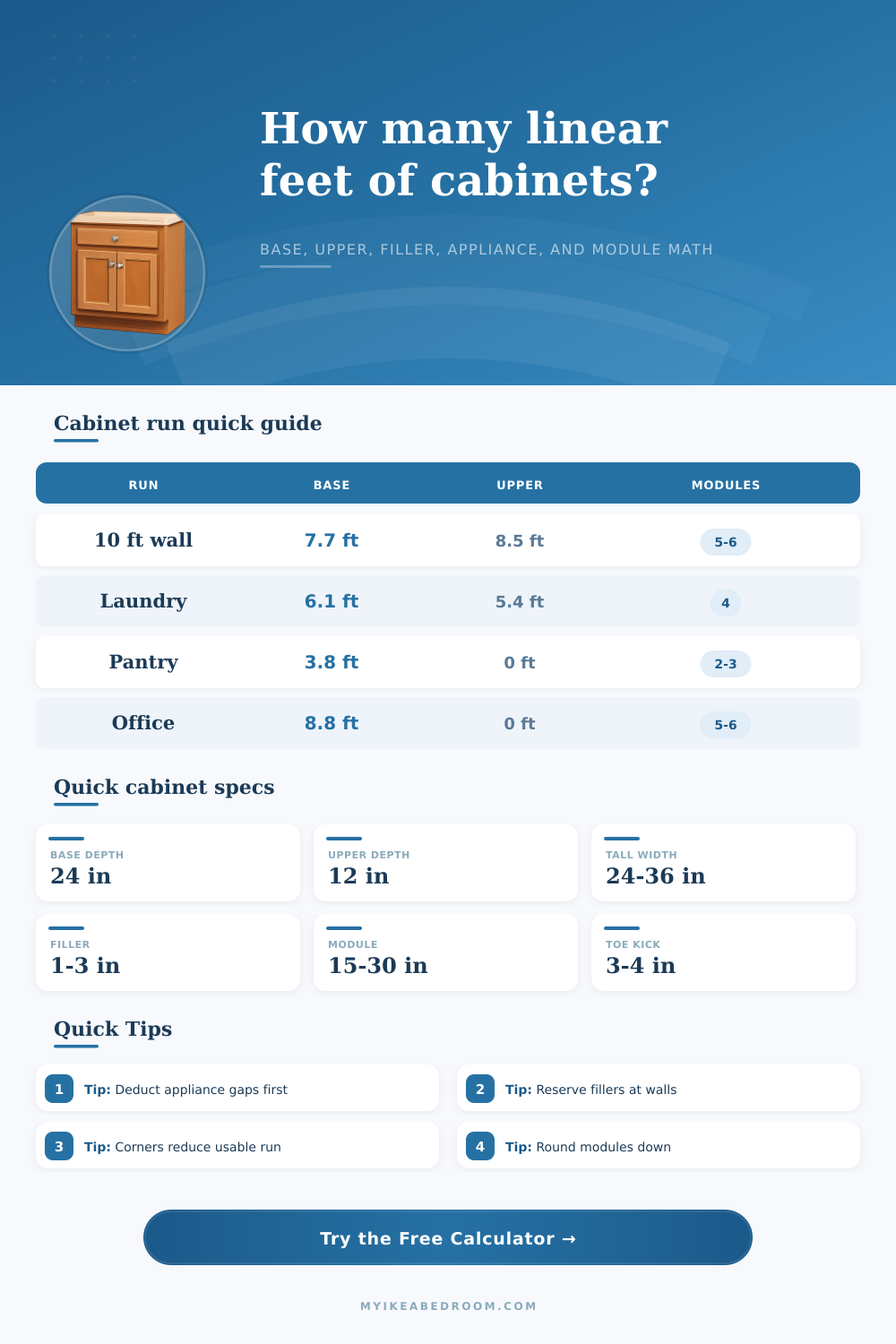
| Standard base cabinet | 24 in | 61 cm | Use for kitchens, bars, laundry counters, and built-in desks. |
| Shallow base cabinet | 15 to 18 in | 38 to 46 cm | Useful for hallways, offices, wardrobes, and storage walls. |
| Standard upper cabinet | 12 in | 30 cm | Use for most wall cabinet runs over countertops. |
| Deep upper cabinet | 15 to 24 in | 38 to 61 cm | Useful above refrigerators, laundry machines, wardrobes, or tall storage. |
| Tall cabinet | 15 to 24 in | 38 to 61 cm | Enter width as tall cabinet width so base and upper runs are deducted. |
| Preset | Total wall run | Main deductions | Module target |
|---|---|---|---|
| 10 ft galley run | 10 ft | 24 in appliance, 3 in filler | 24 in modules |
| L-shaped kitchen wall | 20 ft | 42 in corner, 54 in appliances | 30 in modules |
| Laundry cabinet run | 9 ft | 54 in laundry openings | 18 in modules |
| Pantry wall | 12 ft | 72 in tall storage, 6 in filler | 24 in modules |
| Home office base cabinets | 11 ft | 0 in appliances, 6 in filler | 18 in modules |
| Wardrobe cabinet run | 14 ft | 96 in tall storage, 4 in filler | 24 in modules |
Deduct interruptions before counting modules. Appliance openings, tall cabinets, filler strips, and corner allowances are not interchangeable with usable cabinet modules. Subtract them from the wall run first, then divide the remaining run by the module width.
Separate base and upper assumptions. A dishwasher opening may only reduce base cabinets, while a range hood or window may also reduce uppers. Use the upper deduction control to keep the two linear-foot results realistic.
When you begin installing cabinets, you must determine the linear feet of the wall. Linear feet are the total length of the wall available for installing cabinets. If you dont know the linear feet of the wall, you cannot accurately calculate the number of base cabinets and upper cabinets you will need.
The linear feet of the wall will tell you the amount of space for base cabinets, the amount of space for upper cabinets, and the total amount of space for all items that will be located between the base and upper cabinets. The linear feet of the wall is different than the length of the cabinets because there are several feature of the wall that will prevent cabinets from being installed into those areas. Examples of features of the wall that will prevent the placement of cabinets are appliance openings (like for a dishwasher), tall pantry units, corners in the kitchen, and areas where cabinet fillers will be installed.
How to Measure Wall Length for Cabinets
To calculate the length of cabinets that can be installed into the kitchen, you must use a calculator to determine the length of the wall and subtract the length of these features. Base and upper cabinets are two separate type of cabinets. Base cabinets sits on the floor, support the countertop, and are usually 24 inches deep.
Upper cabinets hang on the wall and project roughly half the depth of base cabinets. The different heights and purposes of these two types of cabinets means that you must calculate the linear feet for each cabinet separately. For instance, an opening for a dishwasher will only affect the linear feet of base cabinets, but an opening for a range hood will affect both the linear feet for base and upper cabinets.
Module width is another measurement that help determine the number of cabinets that will go into the kitchen. Most cabinet makers use modules of 12, 15, 18, 24, 30, or 36 inches deep. A 24-inch deep module is the most common because it provides an even number of cabinets in most kitchens.
By calculating the length of the wall and the length of all deductions, you can determine how many of these module can fit into the available kitchen wall space. Any remainder of the length of the wall divided by the module width will indicate that you may need to use a narrower cabinet or a wider filler strip. Another calculation that you must perform is the length of the corners.
Corners take up space that cannot be used for installing cabinets with doors. You cannot use the depth of the corner for installing the cabinets, so you must calculate that measurement before determining the length of the cabinets. For example, if the corner is 14 inches in depth, then it cannot be used as the depth for base or upper cabinets.
In this instance, you must subtract 14 inches from the total length of the wall to determine the length of the cabinets. This calculation will help you to determine how many of the 24-inch modules can fit into the length of the space determined by this calculation. Another consideration is the length of the tall cabinets.
Tall cabinets are usually used in pantries to store cooking utensils and appliances. These tall cabinets goes from the floor to the ceiling and include both the base and upper cabinets. When determining tall cabinet lengths, you must count both the base and upper cabinets as they take up the same length of the wall as they extend from floor to ceiling.
Therefore, when planning for tall cabinets, you must subtract the length of each of these tall cabinets from the total length of the wall. Fillers are small strips used to fill the gap between the last installed cabinet and the wall, or between two installed cabinets. Fillers are usually 1 to 3 inches in width.
Fillers are used to prevent cabinet doors from binding against the wall. By calculating for the length of the fillers, you can include that length in your calculations. By doing so, the cabinets will not bind against the wall during installation.
Toe kicks are the recessed spaces beneath base cabinets. These spaces provide for your feet when standing near the base cabinets. Toe kicks extend the full length of base cabinets along most kitchen walls; however, some installations may require short toe kick returns to be installed beneath the exposed ends of the base cabinets.
If exposed ends are part of your project, calculate the number of exposed ends before you determine the length of the toe kicks. If the returns are not included in your calculation, there may be a gap between the base cabinets and the exposed end of the cabinet. In the tables provided in this article is information about common module widths, deductions in length for different features in the kitchen, and depth of the different types of cabinets.
These tables allow for you to determine the length of your cabinets by using the information in each table. For instance, the table that specifies module widths can help you to determine that 24-inch deep cabinets are the most common. Other tables list the length of common deductions in length, such as 14 inches for corners, or 12 inches for tall cabinets.
These tables allow you to determine the total length of cabinets by using the information in the tables. Although the calculations determined on paper may be difficult to apply to real projects, there are ways around these difficulties. Walls are rarely ever square, and appliances may not be the same models as those indicated in these calculations.
However, the calculator can provide you with the best estimate of the length of the cabinets required for the kitchen. Using a tape measure will allow you to verify the measurements of the kitchen walls. Although you may be able to find the best solution on paper for calculating the number and length of cabinets needed for the kitchen, using a calculator to perform the calculations will provide you with a starting point for the calculations.
However, using a tape measure will help you verify the measurements of the cabinets. By doing so you can shift the position of the cabinets in your kitchen by only a few inches to accommodate the measurements of the walls. Regardless of whether you are planning cabinets for your kitchen or your storage wall in your kitchen, the process for calculating the linear feet of base and upper cabinets is the same.
You must measure the length of the available wall, you must subtract the length of the features of that wall that will prevent the installation of cabinets, and you must calculate the length of the cabinets by choosing the module width. Once you have performed these calculations, you will have the length of the cabinets that will fit into your kitchen walls.